Biography
Julie Billiart
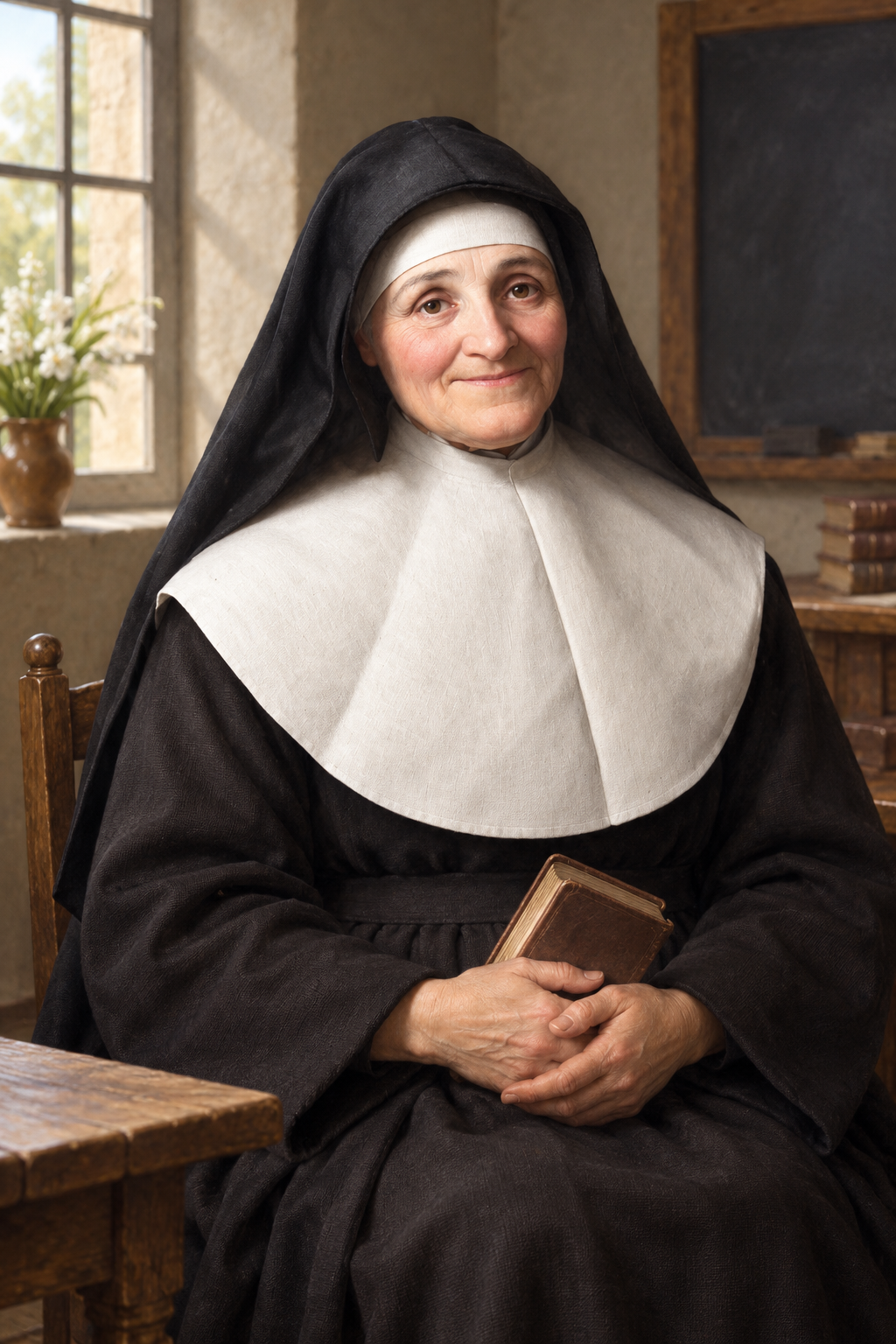
About Julie Billiart
Julie Billiart was a French religious founder whose work placed the Christian education of girls at the center of a new community. Born in Cuvilly on July 12, 1751, she grew up with a strong religious formation and began teaching other children. Her later work developed through illness, displacement and the friendships that sustained her during the French Revolution.
For many years Julie could not walk. Even while confined to bed, she taught catechism and offered spiritual advice. During the Revolution, her support for priests refusing the government’s oath placed her in danger. Friends helped her escape, and she lived in several places before settling in Amiens. There she met Françoise Blin de Bourdon, who became her close collaborator.
On February 2, 1804, Julie, Françoise and Catherine Duchâtel committed themselves to chastity and to the care and education of girls. The congregation regards this as its founding day. Its account describes Julie regaining the ability to walk that June after a novena to the Sacred Heart, a recovery understood within the community as miraculous.
The community needed trained teachers as well as schools. The Catholic Encyclopedia describes Julie’s rejection of a separate rank for lay sisters and her attention to the preparation of those who would teach. Françoise’s education helped support this work. A superior-general would visit the houses, appoint local leaders and maintain correspondence across the growing congregation.
Imperial permission was also necessary: Napoleon approved the association’s statutes on June 19, 1806, authorizing the opening of free schools.
Her educational practice can be followed through letters preserved by the congregation. Archivist Marie Felten and Heritage Centre coordinator Christiane Houet describe how she taught novices the catechism: they memorized passages, repeated them to her, questioned one another and then heard her explanations. Religious learning remained central, but she also wanted teachers to develop their knowledge of secular subjects. Writing, languages and arithmetic belonged within their preparation.
Julie expected firmness from teachers while insisting on gentleness and respectful speech toward children. Her correspondence asked about pupils’ progress, and she examined their notebooks. The schools received poor children, paying day pupils and boarders in separate groups. Providing clothing and food helped children from impoverished households attend and return to lessons. Fees from boarders helped support the houses. The congregation’s historians also describe classroom signals adapted from the Brothers of the Christian Schools and prize books bearing Julie’s signature, preserved at Namur. These details show the practical organization behind her commitment to teaching.
The institute’s early history also involved negotiations over women’s authority. In a published conference abstract, historian Marie-Elisabeth Henneau explains that the Fathers of the Faith helped the founders with spiritual direction, intellectual and religious formation, and their first constitutions. Yet a women’s congregation governed by a superior-general encountered church authorities reluctant to allow it relative autonomy. Henneau’s study examines the biography written by Françoise, Julie’s companion and successor, alongside letters and annals. This approach treats the remembered founder within the community that preserved her story, asking how its ideal of female holiness and its connection with Ignatian spirituality developed. It also gives the Amiens conflict a wider institutional setting.
Expansion also brought conflict. At Amiens, the priest Sambucy opposed the congregation’s direction and influenced Bishop Demandolx against Julie. She moved the center of the community to Namur in 1809, where Bishop Pisani welcomed her. Demandolx later asked her to return, but attempts to reestablish the work at Amiens did not last. These disputes concerned the shape and government of the institute, not simply the difficulty of finding pupils.
Julie died at Namur on April 8, 1816.
Her first grave monument made the schools part of her public remembrance. The Heritage Centre records that a stone placed in July 1816 listed the houses she had founded, at Bishop Pisani’s direction. Preserved when the cemetery closed, it was eventually displayed in the Heritage Centre garden.
Paul VI canonized her on June 22, 1969. In his homily, he emphasized the religious instruction and Christian education of girls, especially poor girls, as the defining purpose of her foundation. He also cautioned against reducing holiness to miraculous stories and stressed the importance of examining historical facts and documents. His tribute placed her educational work within the Church’s continuing responsibility toward people in need.
Her remembrance includes more than one calendar date. The Dicastery for the Causes of Saints lists April 8.
The Sisters of Notre Dame de Namur identify May 13, the anniversary of her beatification, as their official liturgical feast.
In Liverpool, St. Julie’s Catholic High School explicitly names her as its patron and connects her educational ideals with attention to each pupil’s needs.
Franciscan Media lists her as a patron of educators and teachers.
Saint Mary’s Press records invocation against illness and poverty. These are devotional associations rather than guarantees of a particular outcome.
Wondering how to weigh the stories and sources? Learn how to read a saint biography.