Biography
Justin Martyr
About Justin Martyr
Justin is one of the best-documented Christian teachers of the second century because several works survive under his name and because an early martyr account records his examination at Rome. In the opening of his First Apology, he identifies himself as Justin, son of Priscus and grandson of Bacchius, from Flavia Neapolis in Palestine. The family names and his own statements suggest a non-Jewish background, but the sources do not establish an exact birth year, childhood home, or ethnicity in modern terms. A birth around 100 remains a useful approximation. Flavia Neapolis, near ancient Shechem, supplies a secure regional setting without permitting a precise birthplace marker.
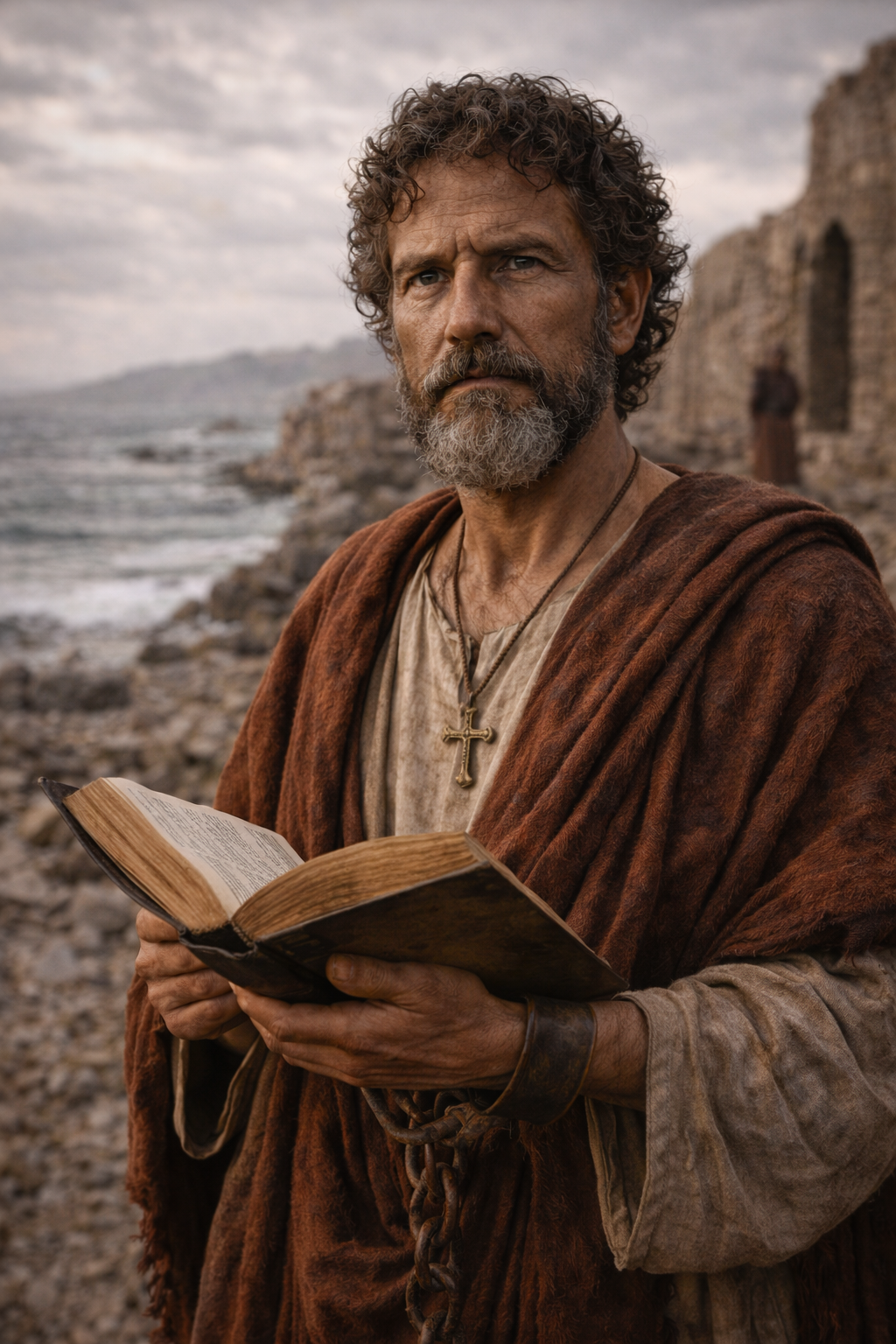
Justin presents his intellectual formation in the Dialogue with Trypho. He says that he moved among Stoic, Peripatetic, Pythagorean, and Platonic teachers while seeking knowledge of God. The account culminates in a conversation with an unnamed elderly Christian beside the sea. The old man challenges the sufficiency of philosophy and directs Justin toward the Hebrew prophets and prayer. Justin describes a fire kindled in his soul and says that he found this philosophy safe and profitable. This is Justin's own literary account of conversion, written as part of a dialogue rather than an independently witnessed diary entry. It shows how he wished readers to understand the continuity between philosophical inquiry and Christian commitment.
After becoming Christian, Justin continued to wear the philosopher's cloak and taught Christianity as the true philosophy. The martyr acts place him in Rome for a second stay, living above the bath of a man named Martinus and speaking with anyone who came to hear his teaching. Benedict XVI describes him as the most important second-century apologist. The label does not mean that Justin merely defended an institution. His writings address emperors, the senate, educated pagan readers, and a literary Jewish interlocutor. They attempt to explain Christian worship, answer accusations, connect biblical prophecy with Jesus, and argue that truth found by philosophers participates in the divine Logos.
The First Apology addresses Antoninus Pius, members of the imperial family, the senate, and the Roman people. Justin asks rulers to investigate conduct rather than condemn Christians simply for bearing the name. If Christians are proved guilty of crimes, he says, they should be punished; if no wrongdoing is established, prejudice is unjust. This appeal is historically important because it combines loyalty to truth with a public demand for fair procedure. Justin does not ask for privilege or immunity from ordinary law. He presses Roman authorities to make accusation answerable to evidence and presents Christian moral teaching as open to examination.
Justin also gives one of the earliest extended Christian descriptions of initiation and Sunday worship. He writes of washing converts in water, common prayers, a greeting of peace, bread and wine mixed with water, thanksgiving led by the presider, distribution by deacons, readings from the apostles and prophets, instruction, and contributions for orphans, widows, prisoners, strangers, and others in need. His account is apologetic and selective, not a complete service book. Even so, it documents organized communal practices in the mid-second century. The passage makes care for vulnerable people part of the community's regular gathering rather than a detached ideal.
The Dialogue with Trypho addresses the relationship between Christian claims and Jewish Scripture. It preserves extensive biblical interpretation and stages disagreement with Trypho, a Jewish interlocutor. The work must be read within second-century controversy: some passages use harsh generalizations that should not be repeated as timeless descriptions of Jewish people. Justin's historical importance includes both his effort to reason from shared texts and the legacy of Christian anti-Jewish argument to which such writing contributed. A responsible biography can acknowledge his intellectual courage without treating every polemical judgment as exemplary or erasing the harm that later readers could draw from supersessionist claims.
Justin's Second Apology responds to executions in Rome and names the Cynic philosopher Crescens as an opponent. Eusebius later reports that Crescens plotted against Justin, drawing partly on Justin and Justin's student Tatian. The direct causal claim cannot be verified from the surviving trial account, which does not mention Crescens. It is therefore safer to say that Justin expected hostility and that later tradition connected his death with philosophical rivalry. The acts place the decisive encounter before Rusticus, prefect of Rome, during the reign associated with Marcus Aurelius. This setting supports a death around 165, while exact dating remains approximate.
In the martyr acts, Rusticus asks Justin about his teaching and meeting place. Justin identifies himself as Christian and explains that he taught above the Timiotinian Bath. Other Christians—Chariton, Charito, Euelpistus, Hierax, Paeon, and Liberianus—are questioned with him. When ordered to sacrifice to the gods, they refuse. Rusticus sentences them to be scourged and beheaded according to law. The text concludes that fellow Christians secretly carried away their bodies for burial. The record is concise and may preserve a trial protocol beneath later editorial framing; exact speeches remain reported testimony, not a modern transcript.
Justin's lasting significance joins writing, teaching, public advocacy, and martyrdom. His Apologies preserve an early Christian attempt to address imperial power in the language of reason and justice. His worship account offers rare evidence for communal practice. His Logos theology provided a way to recognize partial truth in Greek philosophy while locating its fullness in Christ. His Dialogue records sustained engagement with Jewish Scripture but also demands critical attention to adversarial rhetoric. Finally, the martyr acts remember him not dying alone but confessing faith beside students and companions. Historical care presents this complex legacy more faithfully than either unqualified praise or dismissal.
Wondering how to weigh the stories and sources? Learn how to read a saint biography.