Biography
Kinga of Poland
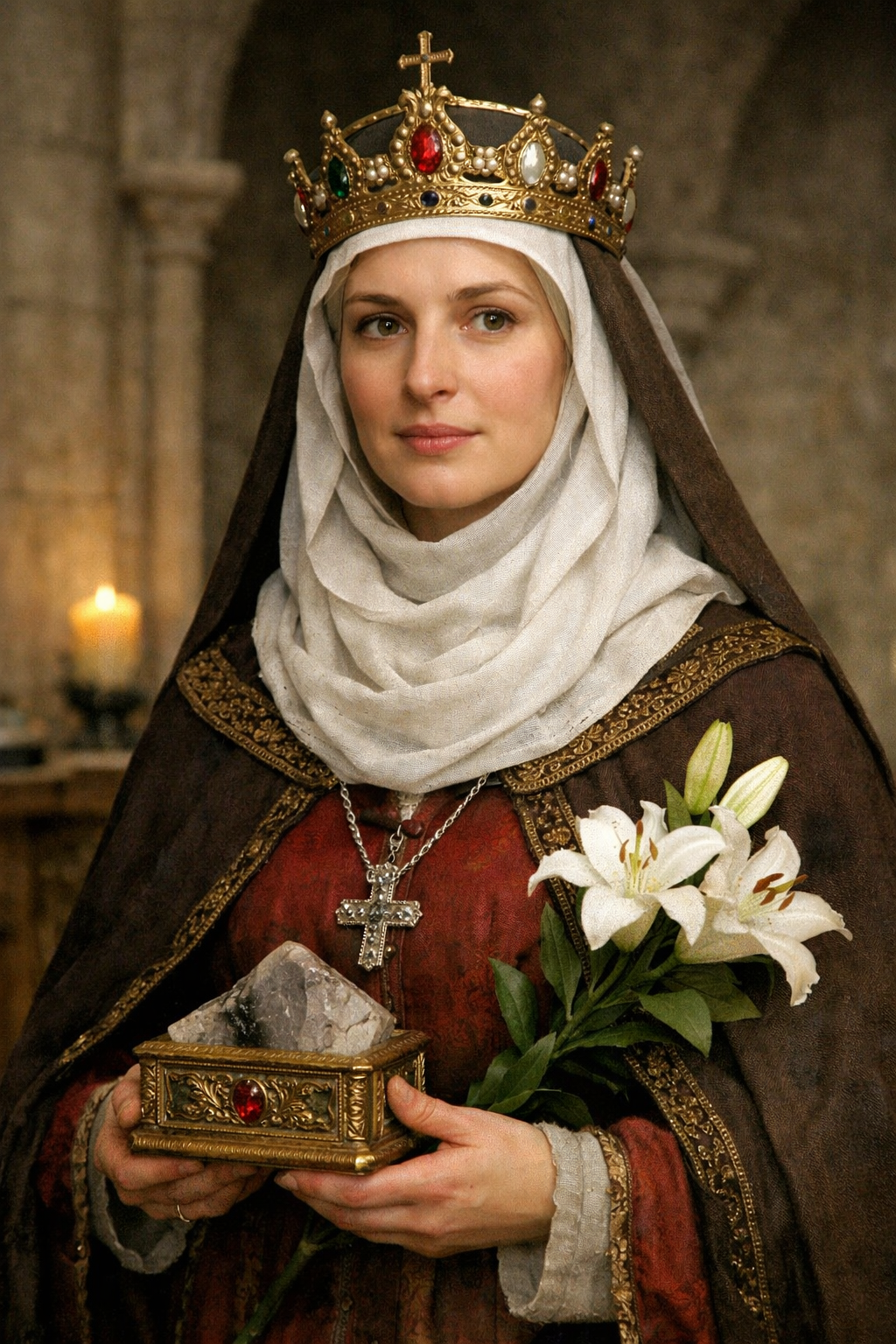
About Kinga of Poland
Kinga belonged to the Árpád royal family of Hungary, but much of her adult life unfolded in Poland. She was a daughter of Béla IV and Maria Laskaris, and her name also appears as Kunigunda. Her birth year is disputed: the Hungarian Catholic Lexicon prints 1224 while its accompanying note records the alternative 1234 chronology. A precise birthday cannot resolve that disagreement. The same entry places her arrival in Poland in 1239 and her marriage to Boleslaus around 1247. Those dates belong to a dynastic setting in which a royal daughter's move abroad could precede the marriage itself by several years.
Kinga joined a new household. At her canonization, John Paul II recalled her arrival at Wojnicz and then Sandomierz, and the influence of Grzymisława and Salomea. The tradition of her marriage emphasizes a shared commitment to chastity. According to that tradition, she persuaded Boleslaus to accept this way of life and eventually made her vow before Bishop Prandota. The pope recalled her use of dowry money to help the country recover from invasions.
As duchess, Kinga could put wealth and influence behind institutions that served others. The Diocese of Tarnów's account describes her support for churches and religious houses, including foundations at Nowy Korczyn and Bochnia. She appears beside Boleslaus in documents concerning Benedictine, Cistercian and Franciscan communities. Her patronage was therefore more than an occasional gift: it helped sustain places of worship and the people who maintained them. The same account connects her with efforts toward the canonization of Stanislaus of Kraków in 1253. These activities place her within the religious life of her adopted country, using a ruler's resources to support its communities.
Historian Éva Teiszler describes a further side of Kinga's work: rebuilding after invasion. In this account she supported the return of population to damaged districts, encouraged settlement under German law and helped develop towns and industry. Hungarian miners brought technical experience to the extraction of salt. Such work required people, equipment and arrangements that could endure beyond an immediate act of relief. Teiszler also places Kinga within a family culture of religious commitment, while distinguishing her Franciscan sympathies from her sister Margaret's Dominican vocation. The portrait is of a woman whose piety found expression in material assistance and the recovery of ordinary communal life.
The Sącz region gave that activity a lasting geographical center. In 1257 Boleslaus granted Kinga land there as security for her dowry. The municipal history describes a territory stretching toward Biecz, Limanowa and Podoliniec, along routes connecting Poland with Hungary. The Dunajec and Poprad valleys formed part of this corridor of travel and trade. Stary Sącz developed within that setting, and its later relationship with the convent was also a relationship of landholding and jurisdiction. Kinga's foundation was not isolated from the surrounding town. The municipal account also credits her with establishing a Franciscan house for men alongside the convent for women at Stary Sącz. Its endowment tied the religious community to the income, obligations and daily life of the district around it.
After Boleslaus died in 1279, Kinga established the Poor Clare convent at Stary Sącz. The foundation charter is dated 6 July 1280. Małgorzata Mirek's study describes an endowment including the town's revenues, customs income and twenty-eight villages. The community followed the rule approved by Urban IV, which permitted communal property, and Martin IV confirmed the gift in 1283. These arrangements made a lasting house of prayer possible through carefully specified material support. The nuns also had Franciscan pastoral care. Kinga eventually joined the community herself, making her profession in 1289. Her later vocation thus grew within a house she had already helped to establish.
The convent's own historical account does not turn her widowhood into an instantaneous disappearance from public life. For a time she retained her household and chancery, and the foundation encountered opposition from Leszek the Black. Its account of the charter gives the nuns a purpose beyond their own security: service to God through prayer and a life that could benefit others by its example. The same narrative remembers her care for poor people, pregnant women, widows and orphans. It does not securely establish that she held an important office within the convent. After a final illness, she died at Stary Sącz on 24 July 1292.
Kinga's connection with salt became the subject of a much-loved legend. In the story, a ring cast into a Hungarian mine reappears inside salt found in Poland. The Cracow Saltworks Museum presents this as legend, not as an account of how a mineral deposit came into existence. The tale belongs to the devotion of miners who honored her as their patron and represented her in paintings and sculpture. It gives memorable form to a relationship between religious memory and working life. That remembered ring should not obscure the more practical story of patronage, settlement and care with which her name is also associated.
Wondering how to weigh the stories and sources? Learn how to read a saint biography.
Explore similar vocations
Prayers for Kinga of Poland
Kinga invocation
Obtain for us the grace of holiness!