Biography
Lawrence Giustiniani
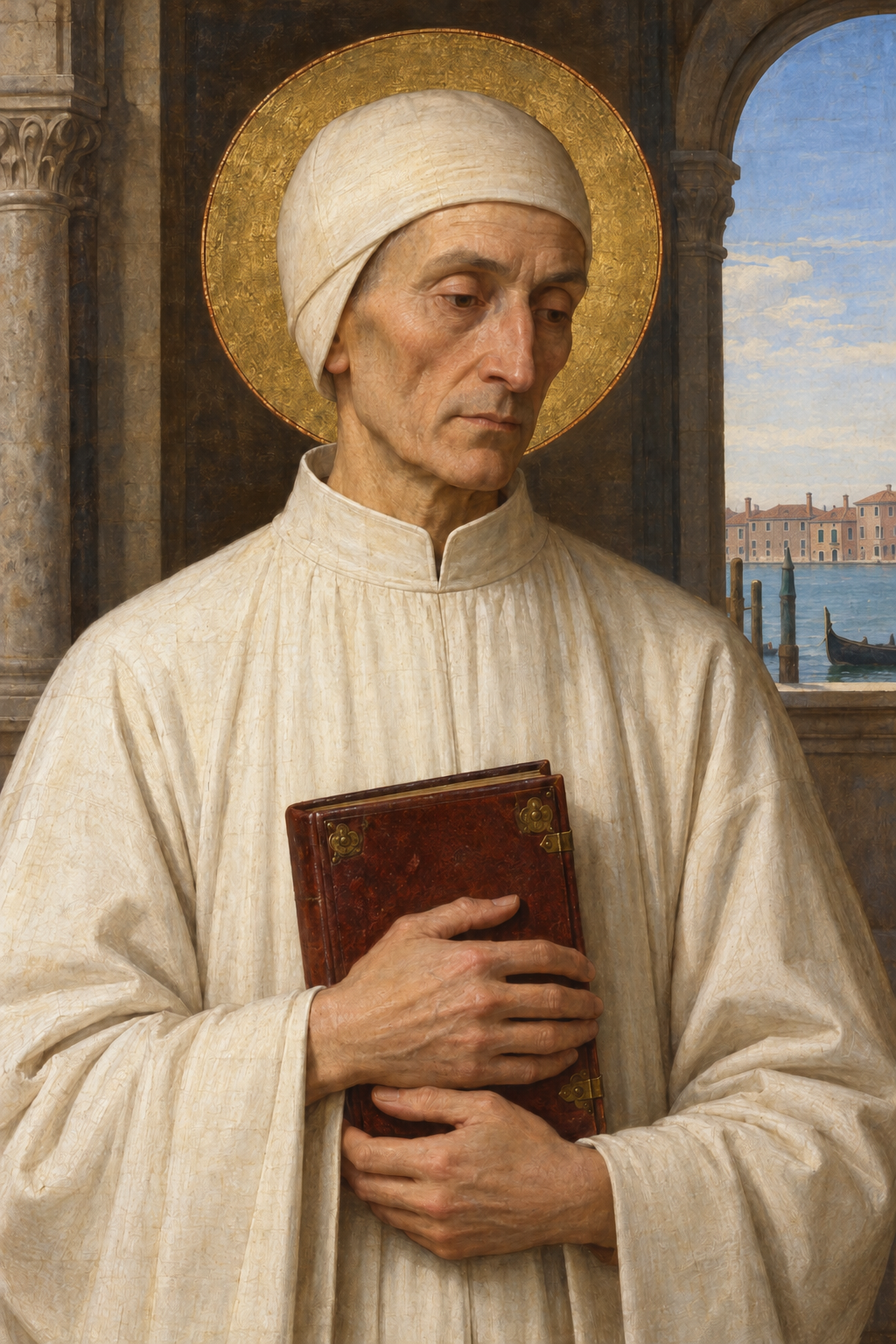
About Lawrence Giustiniani
Lawrence Giustiniani, known in Italian as Lorenzo, was the first patriarch of Venice. Born in the city on July 1, 1381, he came from the Giustiniani family and entered a community on the island of San Giorgio in Alga as a young man. Prayer, study and common life became the foundation of his religious vocation.
His decision meant leaving the expectations of a noble household. The biography published by the Dicastery for Causes of Saints relates his sense of being called by Eternal Wisdom and his willingness to beg for the community. It recalls that he continued asking for alms even where he met contempt. These episodes present the humility and austerity that became central to his spiritual reputation.
The community of secular canons at San Giorgio in Alga received recognition in 1404, and Lawrence repeatedly served as a superior. His leadership included periods at Vicenza and at San Giorgio. In 1433, Eugene IV appointed him bishop of Castello, the diocese that included much of Venice. He held a diocesan synod and issued constitutions intended to reform ecclesiastical life. His work also included support for poor clergy and the renewal of monasteries.
The appointment had a political dimension. Venice’s rulers were accustomed to having a decisive role in selecting their bishop, whereas Lawrence had been chosen directly by the pope. Near the end of his life, the Council of Ten praised his ministry while insisting that the Republic’s electoral privileges be respected in choosing his successor. Personal esteem for Lawrence did not remove this dispute over authority.
His care for the city included assistance to those affected by the plague of 1447, continuing work he had undertaken during an earlier outbreak.
In 1451, Nicholas V joined the jurisdictions of Grado and Castello and transferred the patriarchal title to Venice. Lawrence became the first holder of the new title. The change responded to Grado’s weakened economic and ecclesiastical position; its patriarchs had already been living in Venice. San Pietro di Castello remained the center of the reorganized see.
Lawrence continued to live austerely as a bishop. The Causes of Saints biography describes his personal visits to people in poverty and his distribution of food and clothing. It also acknowledges resistance to his reforms, both among clergy and in the Senate. His concern for renewal was not universally welcomed, even while his reputation for holiness grew among the population.
He relied on writing more than public eloquence. His theological works and shorter spiritual texts sought to guide both clergy and laypeople toward reform of their own lives.
His writings approached reform from the inner life as well as from administration. In the introduction to his treatise on sorrow over the state of Christian perfection, Alberto Peratoner describes Lawrence’s criticism of pastors who neglected their people and failed to study. The proposed remedy began with love of God and neighbor, humility and personal renewal. It included responsible use of wealth and generosity toward people in poverty.
An excerpt from his work on the degrees of perfection remains part of Venice’s liturgical office for his feast. Addressing Eternal Wisdom, Lawrence meditates on Christ’s sharing in human hunger, labor, suffering and death. He then turns to the need for inward attention: the person who never becomes quiet enough to listen misses the invitation that divine grace offers. The passage links contemplation with his enduring theme of God’s compassionate love.
Lawrence died on January 8, 1456. His remains are preserved at San Pietro di Castello. Venice’s diocesan calendar celebrates him on the anniversary of his death.
His public image developed soon afterward. Gentile Bellini’s painting of 1465, now at the Gallerie dell’Accademia, presents him in profile, with an austere face and an imposing figure. The museum connects the probable commission with the canons’ campaign for his beatification. Its possible use as a processional banner remains a scholarly interpretation, rather than an established original function.
The museum also distinguishes this image from an earlier portrait by Gentile’s father, Jacopo Bellini, made around 1456–1457. Gentile’s composition became influential through numerous copies. The painting therefore bears witness both to Lawrence’s early reputation and to the deliberate shaping of a devotional image after his death.
Alexander VIII canonized him on October 16, 1690.
His patronage remains closely tied to Venice. In an address to Venetian confraternities in 1961, John XXIII explicitly included Lawrence among the city’s heavenly patrons.
Historically, the Venetian pistori, a bakers’ guild, honored him with Saint Roch as a patron. The association belongs to that particular guild and should not be extended automatically to every baker.
Devotion also continues among the Justinian nuns in Arequipa. A diocesan report describes their celebration of his feast at the Monastery of San Lorenzo Justiniano and the Immaculate, and calls him their patron. The community remembers him through its life of contemplation, prayer and religious commitment.
Wondering how to weigh the stories and sources? Learn how to read a saint biography.