Biography
Lucien Botovasoa
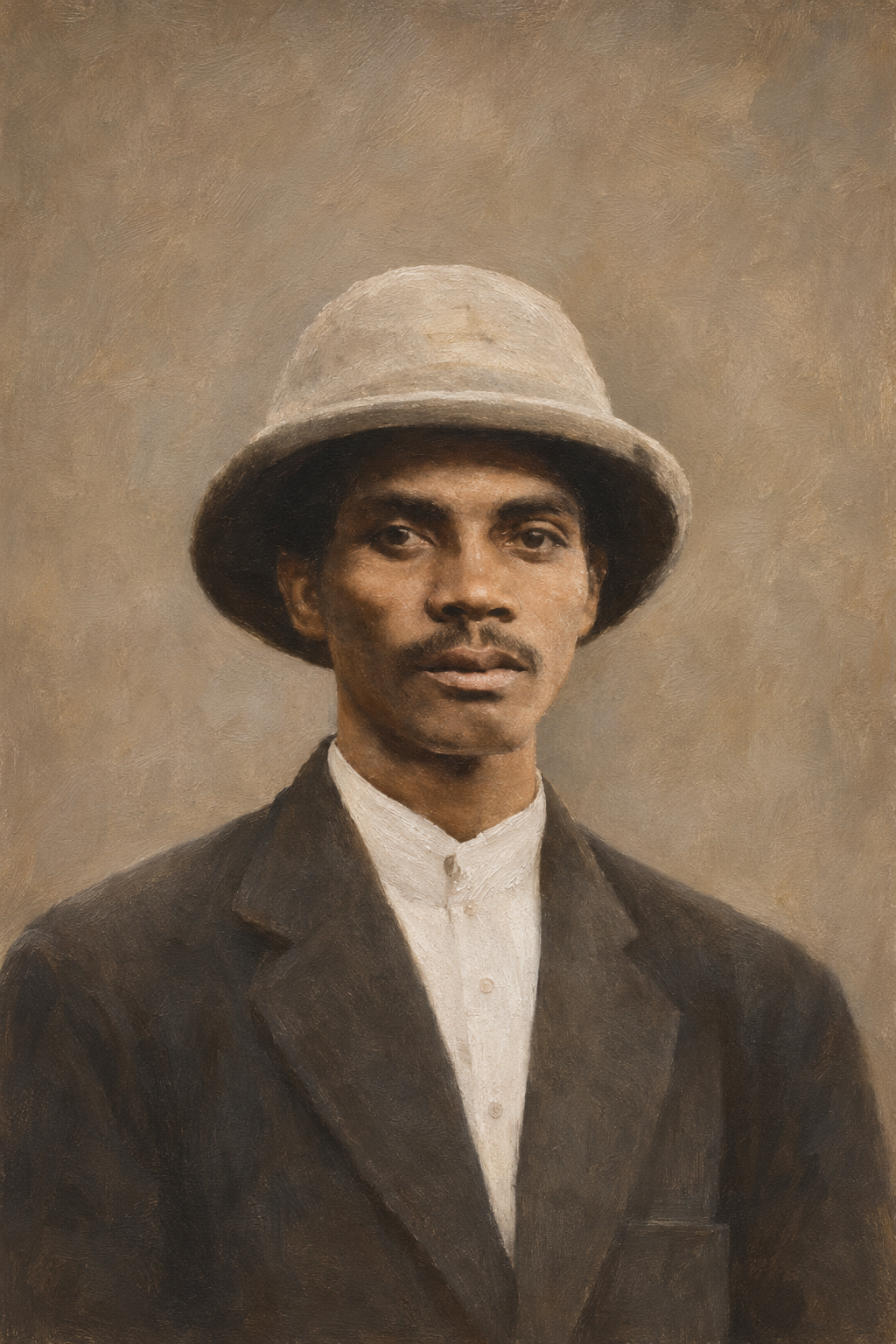
About Lucien Botovasoa
Lucien Botovasoa grew up in Vohipeno, beside the Matitanana River in southeastern Madagascar. His birth is generally placed around 1908. His family belonged to a region with a long tradition of writing Malagasy in Arabic characters. Cesare Giraudo’s study describes his father teaching him that script, while also sending him to school to learn another system of writing. Later, Lucien helped his father learn the Latin alphabet. This exchange of knowledge within the family preceded his own work as a teacher.
He attended a state school and continued his education with the Jesuits at Saint Joseph in Ambozontany. Having qualified to teach, he returned to Vohipeno and worked in its parish school. He married Suzanne Soazana in 1930. The couple had children, and his responsibilities as a husband and father remained central to his Catholic vocation. He also directed the parish choir and took part in its other activities. School, family and parish were closely connected in his adult life.
His classroom methods included competitions in which children could gain points and receive small school supplies as prizes. Giraudo describes lessons that combined general subjects with catechism, followed by readings about saints for pupils who wanted to remain. He also recounts a family memory of money found beside a path and returned to its owner. That remembered incident gives a concrete expression to the honesty associated with the teacher, whose income was modest.
In a 2015 interview, the Jesuit anthropologist François Noiret emphasized the importance Lucien gave to his wife and children. His description also connected the teacher’s approach to his pupils with the education he had received from the Jesuits. Lucien kept their concern for God’s glory as a guiding purpose. His search for a practical rule of Christian life eventually led him to a manual of the Franciscan Third Order. It offered a way to deepen his faith while continuing to live at home and teach in the village.
Other lay Catholics joined him in forming a Franciscan fraternity. Among them was Marguerite Kembarakala, who had helped him become a Christian. The group gave his religious commitment a shared form. Bishop Benjamin Marc Ramaroson’s account describes regular prayer, fasting and simple clothing, alongside continuing concern for the education and nourishment of his children. His life as a Franciscan was lived in those ordinary relationships. He understood marriage and teaching as his own calling, rather than expressing regret that he had not entered the priesthood.
He became director of Saint Joseph’s parish school in 1943. The formal decree also records his help after a destructive storm in 1945. It places these acts of responsibility beside his daily religious practices: attending Mass, spending time in prayer and observing the Franciscan rule. Those details show service that continued across the school calendar and the unexpected needs of neighbours. His later death did not erase the earlier history of a working teacher involved in the town’s practical life.
Political conflict placed that life in danger during the 1947 uprising against French colonial rule. Ramaroson’s narrative describes competing groups trying to recruit a man respected in the community. Lucien refused the roles offered to him. The account links his eventual arrest with his refusal to compromise his religious commitment amid violence. He was taken to the riverside and killed. Witnesses recalled him praying for those about to execute him. These recollections stand within a conflict that also left many other people dead and communities deeply wounded.
The record of his life was assembled with considerable care after his death. In a signed 2011 letter, Noiret explained that he had transcribed an earlier inquiry conducted by Father Louis Deguise between 1965 and 1968. He then made eight research visits between 2007 and 2011. His work included conversations with relatives, former pupils and people involved in the killing, as well as parish documents and records from a 1948–1949 judicial proceeding. He described the difficulty of revisiting painful memories, comparing testimony and separating reliable recollection from later embellishment.
That letter also records a public commemoration in 2008, held on 17 April at the place associated with the death. Local people had preserved the site. The gathering brought a much wider response than its organizers had expected, and the anniversary became a recurring occasion of remembrance in the town. Lucien’s story had therefore remained part of the community’s memory before its formal recognition in Rome.
He was proclaimed Blessed at Vohipeno on 15 April 2018. Pope Francis announced the celebration that day, describing him as a father of a family who had remained faithful to Christ and the Church at the cost of his life. The pope presented his witness through charity and courage in faith. Catholic remembrance thus holds together his final refusal of violence and the years he spent teaching, praying and caring for a household.
Wondering how to weigh the stories and sources? Learn how to read a saint biography.