Biography
Lucy
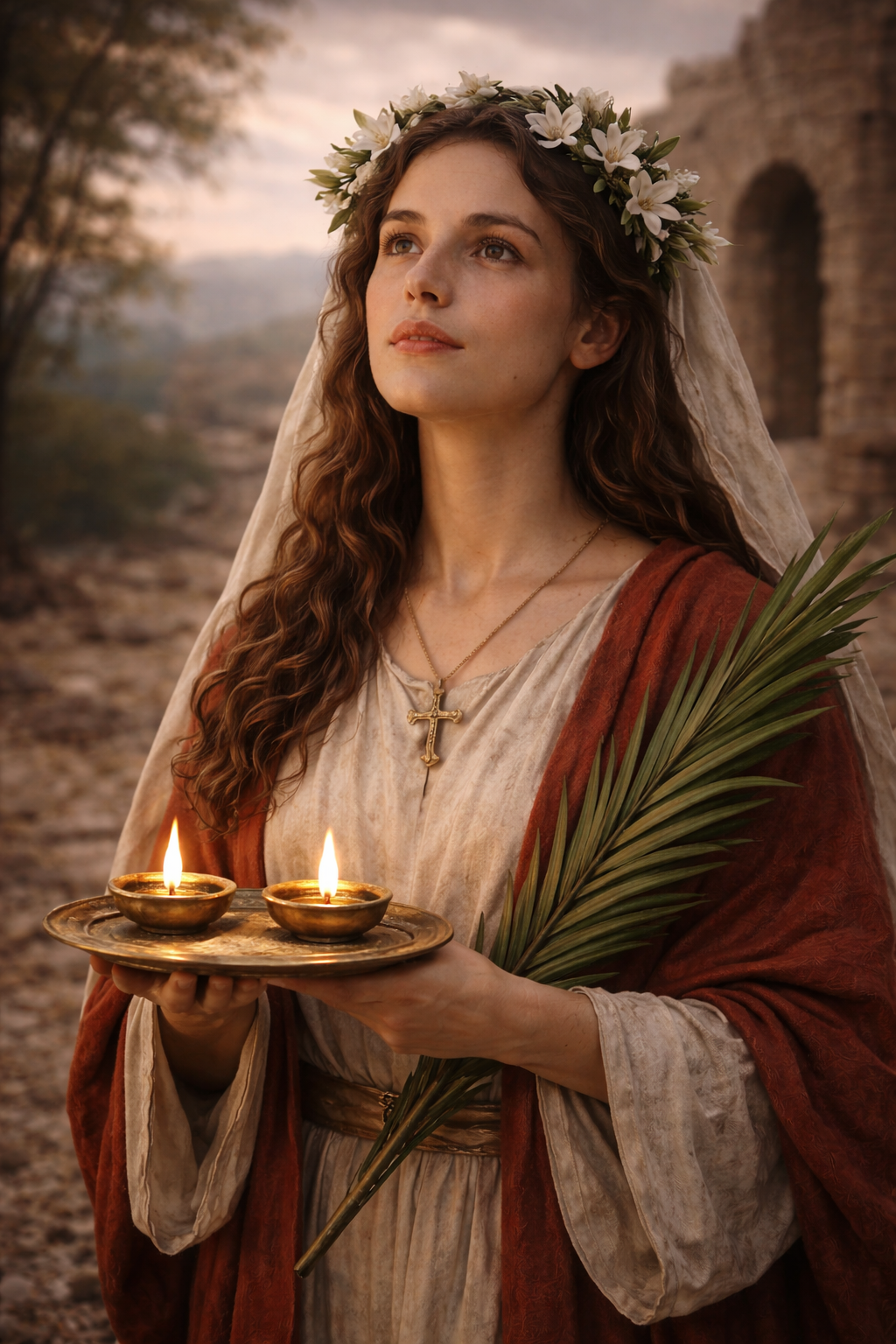
About Lucy
Lucy is remembered as a young Christian martyr of Syracuse in Sicily. The surviving evidence establishes her early cult more securely than it establishes the details of her life. A Greek inscription commissioned by a woman named Euskia was found in the catacombs of San Giovanni at Syracuse in 1894. Dated to the fourth or early fifth century, it invokes Lucy's feast and shows that devotion to her was already rooted in the city. The inscription does not tell her age, family history, or the circumstances of her death. It nevertheless provides physical evidence close enough to late antiquity to make Lucy more than a figure known only from medieval legend.
Lucy probably died during the era of imperial persecution at the beginning of the fourth century. Her feast was fixed on December 13 in an old Syracusan tradition, and churches in both East and West continue to keep that date. The familiar year 304 places her death during the persecution associated with Diocletian, but the surviving passions contain internal chronological difficulties. A civic guide published by Syracuse therefore describes the year as controversial even while presenting 304 as the received date. This account retains circa 304 rather than an invented exact birthday or death certificate. Syracuse is the secure city association; no exact execution site is asserted.
Most narrative details come from Greek and Latin Acts of Martyrdom composed after Lucy's time. The extant versions are generally dated to the fifth or early sixth century and share patterns found in other virgin-martyr legends. Vatican News explicitly introduces the story as a collection of traditions, popular tales, and legends. According to this received account, Lucy belonged to a prosperous Syracusan household and was raised by her widowed mother, Eutychia. She wished to dedicate her life to Christ, while her mother planned a marriage. These details may express genuine local memory, but no surviving contemporary document confirms them. They should therefore remain attributed to the passion.
The passion next sends Lucy and Eutychia from Syracuse to the shrine of Agatha at Catania. Eutychia is said to have suffered from bleeding, and Lucy prayed for healing beside Agatha's tomb. In a dream or vision, Agatha assured Lucy that faith had helped her mother and foretold Lucy's future honor at Syracuse. Lucy then persuaded Eutychia to distribute her property among poor people rather than preserve it as a marriage dowry. This episode links two Sicilian martyr cults and gives Lucy a concrete act of generosity. Yet the journey, cure, vision, and dialogue are known through later hagiography. A map may show Catania as a traditional narrative setting, not as a verified stop on a historical route.
According to the same tradition, a disappointed prospective husband learned that the family's wealth was being given away and denounced Lucy as a Christian. The official Paschasius demanded sacrifice to the imperial cult. Lucy refused. Their extended exchange presents her as arguing that care for widows, orphans, and people in need was a fitting offering to God. The speeches are literary dialogue, not a stenographic transcript. Still, they reveal what the later community considered central to her witness: public confession joined to material generosity. A brief answer attributed to Lucy may be preserved as a traditional quotation only when its source and uncertain status are made explicit.
The passion heightens the conflict through a series of wonders. Paschasius threatens to send Lucy to a brothel, but guards and even oxen cannot move her. Attempts to burn her fail. Greek and Latin versions then differ over whether she is beheaded or stabbed in the throat. These motifs resemble other martyr legends and cannot be independently verified. The popular claim that Lucy's eyes were gouged out does not appear in the earliest forms summarized by the Syracuse civic account; it developed later alongside wordplay on Lucia and the Latin lux, meaning light. Her association with sight is culturally important, but it should not be inserted into her biography as a documented torture.
The memory of Lucy continued through worship, architecture, movement of relics, and local civic identity. The Archdiocese of Syracuse describes the Euskia inscription as the earliest secure witness to devotion at her feast. It also reports a later history in which relics were taken to Constantinople and then Venice, though those medieval movements lie far beyond Lucy's life and carry their own evidentiary questions. In Syracuse, December observances center on the cathedral, a silver image, relic veneration, and a procession to the basilica outside the walls. These practices document the community that remembers Lucy; they do not retroactively prove every incident in her passion.
Lucy remains significant at the meeting point of sparse history and abundant tradition. An ancient inscription supports a martyr cult at Syracuse, while later passions supplied a memorable story of almsgiving, resistance, threatened sexual violence, miraculous protection, and death. Responsible retelling keeps those evidence levels distinct. It can honor the action imagined at the center of the tradition—redirecting wealth toward vulnerable people and refusing coerced worship—without claiming access to Lucy's private thoughts or exact words. Her December feast still joins Sicilian devotion with celebrations of light in other cultures, but her enduring historical foundation is the early Syracusan community that preserved her name.
Wondering how to weigh the stories and sources? Learn how to read a saint biography.