Biography
Luke of Armento
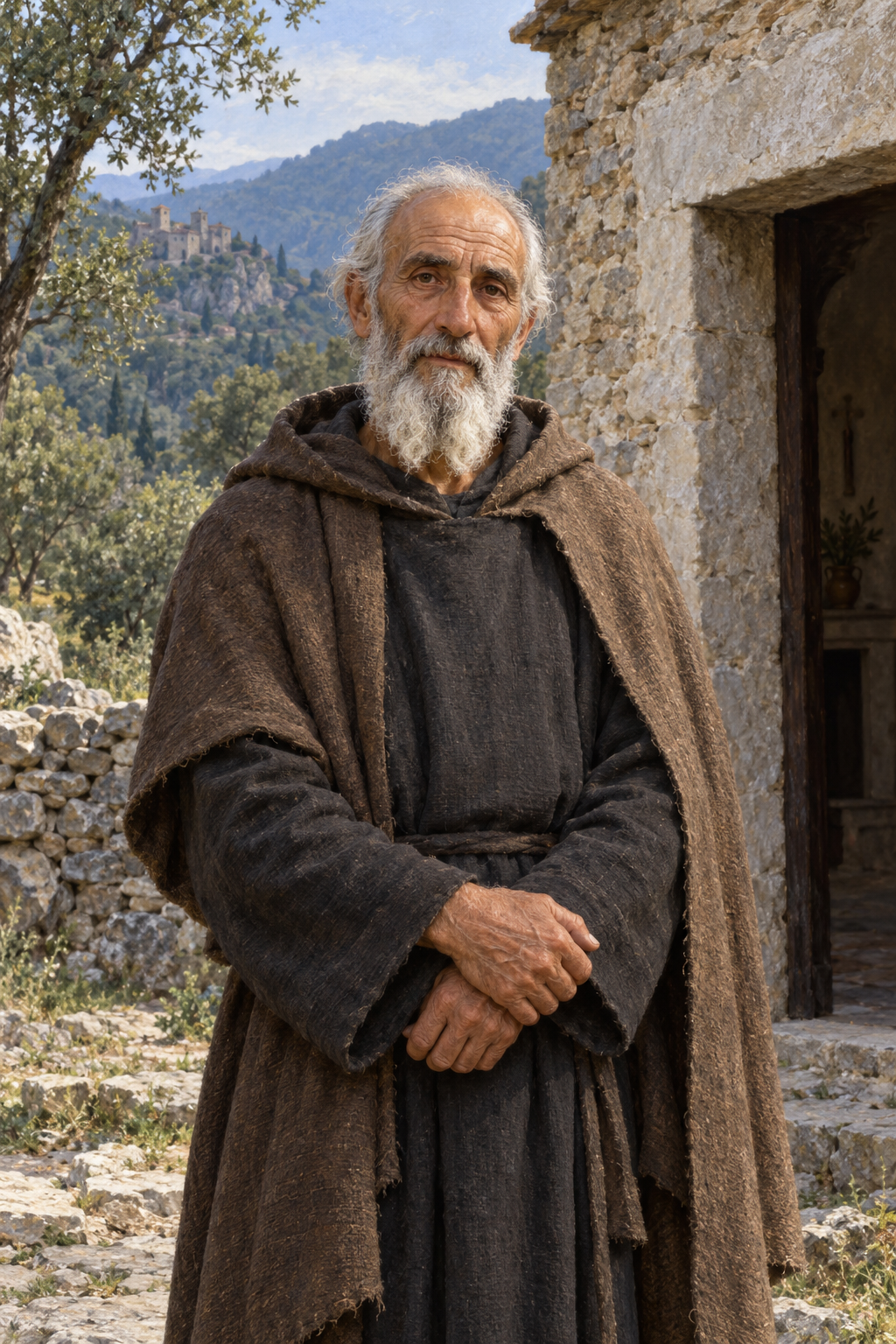
About Luke of Armento
Luke of Armento was a Sicilian monk whose remembered life followed the movement of Greek-speaking religious communities into southern Italy. He restored abandoned churches, gathered disciples and eventually established a community at Armento in Lucania. His biography places his birth at Demenna in Sicily during the early tenth century and names his parents as John and Thedibia. The account presents religious formation, rather than formal learning, as central to his upbringing and vocation.
According to his Life, his parents hoped he would marry, but Luke instead entered the monastery of Saint Philip at Agira. After several years he crossed to Calabria and sought instruction from Elias the Cave-Dweller near Reggio. Raids then drove him northward to Noa, where he restored a church dedicated to Peter and lived with his followers. As visitors increased, he sought a quieter place and rebuilt the ruined monastery of Saint Julian near the river Agri.
The narrative repeatedly connects his religious work with the needs of nearby people. The Orthodox Encyclopedia recounts the Life’s story of food distributed from the monastery during famine, together with accounts of healing and spiritual counsel. The inexhaustible supplies belong to the miracle tradition, rather than to an independently documented record of provisions.
The monks’ occupation of land also brought conflict. The Life tells of a local ruler named Landulf who tried to take their possessions. Luke encouraged the frightened brothers, and the account interprets the ruler’s disappearance as divine protection. The ruler’s precise identity is disputed. A further move followed the campaigns of Otto I in southern Italy in 968–969. Luke and his companions settled at the naturally defensible site of Armento and began a church dedicated to the Virgin Mary and the Apostle Peter.
The most striking episode is also one requiring particular caution. The Life describes Luke leading monks against raiders, appearing on a white horse surrounded by flames. Gianluca Borghese notes that no independent source confirms the encounter and that, if it has a historical basis, it should be understood as a limited skirmish. Its extraordinary imagery belongs to the author’s presentation of the saint.
Family ties remained part of the community’s story. Luke’s widowed sister Catherine came to Armento with her two sons and asked to enter religious life. She established a women’s monastery, while her sons became monks. His Life places his death on October 13 in 984; the competing year 993 in the Latin text is treated by modern scholars as a transmission or translation error. The reported presence of Sabas at his deathbed is less secure than later retellings sometimes suggest.
The surviving text itself explains some of these uncertainties. Its Greek original is lost, and the account is known through Latin versions. The seventeenth-century editor Ottavio Gaetani used a manuscript found in Luke’s church at Armento and substantially revised its language and presentation. The Bollandists later printed a closely related account from another manuscript.
Luke’s local remembrance remains visible in Armento’s religious art. An Italian Ministry of Culture catalog identifies Luke the Abbot, together with Vitalis of Castronuovo, as a protector of the town. The entry concerns a seventeenth-century cycle of paintings illustrating Vitalis’s life and notes later restoration.
A diocesan report published in October 2026 documents the examination and care of relics venerated under Luke’s name in Armento. The work included an urn and an arm-shaped reliquary, whose contents were recorded, secured and sealed. The report also notes uncertainty within the assemblage: one bone was considered probably to belong to another individual.
The report preserves records of earlier care as well. A document describes the placement of relics in the urn in 2005, and an episcopal visitation in 1589 already mentioned a silver arm reliquary associated with Luke.
The town has also brought this religious heritage into contemporary cultural activity. Its submission to the regional heritage register describes exchanges with communities in Greece, a collection of Byzantine-style icons and new artwork depicting Luke and Vitalis. These projects show how the two saints remain part of Armento’s public identity.
Wondering how to weigh the stories and sources? Learn how to read a saint biography.