Biography
Lutgarda Yi Sun-i
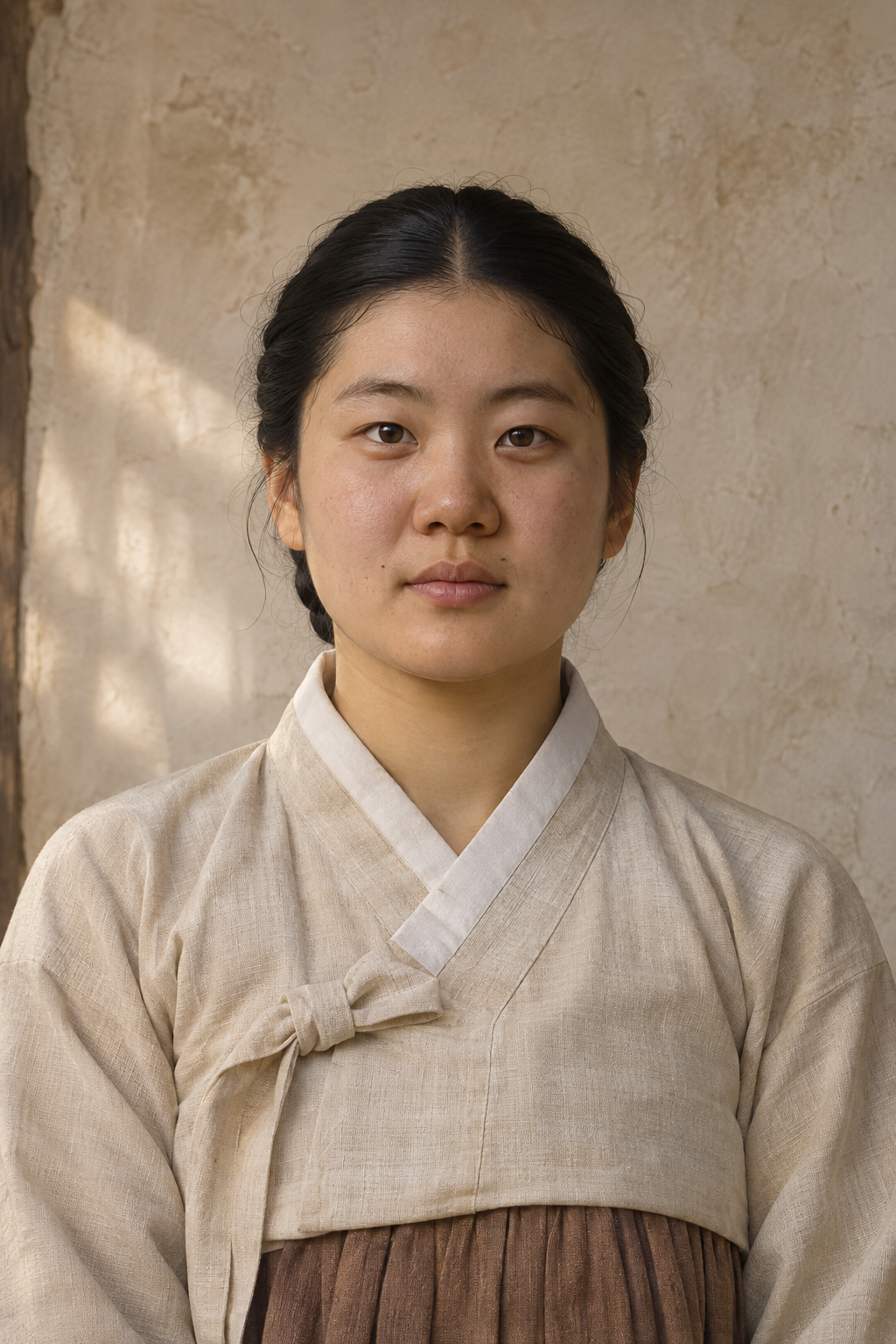
About Lutgarda Yi Sun-i
Lutgarda Yi Sun-i grew up in Seoul in a Catholic family. Her father was Yi Yun-ha, and her mother belonged to the Gwon family connected with the early Korean Catholic community. Her father Matthew became a Catholic in 1784 through contact with Gwon Cheol-sin, Gwon Il-sin, and Peter Yi Seung-hun. His scholarly inheritance came through his maternal grandfather, Yi Ik. Her mother taught her the catechism and basic education from childhood. When her father died in 1793, Lutgarda remained with her mother.
In 1795 she received Communion from the Chinese priest James Zhou Wen-mo. The experience became connected with her desire to dedicate her life to Christ through perpetual chastity. Her brothers Charles Yi Gyeong-do and Paul Yi Gyeong-eon left prison writings preserved with hers.
Historian Ha Tae-jin places that decision within her family’s intellectual and religious inheritance. In his account, her maternal uncles Gwon Cheol-sin and Gwon Il-sin offered complementary examples: learning directed toward practical duties, and active commitment to the new faith. Ha also emphasizes the devotional books and lives of saints that praised virginity, together with the importance of the Eucharist in Lutgarda’s religious life. Ha identifies both parents’ families with the practical-learning tradition known as Sirhak and connects its ethical emphasis with filial duty and neighborly love.
Remaining unmarried was difficult for a young woman of her background. With her mother’s consent, Father Zhou introduced her to John Yu Jung-cheol, the eldest son of Augustine Yu Hang-geom, who also wished to remain celibate. Their marriage was arranged with that intention. She moved to his family’s home near Jeonju, and the two undertook a shared commitment to chastity. Marriage therefore gave their chosen vocation a household in which to live; it did not mean abandoning it.
Lutgarda’s own account makes clear that their commitment required effort. Writing to her mother, she recalled their mutual vow and acknowledged repeated temptations during their years together. She described prayer as their response. Her letter does not portray the marriage as an effortless arrangement between people without desire: she wanted her mother to know both what they had promised and how they had tried to keep it.
The persecution of 1801 broke apart the Yu household. Augustine was arrested and taken to Seoul; John was also imprisoned. Lutgarda and other relatives were subsequently taken to Jeonju. She encouraged the family to remain faithful together. Initially sentenced to exile, she was brought back after beginning the journey and faced renewed interrogation and punishment before being condemned to death.
The consequences reached the youngest members of the household. A government order preserved in Sahakjingui assigned three of Augustine’s children to slavery in separate island destinations: Yu Il-seok to Heuksando, Yu Il-mun to Sinjido, and Yu Seom-i to Geoje. Lutgarda’s prison letter also grieves over the children being sent away. Their mother Shin Hui’s distress concerned children who were still alive and would face a future without their parents. The family’s ordeal included forced separation and dispossession alongside imprisonment and death.
Writing to her elder sister and sister-in-law, Lutgarda described interruptions and the uncertainty of each summons. She worried about her mother and about relatives separated by arrest, while entrusting practical responsibilities to those who would survive.
One concern was John’s sister, who had lost the security of a prosperous household and was living with an elderly grandmother and an aunt in a poor dwelling. Lutgarda also requested bodily and spiritual care for Charles’s child. For younger brothers, she asked for education and encouragement toward responsible adulthood, entrusting needs she could no longer meet to surviving relatives.
To her own mother, she tried to explain how she understood the death that threatened her. She contrasted what she called her own limited usefulness in earthly life with the hope of becoming a precious child through fidelity to God. The point of that difficult assurance was also practical: she begged her mother not to be overwhelmed by grief.
She asked her family to keep contact with her husband’s relatives after her death. She also hoped the letter itself could stand in for her presence, offering her mother consolation after years in which they could no longer share their thoughts face to face.
Lutgarda was beheaded at Supjeongi in Jeonju on January 31, 1802, with relatives from the Yu family. She was twenty. Her letters survived her execution: a young woman speaking to people who had raised her, married into her life, and depended upon her household.
Her two letters were copied and preserved alongside Charles’s letter and Paul’s prison diary in the collection known as Nugalda Chonami Ilgi Nammae. Historian Kim Gu-jeong brought a Korean manuscript copy to scholarly attention in 1965 after finding it among the descendants of Kim Jong-ryun. The surviving book thus preserves the writings of siblings whose imprisonments occurred in different years.
Wondering how to weigh the stories and sources? Learn how to read a saint biography.