Biography
Lutgardis
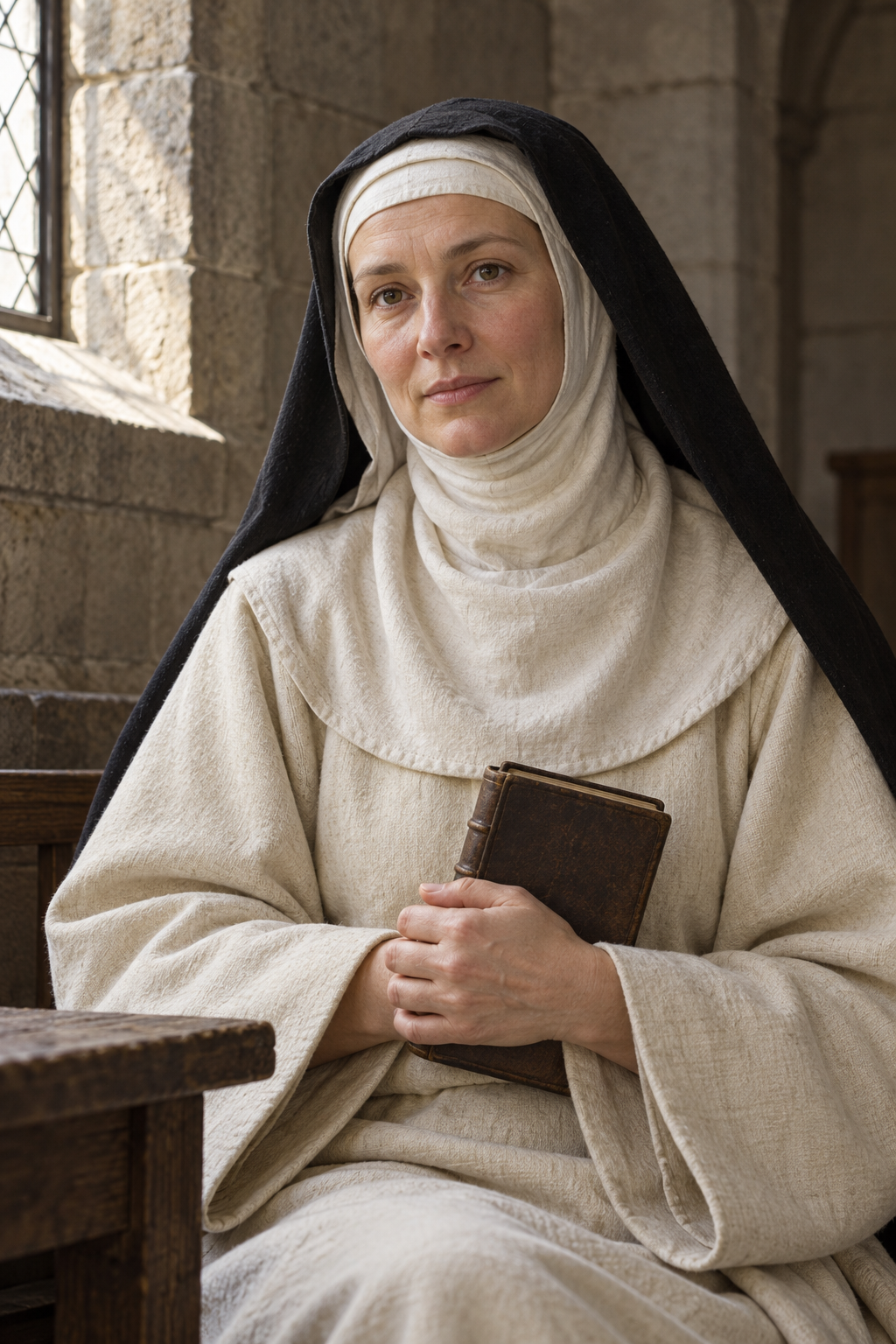
About Lutgardis
Lutgardis was a nun from Tongeren, born in 1182, whose life became closely associated with prayer on the suffering and love of Christ. She entered the Benedictine community at Saint-Trond while young and later joined the Cistercian community of Aywières. Her years there were remembered for contemplation, demanding penitential practices and intercession for others. She became blind late in life and died at Aywières on June 16, 1246.
Much of what is known about her comes through Thomas of Cantimpré, a Dominican who knew her personally and regarded her as a spiritual mother. His Life preserves conversations and memories alongside the conventions of medieval saints’ lives. Jennifer Brown’s review of the modern edition emphasizes both the intimacy of this relationship and the author’s purpose as a preacher. The work sought to form its readers’ religious lives, as well as to remember a woman he loved and admired.
Ludo Jongen explains that Thomas arranged the Life in three books, tracing a spiritual ascent. The first follows Lutgardis from childhood into religious life and recounts her early visions. Among the best-known is an exchange of hearts: she asks Christ for his heart, and the narrative expresses their union in love. This is a mystical story preserved by her biographer, rather than an independently verifiable physical event.
The second book presents prayer, fasting and struggles with evil; the third describes blindness and the approach of death. These episodes belong to a devotional understanding in which prayer and penance could benefit other people, including the dead. Jongen also notes that her fellow nuns were not unanimous in accepting her reputation for holiness. The surviving account thus preserves both admiration for Lutgardis and traces of a community in which her unusual religious life was not always easily understood.
The New Catholic Encyclopedia describes her frequent Communion and the tensions it aroused. It also recounts prolonged fasts undertaken in reparation for the religious divisions of her time. These severe practices form part of her medieval spiritual portrait; they should be read within the devotional sources that preserve them. Her religious life centered on Christ’s Passion and the hope that suffering and prayer could serve others.
Thomas’s account also places her among people who sought spiritual help. Brown notes the importance of prayer for souls in purgatory throughout the Life. Thomas’s grief and affection remain visible even after her death: he kept a relic of her finger, following a pattern associated with his mentor James of Vitry and Mary of Oignies. The detail reveals how personal friendship could continue through the material practices of medieval devotion.
The Life circulated in Latin, Dutch and French. Barbara Zimbalist’s study shows that its manuscript history is more complicated than a single fixed text: shorter and longer forms, prose and verse translations, and later editorial choices all shaped the story readers encountered. Scholars have disagreed about whether the shorter Latin version is an early draft or a later abridgment. This uncertainty concerns the history of the text and does not erase the evidence of Lutgardis’s life.
Lutgardis was never formally canonized, although devotion to her continued. She is remembered as a patron of people who are blind and people with disabilities.
The Roman Martyrology commemorates her on June 16, particularly recalling her devotion to the heart of Christ.
Her association with Flanders acquired a new meaning in the nineteenth century. A story that she never learned French was adopted as a symbol of fidelity to Flemish language and culture. Bussels traces this development through writers, clergy and cultural associations, rather than treating it as a medieval national campaign. The Davidsfonds chose her as its patron in 1931. Her patronage of the Flemish people and movement belongs to this later history of devotion and cultural identity. In the medieval story, her inability to learn French kept her from being made superior of a French-speaking community; its later use as a national symbol changed the emphasis of that narrative.
Another tradition centers on a medieval chair associated with her, now kept in Saint Odulphus Church in Borgloon. Women hoping for children have prayed beside or on it for her intercession. The heritage account notes that the chair is not mentioned in her medieval Life and that the beginning of this ritual remains uncertain. Its continuing use records the hopes brought to Lutgardis across generations, without establishing the miraculous effects attributed to it.
The chair’s later history also illustrates the care required to preserve a devotional object. Some visitors once scraped off small fragments as keepsakes; protective measures and restoration followed. After the community at Mariënlof closed, the chair found a new home in Borgloon in 2020. The heritage account describes a continuing practice supervised by the dean, in which the object remains part of religious life as well as a protected piece of cultural history.
Wondering how to weigh the stories and sources? Learn how to read a saint biography.