Biography
Macarius of Corinth
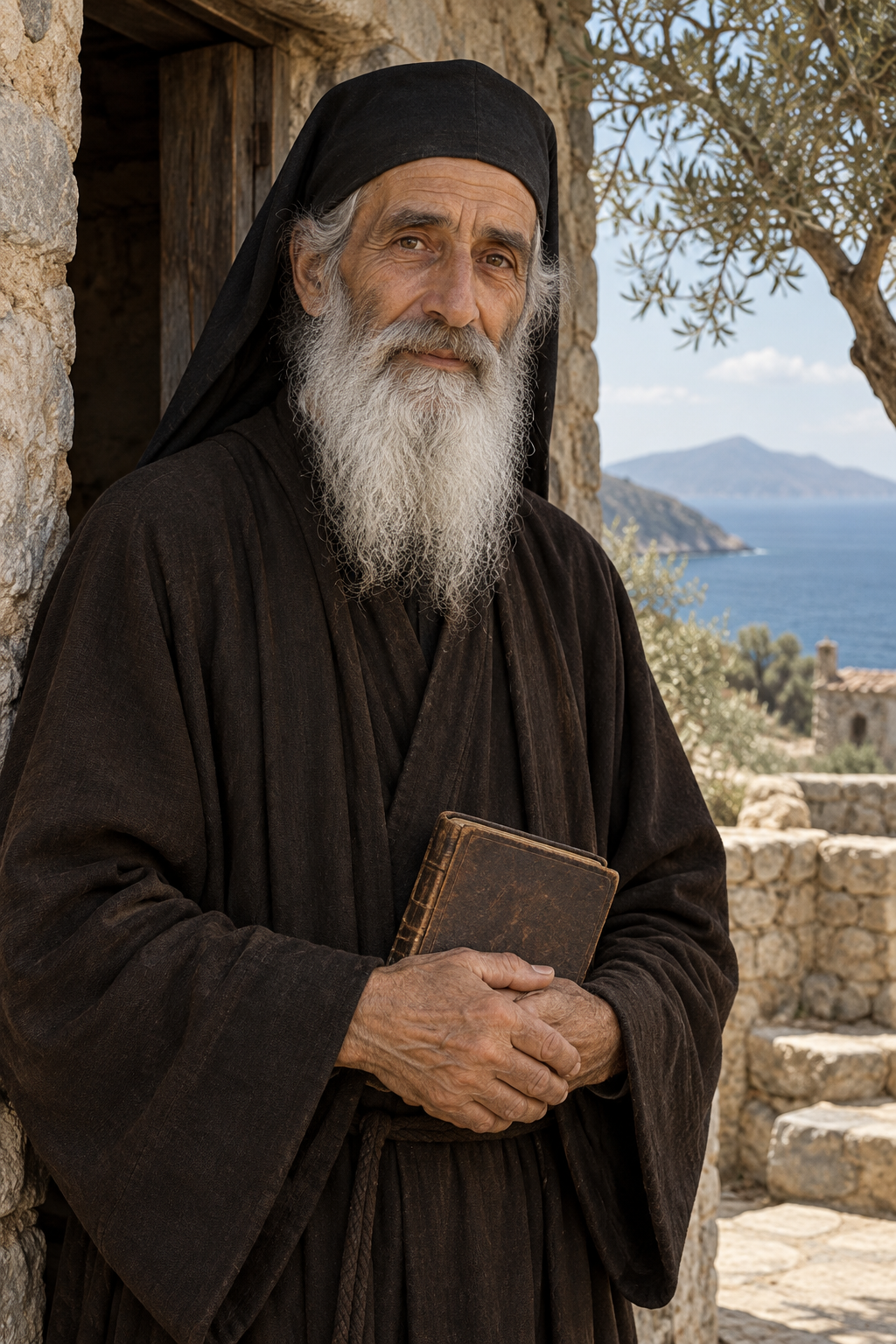
About Macarius of Corinth
Macarius of Corinth began life as Michael Notaras in Trikala, near Corinth. His family belonged to the Greek aristocracy, but his early interests centered on study and religious life. He attempted to enter the monastery of the Great Cave without his father’s permission and was sent home. He later taught young people in Corinth without payment. The church account remembers his teaching as an important reason the community wanted him to succeed its archbishop.
He became archbishop in January 1765, passing through ordination from the lay state. His tenure ended amid the upheaval surrounding the Russo-Turkish War and the failed Peloponnesian revolt of 1770. He fled with relatives to Zakynthos and later lived on Hydra. His involvement in the revolt remains disputed: later historians describe him as a participant, while his early biographer Athanasius of Paros explicitly denies that he supported the rebellion. The surviving evidence does not settle the disagreement.
As bishop, Macarius had worked to improve the preparation and conduct of his clergy. He distributed catechisms, required suitable ages for ordination and directed insufficiently trained candidates to monasteries for instruction. He also sought proper baptismal basins for parish churches. These practical reforms show a concern with how worship was actually conducted and how parish priests learned their responsibilities. His educational ambitions were interrupted when war forced him away from Corinth.
After losing his position in Corinth, he became involved with the Kollyvades, monks who opposed holding memorial services for the dead on Sundays. They argued that Sunday should retain its character as the weekly celebration of the Resurrection. The controversy spread beyond scheduling to questions about the renewal of Christian life. Many participants advocated more frequent Communion at a time when receiving it only a few times each year had become common. Their proposals encountered resistance within the Church.
Mount Athos became an important center of his work. Vassa Kontouma’s study places his arrival there around 1774, earlier than the often-repeated date of 1777. This gave him several years to gather and arrange texts for the Philokalia. Macarius then entrusted the collection to Nicodemus the Hagiorite, who corrected the texts and supplied the introduction and short accounts of the authors. Their contributions were different but complementary; the book cannot accurately be credited to only one of them.
Publishing also required money and personal connections. Macarius went to Smyrna, where John Maurogordatos supported the Philokalia and John Kannas helped finance the Evergetinos. Kontouma identifies both as local notables connected with the Evangelical School. The first should not be confused with an earlier prince of Wallachia who bore the same name. Because the Philokalia’s introduction thanks its supporter, Kontouma argues that the final editorial work continued after Macarius’s journey to seek funding.
The two collections served related but distinct purposes. Constantin Papoulidis distinguishes the Philokalia’s writings about inward prayer and watchfulness from the Evergetinos’s collection of ascetic teachings. Their early publication histories have sometimes been confused. The Philokalia appeared in Venice in 1782, and the Evergetinos followed in 1783. Subsequent translations of the Philokalia were not always complete reproductions: translators selected, omitted or added material. Its later international readership therefore encountered a developing family of collections, rather than a single unchanged book.
Papoulidis traces this process into twentieth-century editions: the early English selections drew on Theophan the Recluse’s Russian version, while Jean Gouillard’s French selection used Greek editions. Macarius’s collecting work thus reached later readers through further editorial choices and translations, whose contents should not be assumed to match the first edition.
Macarius’s advocacy of frequent Communion belonged alongside his interest in prayer. A later church review of Stylianos Papadopoulos’s study emphasizes this connection: inward spiritual discipline and participation in the Church’s sacraments were intended to strengthen one another. In this interpretation, Macarius did not promote private contemplation as a substitute for communal worship. His cooperation with Nicodemus helped bring both concerns into print, through the Philokalia and the book on frequent Communion.
His final years were spent on Chios, where people came to his hermitage for guidance and material help. He also encouraged some Christians who had converted to Islam to return publicly to Christianity, knowing that such declarations could lead to execution under Ottoman authority. The church biography presents this as preparation for martyrdom. It was a consequential part of his activity, not simply another form of quiet literary work, and belongs in any account of his life.
A stroke in 1804 prevented him from completing the publication of the New Leimonarion, a collection of saints’ lives and related services. He died on Chios on April 17, 1805. The collection appeared in 1819 with contributions from several collaborators. His local veneration began soon after his death, without a formal canonization process. The continuing importance of his work rests on this combination of gathering texts, supporting their publication and connecting scholarship with the religious needs of his communities.
Wondering how to weigh the stories and sources? Learn how to read a saint biography.