Biography
Macarius the Great
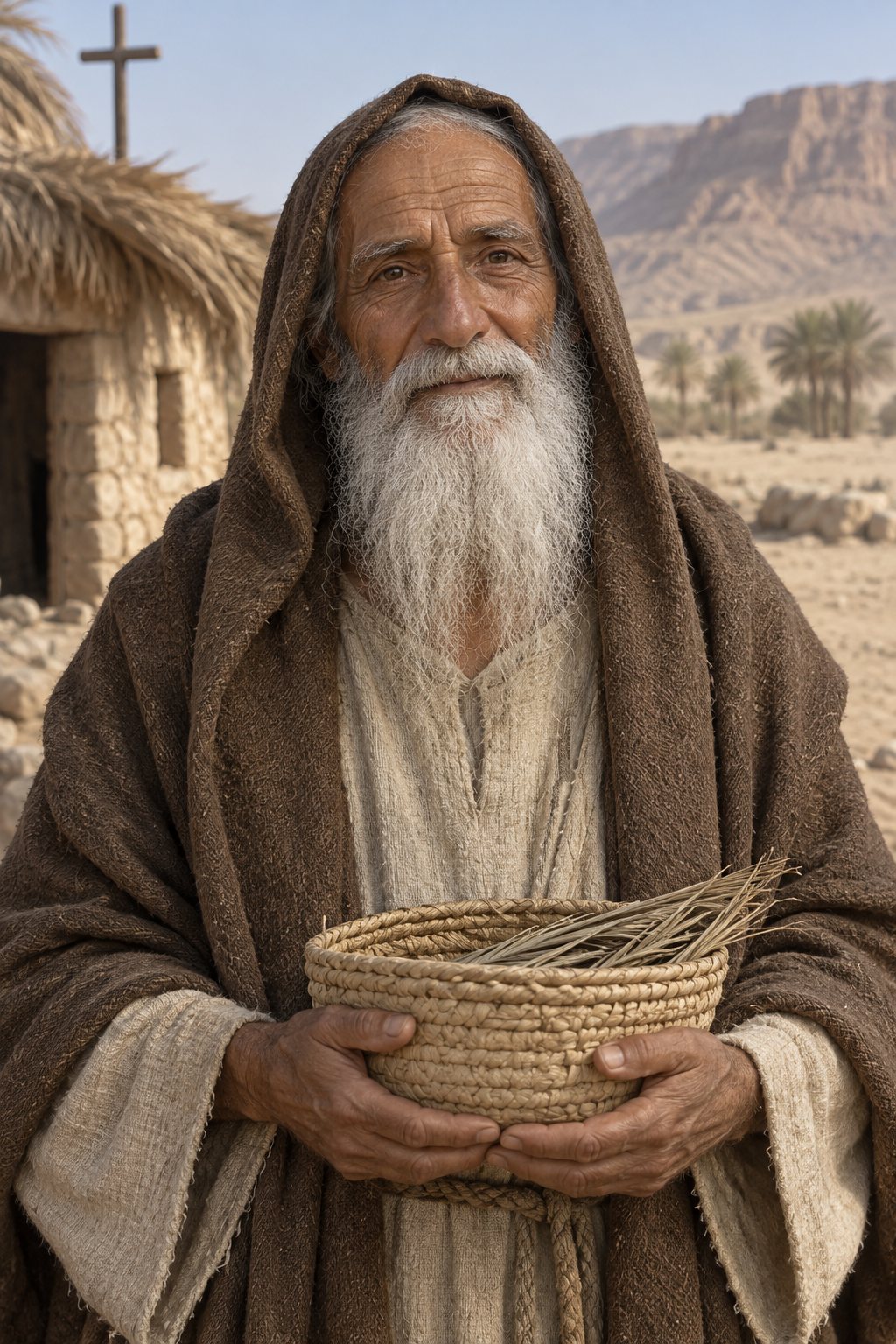
About Macarius the Great
Macarius the Egyptian, or Elder, lived at Scetis. Healy distinguishes him from Macarius of Alexandria, dating his life around 300–390. His monks gathered for weekend worship and guidance.
Antoine Guillaumont's account places his beginnings at Jijber, in the southwestern Nile Delta. Before moving into the desert, Macarius lived as a hermit near a village. Around 330 he withdrew into Wadi al-Natrun, first living near its lakes and then farther south, near the site of the later Baramus monastery. There he had a cave with two rooms, one reserved for prayer. He subsequently moved westward in the same desert, where followers gathered near another cave and sought his direction. Guillaumont also identifies Evagrius, who lived at Kellia, among those who came to consult him. His authority extended beyond Scetis to monks in Nitria and Kellia, who sought his guidance. This was a community linked by visits and teaching across considerable distances, not simply a group permanently sharing one building. Guillaumont considers a letter known as Ad filios Dei the only Macarian writing with some prospect of authenticity.
The Orthodox Church in America's traditional life gives a more intimate account of his first responsibilities. It remembers him caring for his parents after the death of his wife, then learning basket making and prayer from an older ascetic. That narrative places ordinary family obligations and manual work before his later reputation as a desert elder. Its details belong to the Church's received life rather than a contemporary household record.
Palladius describes two disciples near Macarius's cell and a passage leading to a cave for withdrawal from visitors. He attributes the cave story to a disciple and acknowledges that Macarius died before his own arrival.
The desert did not shelter Macarius from church conflict. Socrates recounts a military assault on Egyptian monasteries under Valens, whose government supported the opposing religious party. When force failed to secure submission, Lucius arranged the exile of Macarius and his Alexandrian namesake to an island. The historian connects their punishment with their support for the Nicene confession. His account continues with a healing and the islanders' conversion: that is Socrates's religious interpretation of the episode, not independent verification of a miracle.
The Sayings portray him recommending silence, concealing others' faults, and urging brief petitions for help.
A story in the Latin History of the Monks portrays his concern for someone threatened with punishment. An accused man takes refuge with Macarius, while pursuers demand that he be surrendered for the killing of another person. His pursuers say they risk punishment themselves unless they deliver the suspect to the authorities. The refugee swears innocence. Macarius brings them to the victim's tomb. The narrative then turns miraculous: a voice from the grave declares the refugee innocent. When pressed to identify the murderer, Macarius declines; freeing the wrongly accused is sufficient, without exposing someone else to punishment. The episode is a religious story, not a verifiable criminal proceeding. It gives a concrete picture of the mercy the narrator associated with this particular Macarius: protecting a vulnerable person rather than using spiritual authority to secure revenge.
His name acquired a second life in books. Nathan Gibson's Syriaca entry explains that Pseudo-Macarius is a scholarly designation for the author or authors of writings transmitted under Macarius's name. Manuscripts do not agree even about which Macarius they mean: Syriac recensions name the Egyptian, the Alexandrian, or simply Macarius. That unstable attribution prevents treating the whole literary collection as his autobiography.
Manuscript research nevertheless shows how widely this literary inheritance travelled. In 2011 Alin Suciu identified three Sahidic Coptic leaves as witnesses to the spiritual homilies. They had belonged to a manuscript from the White Monastery's library, perhaps copied around the year 1000. Two leaves now in Naples had previously been attributed to Shenoute; a third survives in Paris. Suciu matched their contents with homilies known in Greek and Arabic collections. The order of the surviving passages led him to argue that the Arabic collection had a Coptic predecessor. These are findings about the transmission of writings, not newly discovered words securely spoken by the fourth-century elder. They show readers and copyists carrying the Macarian tradition across languages and reorganizing its texts.
The monastery bearing his name also remains a working religious community. Its own historical overview describes a renewal beginning in 1969, when Father Matta el-Meskeen arrived with twelve monks at Patriarch Cyril VI's request. The community restored buildings, established farm buildings, and provided a library and guest accommodation. A printing press began operating in 1978 to support its publishing work. The overview presents prayer and manual labour as connected parts of the monks' common life. This later chapter belongs to the reception of Macarius, not to his personal achievements. It gives his legacy a material setting: farm buildings, repaired churches, books, and a community still gathering for worship.
Wondering how to weigh the stories and sources? Learn how to read a saint biography.
Explore similar vocations
Prayers for Macarius the Great
Macarius the Great: petition
Lord, help me.