Biography
Macrina the Younger
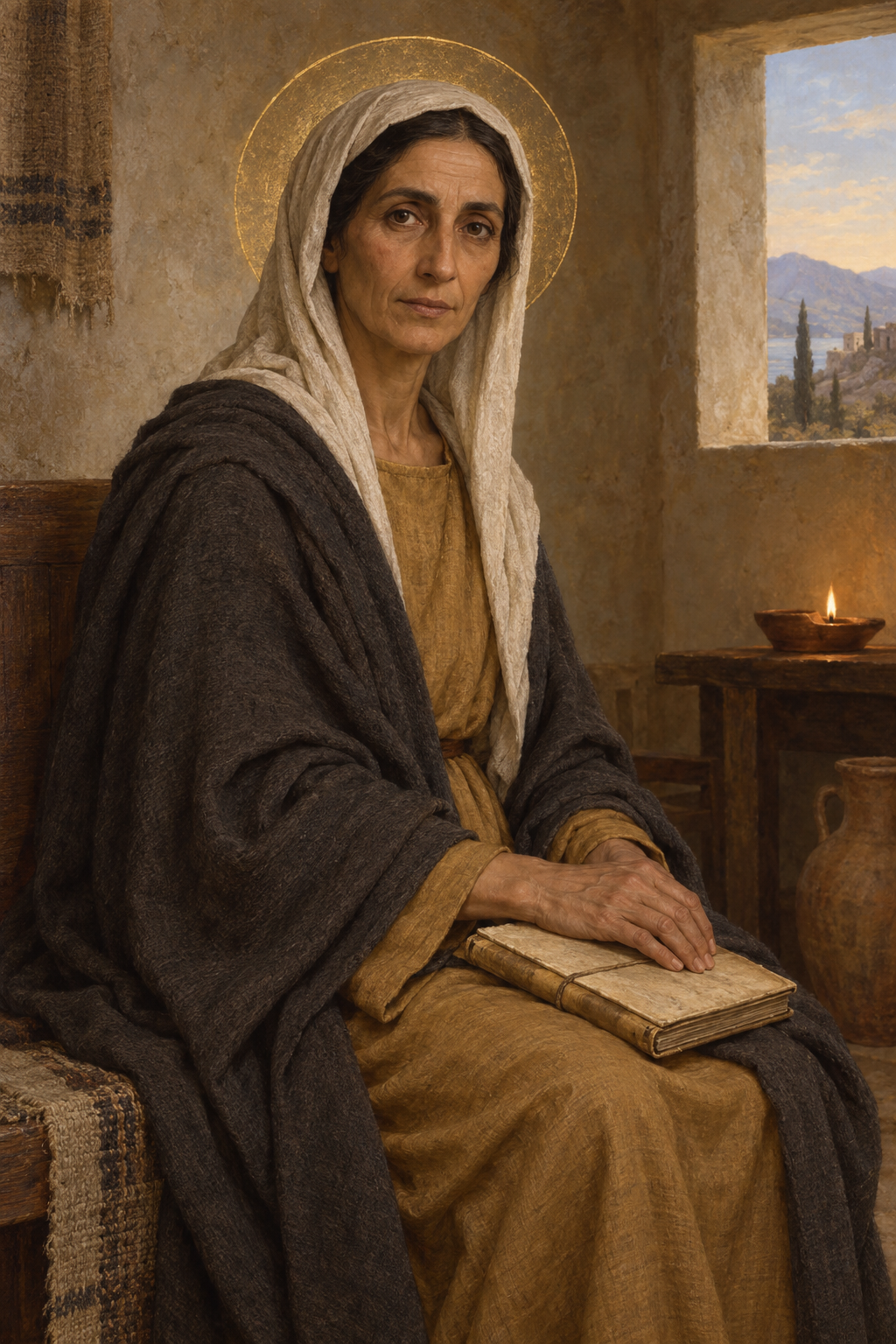
About Macrina the Younger
Macrina the Younger belonged to the fourth-century Christian family that included Basil of Caesarea, Gregory of Nyssa and Peter of Sebaste. She was the eldest child of Basil the Elder and Emmelia, and her name recalled her grandmother, Macrina the Elder. The younger Macrina became a leader of women living an ascetic life at the family’s property in Pontus. Her brother Gregory preserved her memory in a biography and presented her as his teacher. The Catholic Encyclopedia places her birth around 330 and her death in 379. These dates belong to a reconstructed chronology of the family rather than to a surviving personal register. She helped form Peter during his upbringing, shared her mother’s religious commitments and became a decisive influence in the family’s turn toward monastic life.
Her education began at home. In Bert Ghezzi’s account, Emmelia trained her daughter through Scripture rather than the usual Greek literary curriculum, and Macrina helped educate the younger children. Betrothed at twelve, she lost her intended husband before their marriage and chose to remain unmarried, giving her life to Christian service. Ghezzi also retells Gregory’s memory of Basil returning from his studies at Athens with a high opinion of his own learning. Macrina challenged that pride and encouraged him toward the monastic life. Another brother, Naucratius, died suddenly, bringing a different kind of grief into the household. Macrina supported her mother through that loss. These family responsibilities accompanied her religious commitment; the care of relatives and the formation of younger siblings were already part of the life from which her later community grew. Ghezzi locates their retreat at Annesi in Pontus, in present-day Turkey.
The Orthodox Church in America’s account describes a deliberate change in the household’s relationships as well as its way of living. Macrina persuaded Emmelia to release their enslaved servants and enter a community of women, with some former servants joining them. They shared prayer, work and possessions, living together without the earlier distinctions of household rank. After her mother’s death Macrina guided the sisters. The same notice emphasizes her personal restraint: she slept on boards and accumulated no private possessions. It also preserves traditions of help during famine and of a girl’s healing. These are remembered as signs of holiness in the received life. The Orthodox notice dates her death to 380, differing from the 379 given in the Catholic Encyclopedia. Both traditions commemorate her on July 19, a shared calendar remembrance that does not resolve the historical difference over the year.
Gregory’s own Life makes her care for vulnerable people especially concrete. Among the women grieving after her death were people whom she had taken in as children abandoned by the roadside during famine. They remembered her as both mother and nurse. At the end of her life, Gregory came to the retreat and found her gravely weakened, yet attentive to his exhaustion and sorrow. She recalled the family’s past with gratitude and spoke about resurrection even as her strength failed. After her death the women who knew her wishes helped arrange her burial. Lampadia, a deaconess and leader among the sisters, explained how little Macrina owned: her cloak, head covering and worn shoes were almost the whole of her remaining goods. Gregory’s narrative also remembers an iron cross and ring worn at her breast. Such details join the public esteem surrounding her funeral to a life of very limited personal property.
Gregory gave that final encounter another form in On the Soul and the Resurrection. There he approaches his dying sister while mourning Basil, and calls her the Teacher. His grief becomes the starting point for a sustained examination of death, the soul and Christian hope. The Macrina of the dialogue does more than offer a brief consolation: she answers objections and asks her brother to reason with her. In one example she points to a physician’s use of touch, sight and other senses, arguing that understanding involves an intellectual power working through bodily organs. The conversation belongs to Gregory’s authored theological work, rather than a verbatim record or a treatise surviving under Macrina’s own authorship. Its choice of teacher nevertheless gives her an unmistakable place within his account of Christian understanding.
Modern scholarship helps explain the character of that remembrance. Christos Christakis reads the Life as a work of religious instruction shaped by a brother’s admiration, with biblical examples directing its portrait of wisdom and holiness. His discussion places Macrina’s modest clothing, simple bed, generosity and Scriptural formation within the ascetic life of her century. The narrative’s attention to her final prayer also belongs to a Christian tradition of portraying a holy death. Such literary shaping matters alongside its value as testimony about an early community of women. Macrina’s remembered authority rested in teaching, care, shared work and disciplined living. Through Gregory’s writings, those ordinary practices remained joined to the larger questions of suffering, human mortality and hope that her brother brought to her bedside.
Wondering how to weigh the stories and sources? Learn how to read a saint biography.