Biography
Marcellus the Acoemete
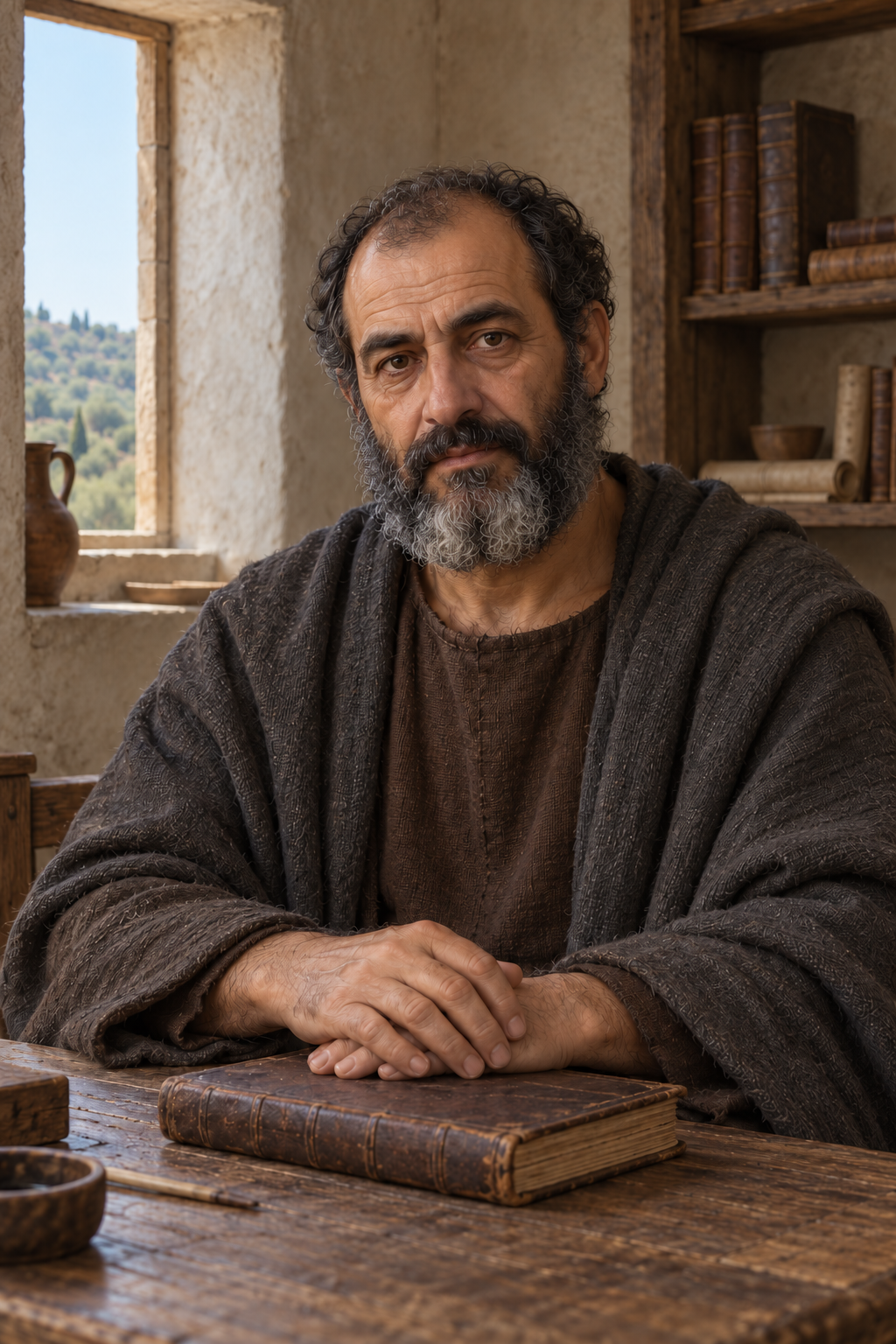
About Marcellus the Acoemete
Marcellus the Acoemete was a Syrian monk who led a community near Constantinople in the fifth century. Its members became known for sustaining the chanting of psalms throughout the day and night. Under his leadership, the monastery also developed as a place of learning, with a library and workshops for copying books. People sought him out for counsel as well as religious instruction.
Later tradition places his childhood in Apamea in Syria. His wealthy parents died while he was young, and he received an education at Antioch before pursuing an ascetic life at Ephesus. He is remembered as giving away his inheritance. These early episodes come through a saint’s life, rather than records of his childhood.
At Ephesus, the narrative says, he supported himself through calligraphy and learned from a man named Promotus. He eventually joined Alexander’s community near Constantinople. The surviving early Life was written after Marcellus’s death, and its date is debated. Its author did not personally witness the events described. This limits how confidently its private conversations and miraculous episodes can be reconstructed.
The name Acoemetae means the unsleeping ones. The monks did not each remain awake indefinitely: different groups took turns at prayer. Their founder Alexander had brought this form of community life from Syria. After Alexander and his successor John, Marcellus became abbot. The community had settled at Eirenaion on the Asian shore of the Bosporus, within reach of Constantinople.
The church account describes a hesitant beginning to his leadership. Marcellus left the community when he feared that he would be chosen to succeed Alexander, visiting other monasteries instead. He returned only after John had been appointed, and John made him a close assistant. In this telling, his eventual election followed a period of service under another superior rather than an immediate succession to the founder.
Donations helped Marcellus expand the monastery’s church and buildings. The wealthy Pharetrios and his sons entered the community, and their resources supported accommodation for visitors and care for the sick. The monastery’s influence extended through monks who joined other houses. Some helped establish the community at Stoudios in 463, linking its continuing prayer with another important center of monastic life.
Raymond Janin gives concrete examples of the books preserved by the community. Its holdings included letters of Isidore of Pelusium and records of church councils. In the following century, the deacon Rusticus used its manuscripts in his work on conciliar texts. The library’s importance therefore continued beyond Marcellus’s lifetime, providing material for readers concerned with the disputes in which he himself had taken part.
Marcellus also participated in the doctrinal conflicts of his time. He opposed Eutyches and supported the position associated with the Council of Chalcedon. His public role is not merely a later biographer’s claim: letters addressed to him by Theodoret of Cyrrhus survive. They show that he belonged to a network of church leaders seeking support during a bitter controversy.
In Letter 141, Theodoret addresses him as the archimandrite of the Acoemetae, a title for a senior monastic superior. He praises Marcellus’s religious commitment and explains that monks sent by the abbot have provided an opportunity to write. Theodoret asks for prayer and a letter in return. The exchange gives a direct glimpse of communication between a bishop and a monastic community.
The next letter praises Marcellus for remaining firm despite pressure from imperial authority and other bishops. Theodoret writes as a participant defending his own position, not as an impartial observer of every side. Even so, his appeal provides evidence that the abbot’s convictions and influence mattered beyond the monastery walls.
The second letter also explains the convictions behind Theodoret’s appeal. He insists that the incarnation did not add another person to the Trinity, and presents this as the faith he had received, preached and taught at baptism. His request for Marcellus’s prayers accompanies that specific defense of his teaching.
The later Life also describes the monastery offering refuge to a man threatened by the powerful family of Aspar. Marcellus refused to surrender him. Its account of the crisis includes a miraculous sign that frightened soldiers away. The story preserves a memory of sanctuary and resistance to coercion, but its supernatural resolution belongs to hagiography.
The narrative’s treatment of Aspar’s family is partisan. The Orthodox Encyclopedia notes that it contrasts an idealized Orthodox ruler with hostile portraits of his religious opponents. Its stories of healings, visions and abundant supplies likewise express the community’s devotional memory. They should not be treated as independently verified reports of miraculous events.
Marcellus died around 485 after a long monastic life. His legacy included the combination of continuous prayer, manuscript learning and spiritual counsel for a community connected with the wider Christian world. Nominis’s Roman Martyrology notice remembers him specifically as abbot of the monastery on the Bosporus where the psalms were chanted without interruption.
Wondering how to weigh the stories and sources? Learn how to read a saint biography.