Biography
Margaret of Antioch
About Margaret of Antioch
Margaret of Antioch, known as Marina in Eastern Christianity, is remembered as a young virgin martyr. Her cult became one of the most influential of the Middle Ages, but the evidence for her individual life is extremely limited. Juliana Dresvina's scholarly study of the traditions concludes that no contemporary source independently establishes Margaret's family, age, occupation, trial, or death. Even the Antioch attached to her name is uncertain. A responsible biography must therefore begin with the history of a story and its reception, not turn the story into a modern police report. Margaret may preserve the memory of an early martyr, but the surviving narrative cannot demonstrate that conclusion on its own.
The received account calls her Marina in Greek and Margaret or Margarita in Latin tradition. It places her at Antioch in Pisidia, although readers have often confused that city with Antioch on the Orontes in Syria. The page retains the traditional regional association without coordinates or an exact site. Earlier catalog dates of 289 for birth and 304 for death supplied a smooth chronology but exceeded the evidence. They are removed. The broad setting of persecution under Diocletian belongs to later hagiography, and neither a feast day nor the legend's estimate of her age can establish an exact year of birth or execution.
In the passion tradition, Margaret is the daughter of a pagan priest and loses her mother in infancy. A Christian nurse raises her outside the city, and Margaret embraces Christianity while still young. She tends sheep and resolves not to marry. These details create a sharp narrative contrast between a vulnerable rural girl and the political and religious power later used against her. They also belong to texts written long after the period they describe. The named father, nurse, childhood conversion, pastoral work, and age should not be presented as facts recovered from late Roman records.
The story turns when a governor, often named Olybrius or Olymbrios, sees Margaret and demands that she become his wife or concubine. She identifies herself as Christian and refuses both the sexual demand and the order to sacrifice. He responds by imprisoning her and ordering torture. This is gendered coercion as well as religious persecution: authority attempts to control her body, allegiance, and speech. Later retellings sometimes make the governor's attraction decorative. The tradition instead depicts refusal followed by organized violence. Margaret's courage is recorded as an action within that received narrative, not as a verified psychological portrait.
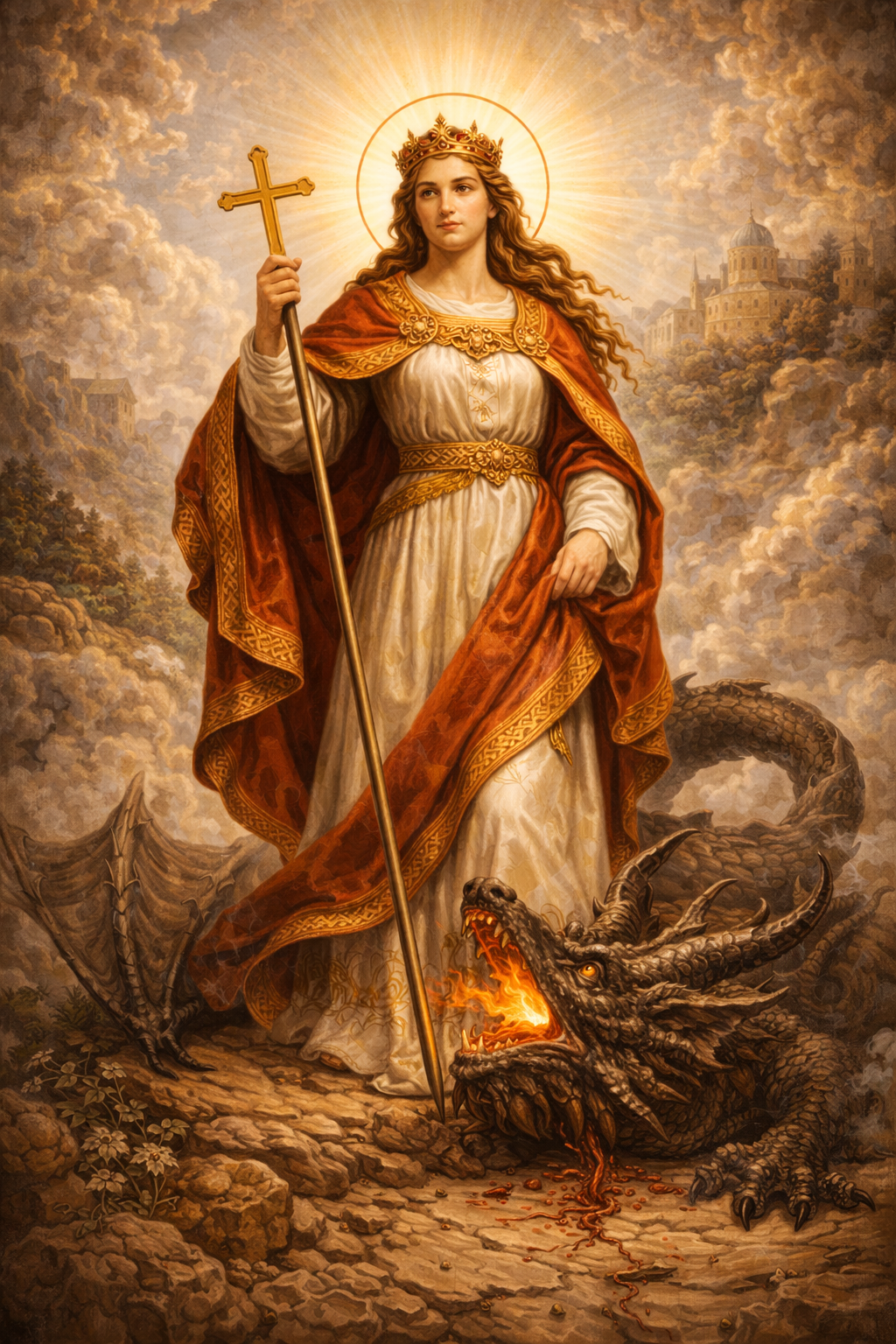
Accounts describe Margaret beaten, cut with implements, burned, and returned to prison. The violence should be named without lingering over injury. It shows what the passion's authors believed steadfast confession could cost. In prison the narrative becomes openly fantastic. A dragon-shaped devil appears and, in Western versions, swallows Margaret; the cross she carries or makes causes the creature to burst and releases her. Some medieval authorities themselves warned that this episode was apocryphal. The dragon is therefore not evidence for an animal encounter, a prison layout, or a miracle witnessed by a court. It is legendary imagery of evil failing to contain the martyr.
Eastern versions also portray Marina confronting a demon directly. The Orthodox Church in America's received life says she seizes and strikes the adversary with a hammer after prayer. Heaven then restores her wounded body. These scenes helped make Margaret unusually active in medieval and Eastern images: she does not merely escape danger but physically resists its personification. The imagery has inspired readers facing fear and coercion, yet it must remain attributed to hagiography. Neither the demon's dialogue nor Margaret's miraculous healing supplies historical speech or medical evidence.
The passion returns Margaret to public torture. It says she is burned and immersed in water, receives a sign of divine favor, and inspires spectators to confess Christianity. The governor orders executions, and Margaret is eventually beheaded. Some forms give enormous numbers of converts killed beside her. Such totals and miraculous survivals are familiar hagiographic amplification and lack independent confirmation. The core claim that tradition remembers Margaret as a martyr is stronger than any individual ordeal, but even the mode, place, and date of execution cannot be reconstructed with confidence. No map marker should imply that a specific prison, square, bath, or execution ground has been identified.
Margaret's legend traveled widely through Greek, Latin, and vernacular versions. In Western Europe she became one of the most familiar virgin martyrs and later one of the Fourteen Holy Helpers. Manuscripts, sermons, drama, church dedications, and images repeatedly showed her with a dragon. This abundant medieval evidence documents the growth of devotion, not the details of a fourth-century life. It also demonstrates that legend is historically important in its own right: stories shaped worship, art, naming, and expectations even when their narrative episodes cannot be verified.
Association with pregnancy and childbirth became especially important in Western reception. The passion's closing promises and the image of Margaret emerging unharmed from the dragon encouraged medieval readers to invoke her in dangerous labor. Women encountered her story in books, churches, images, and oral devotion. This patronage developed many centuries after the supposed martyrdom and should not be projected backward as a ministry Margaret practiced. It also requires care: celebrating historical devotion must not imply that prayer replaces skilled medical care or that a tragic birth reflects deficient faith.
Eastern Orthodox communities represented by the Orthodox Church in America commemorate Marina on July 17. Western martyrological tradition commemorates Margaret on July 20. The differing names and dates show distinct histories of reception; they should not be flattened into one universal calendar or used as death certificates. No historically secure words of Margaret survive. The page includes the line ‘Depart from me, O lawless one’ only as speech assigned to her by the received Eastern life. Its attribution keeps literary witness separate from eyewitness testimony.
Margaret remains significant because her story gave generations a language for resistance to coercion, especially coercion directed at a young woman's body and conscience. Historical care changes how that significance is told. It preserves the possibility of an early martyr without pretending to know her childhood. It identifies the proposal, torture, dragon, miraculous deliverances, and mass conversions as later narrative. It recognizes the real medieval communities that copied, performed, painted, and prayed through her story. The result is neither dismissal nor credulity: Margaret is an uncertain ancient figure whose richly documented cult carried images of courage, bodily danger, and hope across Christian traditions.
Wondering how to weigh the stories and sources? Learn how to read a saint biography.