Biography
Marguerite Bourgeoys
About Marguerite Bourgeoys
Marguerite Bourgeoys built a community of women whose teaching took them beyond convent walls into the settlements of New France. Born in Troyes in 1620, she grew up in a family supported by her father's work as a candle maker and at the mint. As a young adult she joined an external congregation associated with the teaching sisters of her city. There she received religious instruction and preparation for teaching without becoming a cloistered nun. She later recalled a change in her religious outlook during a procession in 1640, when the sight of an image of Mary deeply moved her.
Troyes was a working city, with textile workshops, tanneries and paper mills, but it also experienced severe poverty, epidemics and shortages of grain. Bourgeoys's path into religious service developed within that unequal world. The external congregation offered lay women a way to teach outside the monastery while remaining under a sister's direction. Bourgeoys stayed with it until her departure for Canada and became its prefect. Her eventual foundation drew on experience acquired over years, rather than beginning with an untried desire to teach.
In 1653 she crossed the Atlantic to join Ville-Marie, the settlement that became Montreal. During the voyage she nursed sick passengers. Once there, she assisted Jeanne Mance at the hospital and gave bedding to people with fewer possessions. Teaching was her intended work, but the settlement's immediate needs also demanded practical help. The Canadian bishops' account describes her becoming a trusted adviser among the settlers while she waited for the school to become possible.
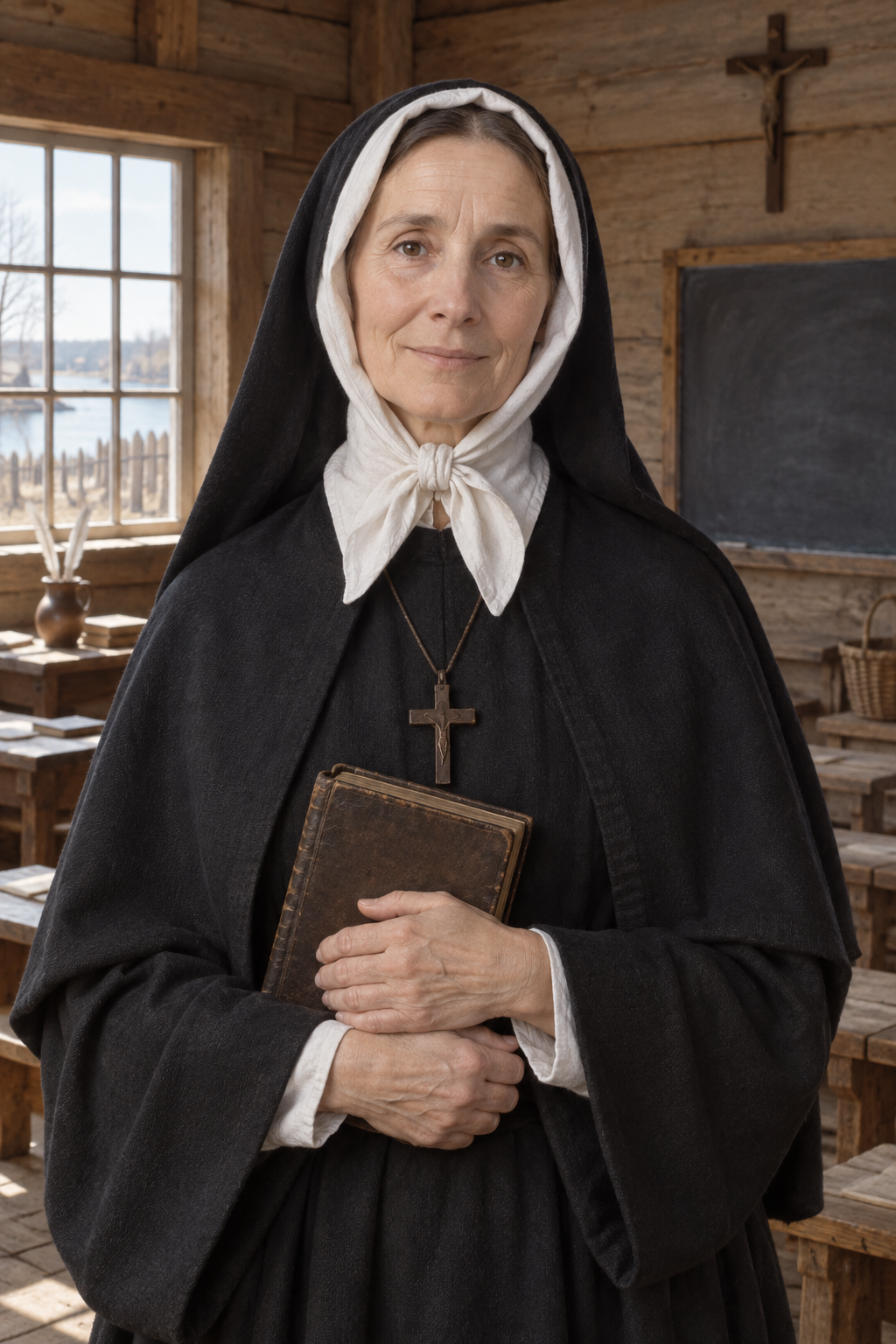
The first classroom was an abandoned stone stable given to her by the governor, Paul de Chomedey de Maisonneuve. Bourgeoys and the children cleaned it, and the school opened on April 30, 1658. Pupils were admitted without fees and learned reading, writing, arithmetic and manual work alongside Christian teaching. These were children of settlers who would need to support themselves and their families. Practical skills were therefore part of the education, not an activity separated from the classroom's purpose.
She returned to France to recruit companions, and their work gradually spread beyond Montreal. The women could travel because their community was not enclosed. They went singly or in pairs to smaller settlements for periods of teaching, including preparation for First Communion. Permanent schools followed in several places along the Saint Lawrence. Their work also reached Indigenous communities at the Mountain Mission and Sault Saint-Louis. The colonial authorities supported European-style education for Indigenous girls as a means of assimilation; that purpose should not be confused with an equal exchange between cultures.
Supporting free education required food, land and skilled labour. At Pointe-Saint-Charles, Bourgeoys obtained land and later bought a neighbouring farm. Catherine Crolo directed its cultivation and managed the harvests. The farm supplied the teaching sisters and welcomed women arriving from France to marry settlers. At the Providence workshop, girls learned to read and count, sew, prepare meals, process crops and care for gardens and animals. Bourgeoys's educational community thus depended on the work of farming sisters as well as classroom teachers.
Her attempts to secure the community's future involved repeated dealings with civil and church authorities. Royal letters patent gave it legal recognition in 1671. Later she faced pressure to merge her sisters with the Ursulines or accept enclosure. She and her companions resisted those arrangements, preserving the form of life their teaching required. When a fire killed two prospective successors in 1683, she resumed leadership, finally stepping down in 1693. The community received canonical approval in 1698, and she took the name Sister Marguerite of the Blessed Sacrament.
Her concern for women did not end when they married. John Paul II's account of her work recalls material assistance to families during shortages and epidemics, along with gatherings where women found companionship and religious instruction. It also emphasizes her preference for schools near families, accessible to parents rather than replacing their responsibilities. These activities placed education within the continuing life of a household. Learning, work and mutual support belonged together in the network she and her companions sustained.
In her spiritual testament, Bourgeoys described sisters ready to go wherever they were sent, travelling with few possessions and working so that others would not have to support them. She asked them to combine teaching with prayer and to offer an example through their conduct. This was a demanding account of common life, joining daily labour to religious purpose. It explains why mobility and self-support mattered to her community, and why enclosure was more than a question of where its members slept.
Bourgeoys died in Montreal in 1700. Her congregation continued its educational work, eventually extending beyond Canada. John Paul II canonized her in 1982. Her lasting contribution was an organized form of women's religious service able to go out to pupils and families while sustaining its own communal life.
Wondering how to weigh the stories and sources? Learn how to read a saint biography.
Explore similar vocations
Prayers for Marguerite Bourgeoys
Marguerite Bourgeoys: petition
la présence et l’amour du Verbe incarné.