Biography
Maria Bertilla Boscardin
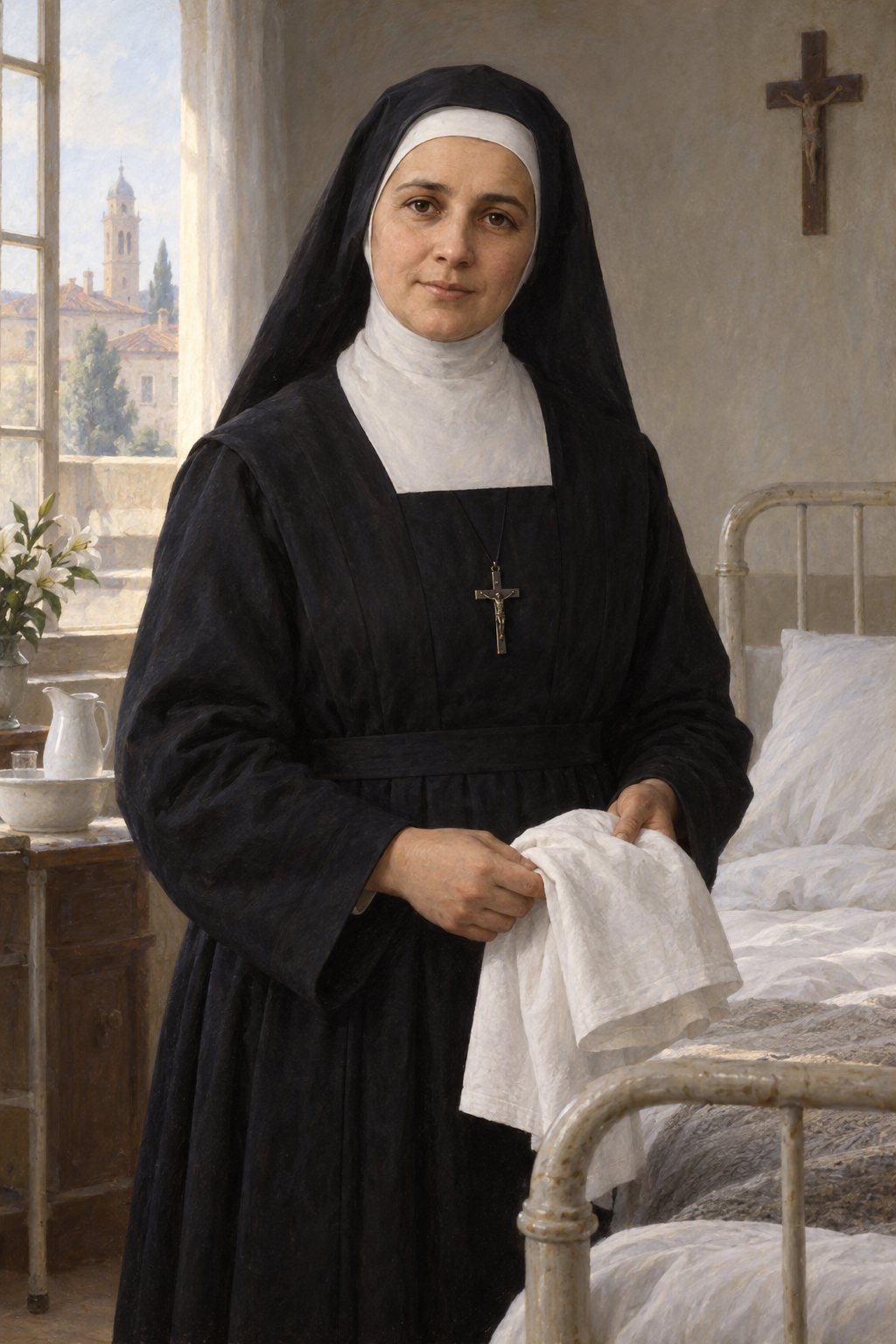
About Maria Bertilla Boscardin
Born Anna Francesca Boscardin in Brendola on 6 October 1888, Bertilla grew up in a farming household. The Dicastery recalls a catechism given by her parish priest, an account of her early religious education.
Anna entered the Sisters Teachers of Saint Dorothy, Daughters of the Sacred Hearts, at Vicenza on 8 April 1905. On 15 October she entered the novitiate and received the name Maria Bertilla. The congregation says the local priest had initially doubted whether she suited religious life. Such a judgment should not be made the whole story of her ability: the later hospital record shows that she learned work requiring attention and skill. After her first novitiate year she spent time at the Treviso hospital, and after profession on 8 December 1907 she returned there.
Her first regular assignment was in the kitchen. Hospital care depended on food, linens, cleaning and many kinds of labor that did not put a sister at the bedside. Bertilla performed these tasks before moving to direct care of patients. The move is significant because later memorial accounts sometimes reduce her to an image of effortless kindness. At Treviso she had to learn the rhythms of an institution and work with people who were ill and frightened. A brief Baltimore diocesan account says she trained as a nurse and later cared for children; it also remembers wartime care for injured soldiers. It does not supply enough detail to reconstruct every shift or ward assignment.
Local UNITALSI memory places her in a ward for children with diphtheria when another sister had to be replaced. The Treviso chapter quotes a doctor who remembered children separated from their families becoming calm in her company. It also credits her with preparing what physicians needed and easing anxiety during treatment. These are retrospective testimonies, not clinical outcome records, but they convey the demands of nursing in an isolation ward. Diphtheria could make breathing difficult; the children needed medical intervention as well as reassurance. Bertilla's service was practical and relational. The example is more precise than a generic claim that she loved the sick: she spent time with children in a ward where infection separated them from home.
Vatican News describes her studying for a nursing diploma to do her work better. It reports that the First World War brought a much heavier load for hospital staff from 1915 to 1918. She did not remain in Treviso without interruption. The account says she followed patients to other communities, including Brianza and Viggiù, and later returned. Local accounts connect the transfer to the danger after the Italian defeat at Caporetto in 1917. The available short biographies do not establish an exact itinerary or the number of wounded people she treated. They do show the hospital's work being disrupted by war and a nurse continuing her service in more than one place.
Pius XII recalled her wartime departure from Treviso in an address to pilgrims just after her beatification. He told them she took a worn catechism with her when she had to leave the patients she knew. The pope used this small book to speak about religious education and the daily formation of conscience. The story is part of the Church's memory of Bertilla, and the address is evidence of how her life was publicly presented in 1952. It should not obscure the hospital work that placed her near sick children and wounded soldiers. Her prayer and her nursing are both present in the records; neither needs an invented miracle to explain why the sisters and patients remembered her.
The Archdiocese of Granada recounts tension during the wartime transfer. Its account says a superior at Viggiù assigned Bertilla to laundry work for some months, and that the congregation's mother general later returned her to nursing. It names a military chaplain and officer who respected her efforts. Those particulars come from a later devotional biography rather than the hospital's personnel files, so they should not be used as a complete account of the dispute. The episode still shows that religious communities and hospitals made assignments through human judgment, including judgments that could be contested. A service life was not a sequence of unbroken praise. Bertilla's response is remembered through obedience and persistence in whichever task she was given.
She also faced serious illness. A 2022 address by a diocesan health-care chaplain says she spent roughly sixteen years in Treviso hospital service, apart from a wartime year at Viggiù, and died in the hospital on 20 October 1922 of a uterine tumor. The Treviso UNITALSI chapter places an earlier operation in 1910. These retrospective accounts do not provide a medical file from which to determine the exact course of treatment or a present-day pathological classification. The address directly supports Treviso as her death place. It does not justify filling a modern administrative hierarchy or claiming that her illness resulted from nursing. She was thirty-four when she died.
Her community remembered both her temperament and her resolve. A Vatican City State account calls her sometimes impulsive and subject to misunderstanding, while emphasizing her effort to govern herself. The congregation also preserves a spiritual program from a 1914 retreat, organized around Jesus as model and God as end. These are religious interpretations and self-descriptions, not measurements of medical performance. They matter because they complicate an overly smooth portrait of holiness: the sister being honored was a person with strong feeling, work obligations, illness and difficult relationships. The sources do not require readers to imagine her as incapable of fear or fatigue. Her significance in these accounts comes through a sustained response to ordinary duties.
Pius XII beatified Maria Bertilla on 8 June 1952. John XXIII canonized her on 11 May 1961. In his homily at the Vatican Basilica, John described her as a woman from the Veneto whose attentive care reached patients with contagious illnesses. He addressed people from Vicenza, where she was born, and Treviso, which he said received her last breath. This papal testimony supports the place of death, although the Dicastery's webpage has a separate, conflicting location label for the canonization ceremony. Her memorial falls on 20 October. The Catholic Church's judgment of sanctity concerns the whole course of her life; the historical narrative is clearest when it preserves the concrete work, dated transitions and limits of later recollection.
Wondering how to weigh the stories and sources? Learn how to read a saint biography.