Biography
Maria Crescentia Höss
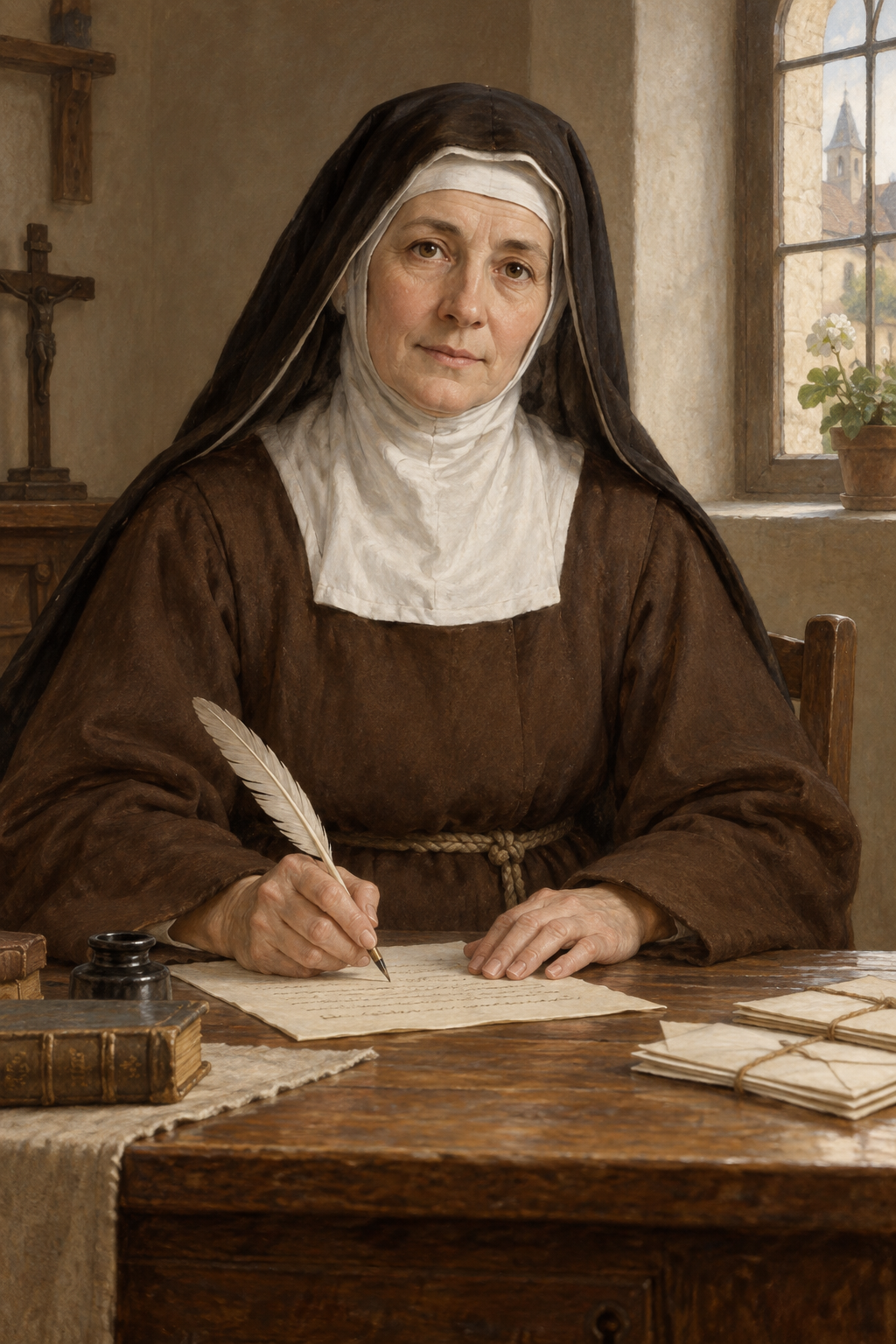
About Maria Crescentia Höss
Anna Höß was born in Kaufbeuren on 20 October 1682 to a wool weaver's family. Her family could not afford a convent dowry; church accounts remember help from the city's Protestant mayor.
The City of Kaufbeuren dates her entrance to 1703 and remembers the Protestant mayor's help in securing it. The town now maintains a memorial museum with objects associated with Crescentia. These are signs of her continuing civic presence as well as of Catholic devotion.
Her monastery offers a more detailed sequence. It dates Anna's entrance to June 1703 and says she took the name Maria Crescentia. She made lifelong vows on 18 June 1704 and worked in the kitchen and at a loom. The account describes resistance from a superior who judged the young woman for lacking a dowry. Such later narratives can sharpen a person's early hardships into a moral lesson, but they also preserve the social importance of class inside the convent. Crescentia's assigned work was familiar from her family trade. Before she was known as a counselor or superior, she belonged to a community sustained by cooking, weaving, shared rules and daily prayer.
By 1710, the monastery says, she served at the gate and cared for sick sisters. A gatekeeper met people from outside as well as members of the community; the role helps explain how her counsel became known beyond the cloister. In 1717 she became novice mistress and took responsibility for younger women entering religious life. The Diocese of Augsburg also remembers her as a formative influence on novices and describes severe early treatment within the convent. It includes a story of water remaining in a sieve, a familiar kind of hagiographic miracle tale. That story cannot be treated as a verifiable event. The dated offices and her long service at the gate provide a firmer account of her responsibilities.
The Bavarian State Library identifies Höß as a writer of religious songs, prayers, poems and letters. Some of those writings survive, alongside a substantial correspondence. The library lists people from different social positions among those seeking her advice, including clergy, religious and rulers. Writing gave a cloistered woman a voice beyond the monastery walls. Her letters were responses to particular needs rather than a program for public office. The library's account is also useful because it separates what can be examined, such as texts and known correspondents, from broad claims about mystical experience. The writings show that she was remembered for judgment and communication as well as for a reputation for sanctity.
One well documented strand of that correspondence concerns Clemens August, the elector and archbishop of Cologne. A publisher's description of Karl Pörnbacher's edition says a fatal duel involving someone at the elector's court gave rise to an exchange of letters with Crescentia. The full letters would be needed for a close reading of her advice, so the episode is best used as evidence that such a correspondence exists. The monastery places visits by Clemens August and the Bavarian electress Maria Amalia in 1731. Her relationships thus extended from ordinary petitioners at the gate to people with political and ecclesiastical power. Those connections did not make her a ruler; they made her counsel valuable to people with very different responsibilities.
Stories of visions also became part of her reputation. Art historian Peter Stoll studies a reported vision of the Holy Spirit as a young man and the images made from Crescentia's description. His analysis places that imagery within a longer Christian artistic tradition rather than treating every later picture as a direct record of what she saw. A painting made in 1728 and subsequent reproductions circulated her account, while church authorities later examined and restricted some depictions. The original painting was destroyed in 1928 in circumstances Stoll says remain unclear. These facts belong to the history of testimony, art and ecclesiastical judgment. They do not permit a historical writer to certify a supernatural event or reproduce its imagery as an established visual fact.
In June 1741 the sisters elected Crescentia superior. During her last three years she directed the community, whose members remembered her care, practical judgment and interest in music and art.
She died in Kaufbeuren on 5 April 1744. The city and convent continued to preserve her memory, and a flow of visitors to her grave became part of local religious life. The city museum now exhibits items linked to her, while the monastery church holds a shrine. These present-day sites are evidence for the continuing public history of her cult, not proof of every miracle later attributed to her. Leo XIII beatified her on 7 October 1900. The long interval between her death and that act also reminds us that canonization is a later Church judgment, not a contemporary job title she held. Her everyday work as a weaver, gatekeeper, novice mistress and superior can be described independently of that judgment.
John Paul II canonized Crescentia on 25 November 2001. In the homily he emphasized the way people sought her counsel, her patience under hardship and her generosity as superior. The next day he addressed pilgrims from Germany and described her importance to Kaufbeuren, Augsburg and the wider Church. These papal texts show how the Catholic Church interpreted her life at the time of canonization. Her memorial is kept on 5 April. A responsible historical account keeps both dimensions in view: a woman who wrote, advised and governed within an eighteenth-century Franciscan house, and a saint whose reported visions and later devotion were interpreted over centuries by readers, artists and Church authorities.
Wondering how to weigh the stories and sources? Learn how to read a saint biography.