Biography
Maria Crocifissa Di Rosa
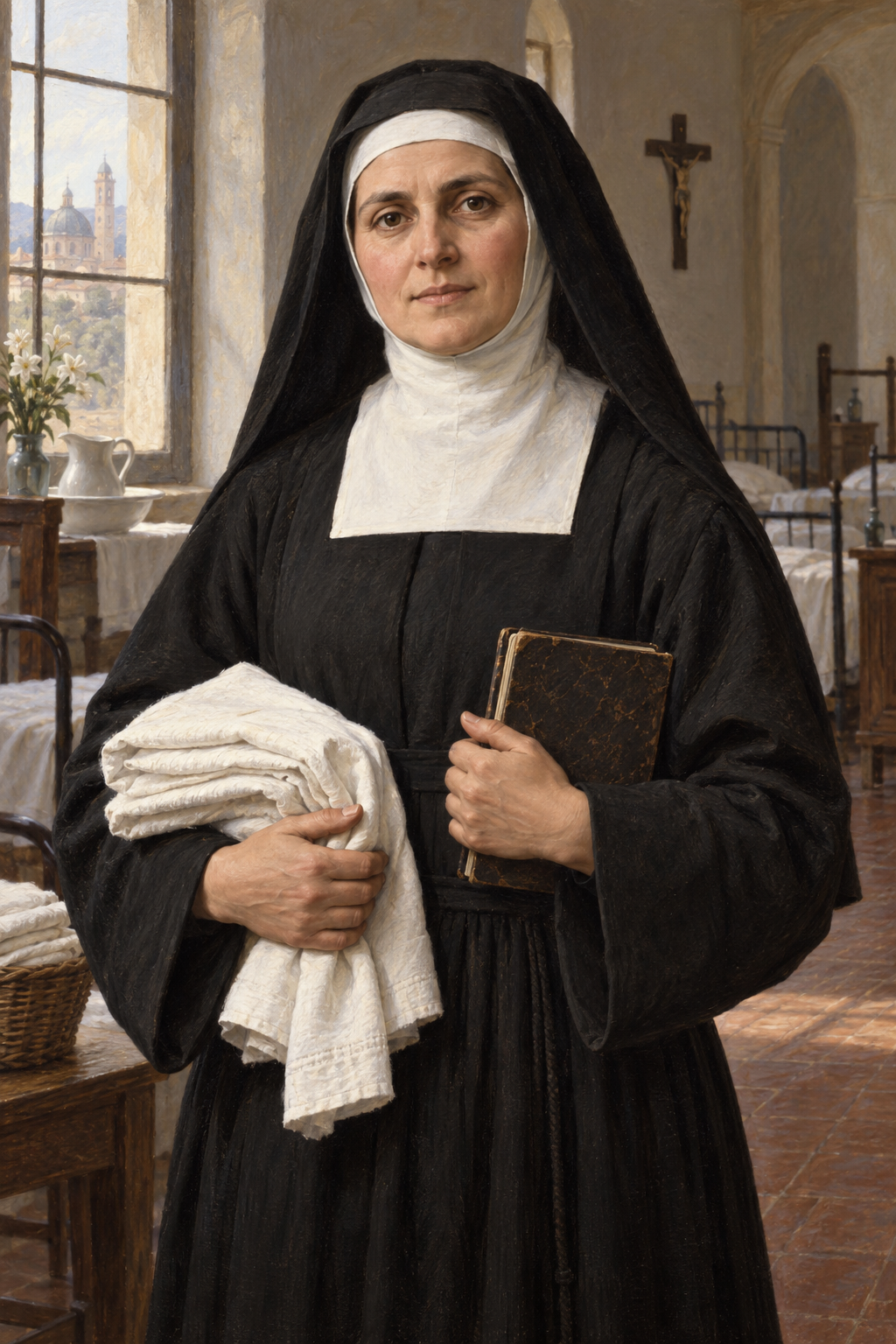
About Maria Crocifissa Di Rosa
Maria Crocifissa Di Rosa was born Paola Francesca Maria Di Rosa in Brescia on 6 November 1813. Her family belonged to the city's wealthy circles. She studied with the Visitation sisters after her mother died. The diocese remembers her later work among employees of her father's silk enterprise and among people sick with cholera. She used them for nursing, teaching and assistance to people with far fewer resources.
Returning home as a young woman, Di Rosa helped manage her father's household and attended to the women employed in his silk enterprise. She also organized instruction for girls in communities where the family owned property. The Italian bishops' account portrays her as practical in using family resources while attentive to workers' material and religious needs. Her early projects were varied rather than confined to a hospital: education, support for young women and visits to people in difficulty all became part of her work. That experience mattered when she later had to organize a lasting community.
Cholera struck Brescia in 1836. The local BeWeB history places a severe surge in June, when many residents had left the city if they could. Di Rosa went into the women's hospital to help those who remained ill. Her access to family money did not shield her from the epidemic's work; instead she chose a setting where the need for sustained care was immediate. The epidemic was also a public health crisis involving many patients, attendants and institutions, not a solitary act by one future saint.
The Brescia museum's public-history guide names Gabriella Echenos Bornati among Di Rosa's companions during the epidemic. Their shared service helped form the group from which a new association would grow. Di Rosa later looked back on 1836 as its beginning, although the formal hospital arrangement came four years later. Between those moments she and her companions also responded to the needs of deaf children, orphans and other people with little access to organized help. The community's origins therefore lie in repeated local work, not in a single ceremony detached from the city around it.
The Ancelle della Carità preserve an 1847 letter in which Di Rosa herself called the cholera response the institute's origin. Their foundation history also records a petition sent to the provincial authorities on 26 August 1839. Its signatories proposed caring for women admitted to the hospital and attending to their bodily and spiritual welfare. By then a plan had been worked out with Di Rosa's father, the priest Faustino Pinzoni and other women. On 18 May 1840 thirty-two women began organized service in the hospital, with Di Rosa as superior and Echenos Bornati as deputy. The petition and formal opening give firmer administrative markers than later accounts that collapse the epidemic and foundation into one date.
The agreement did not remove every difficulty. The hospital administration wanted the women under its direction, while the new association sought a distinct common life and role. The dispute lasted for years. Government recognition of the institute and its regulations in February 1843 eased the conflict, and a motherhouse opened that May in a building obtained with Clemente Di Rosa's support. Their expansion required more than personal resolve: it needed premises, rules, local permission and people prepared to carry the work beyond Brescia.
Education remained part of this wider effort. BeWeB describes a Brescia school for deaf children in 1839 and Di Rosa's concern for young women needing instruction and work. The nursing association gradually took the shape of a religious congregation, but its members served people in several circumstances. Some needed help in hospitals; others needed teaching or protection from destitution. This range helps explain why Di Rosa's initiative cannot be reduced to one epidemic. Her work joined practical care with religious commitment in places where existing institutions were stretched or unavailable.
During the political fighting of 1848 and 1849 the women cared for wounded people in Brescia's hospitals. After the Austrian repression, they also assisted people left hungry or sick. A later encyclopedia account says Di Rosa personally saved a hospital from destruction, but the historical study used here does not substantiate that dramatic episode. The documented service to the wounded is significant without it. Nursing in those years meant responding to sudden violence as well as recurring illness, while the community still had to maintain its daily obligations and negotiate its place in local institutions.
Rules for the sisters took shape over time. The Diocese of Brescia records final papal approval in 1851, more than a decade after the first formal hospital service. As the association became a congregation, it retained care for sick people at the center of its work while spreading to other settings. Legal and church recognition followed years of service rather than preceding it. Paola later received the habit and took the name Maria Crocifissa, the name by which she is remembered in the local liturgical calendar.
The congregation spread to other northern Italian towns and into Dalmatia during Di Rosa's lifetime. The *New Catholic Encyclopedia* emphasizes her ability to organize people and institutions, although some dramatic stories in that account need separate evidence. The women who staffed new houses carried out the work; the founder's task was to give them a durable way of living and serving together. She had also remained connected to care in Brescia, where a motherhouse provided continuity. Her influence is best traced through these organized services rather than through an unverified membership total or a single heroic anecdote.
Di Rosa fell seriously ill while at the Mantua house in November 1855 and was brought back to Brescia. She died there on 15 December, aged forty-two. The sisters continued the hospital and educational work she had helped build. Pius XII beatified her on 26 May 1940 and canonized her on 12 June 1954; the Dicastery lists her memorial on 15 December. Those recognitions are later church judgments on her life. The historical record shows a woman who turned an emergency response into a sustained institution and worked with others to make care available beyond one hospital.
Wondering how to weigh the stories and sources? Learn how to read a saint biography.