Biography
María Dolores Rodríguez Sopeña
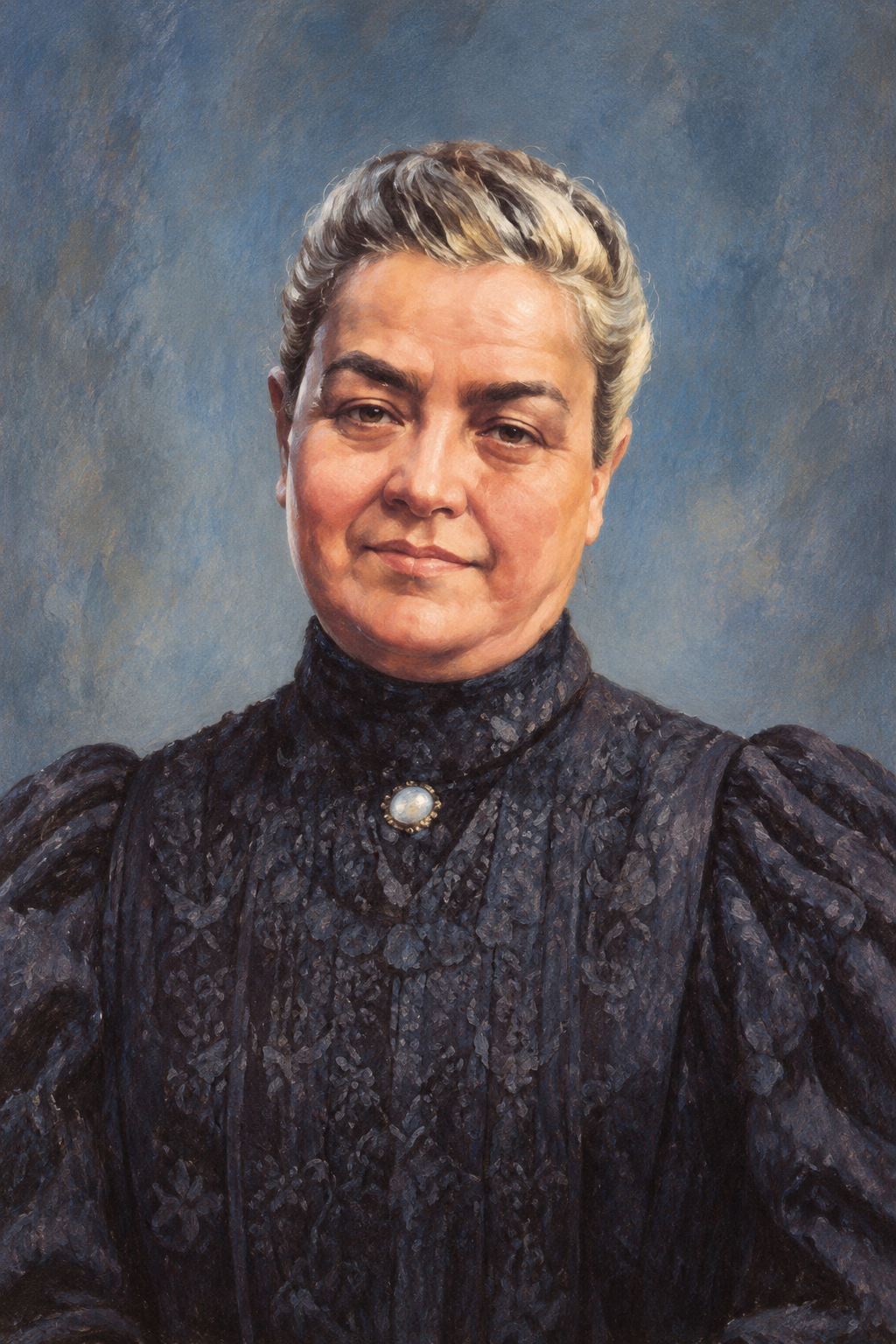
About María Dolores Rodríguez Sopeña
María Dolores Rodríguez Sopeña developed her educational work while moving between Spain and the Caribbean with her family. Born in Vélez Rubio, Almería, she began visiting sick and poor people before joining her father in Puerto Rico. There she organized a Marian association and schools combining literacy with Catholic instruction. Her family moved to Santiago de Cuba in 1873. Her poor eyesight prevented admission to the Sisters of Charity, but she continued visiting the military hospital and later established instruction centers.
The institute’s later narrative describes collaboration with Julia Puncet in Santiago. The two women visited poor neighborhoods and gathered residents for catechism. With assistance from Sopeña’s father, they obtained premises where reading, writing and arithmetic accompanied religious teaching. This account presents education and evangelization as inseparable aims. It also describes the Puerto Rican schools as serving Black women of different ages, within a society marked by racial divisions. These details survive here through an institutional narrative, rather than inspected school registers or contemporary reports.
After returning to Madrid, she combined care for her father with charitable work. She visited prisons, hospitals and poorer neighborhoods. Her efforts developed into a lay association and, in 1901, a religious institute. The sisters did not wear a religious habit, seeking to reach workers estranged from the Church.
Her Casa Social helped people navigate practical difficulties, including paperwork and employment. The institute’s narrative connects her work in Madrid’s Las Injurias neighborhood with a visit to a woman she had known in prison. Sopeña recruited collaborators and divided responsibilities as the work grew. Expansion also brought disagreements: some associates feared that her departure for Seville would weaken the Madrid organization. She eventually resigned its presidency and continued elsewhere. The account shows that building a lasting institution involved negotiation and separation as well as attracting volunteers.
Her relationship with the Jesuits brought help, but also disagreements. Historian Luis García Iglesias places her institute among women’s congregations shaped by Ignatian spirituality while remaining legally distinct from the Society of Jesus. He explains that Jesuit superiors sought to preserve their members’ freedom for other assignments, even when individual priests gave founders substantial assistance. In Sopeña’s case, Juan Crisóstomo Alonso and Félix López Soldado differed over the developing work. García Iglesias compares her account with the memoirs of Luis Martín, the Jesuit superior general: both record her meeting with Martín in Rome and the encouragement she received. The episode shows her seeking a hearing within church structures when advisers disagreed. Correspondence offered another means of sustaining guidance over a distance. García Iglesias identifies a collection of roughly 350 letters from the missionary Francisco de Paula Tarín to Sopeña.
Her autobiography, excerpted by historian José Gámez Martín, recalls hosting Ciriaco Sancha and Marcelo Spínola at Carmona in 1902, where the previously estranged church leaders embraced.
Her activity also had a sustained spiritual discipline behind it. In a study of her writings, Patricia Jacqueline Rivas Agurto emphasizes that prayer and community life supported Sopeña’s outward work. The study follows her concern to discern God’s will through retreat notes as well as accounts of institutional development. Notes from 1900 and 1902 express a desire to unite her choices with what she understood God to ask of her. Entries associated with illness in 1906 record the difficulty of missing planned spiritual exercises. Rivas interprets these passages as part of a developing willingness to accept circumstances she had not chosen. This is an interpretation of Sopeña’s religious experience, based on edited writings; it does not independently establish the divine origin of her decisions.
She died in Madrid on January 10, 1918.
John Paul II beatified her on March 23, 2003. His homily connected her mission with the world of work and identified three foundations: a lay movement, the catechetical institute and a social and cultural organization. It presented their common purpose as bringing people together through Christian faith and service.
A century after her death, the institutions she inspired described the continuing connection between education, faith and practical assistance. A March 2018 report by their adult-education coordinator, Sandra Salazar, set out programs combining vocational workshops, cultural activities, religious formation and solidarity projects. Examples included cooking, sewing and new technologies, taught by volunteers and paid staff. The report treated students as active participants in developing their abilities, rather than simply recipients of aid.
The same publication traced a later return to the Caribbean setting of her early work. Journalist Mercedes Ferrera Angelo described the catechists’ return to Santiago de Cuba in 1995 and the beginning of a mission in Guamá in 1997. Religious sisters and lay collaborators traveled to rural communities, sharing teaching and parish activities. These dated accounts concern later generations, not projects personally directed by Sopeña. They show how her combination of personal contact, learning and Catholic outreach continued to shape the work carried out in her name.
Wondering how to weigh the stories and sources? Learn how to read a saint biography.