Biography
Maria Domenica Mantovani
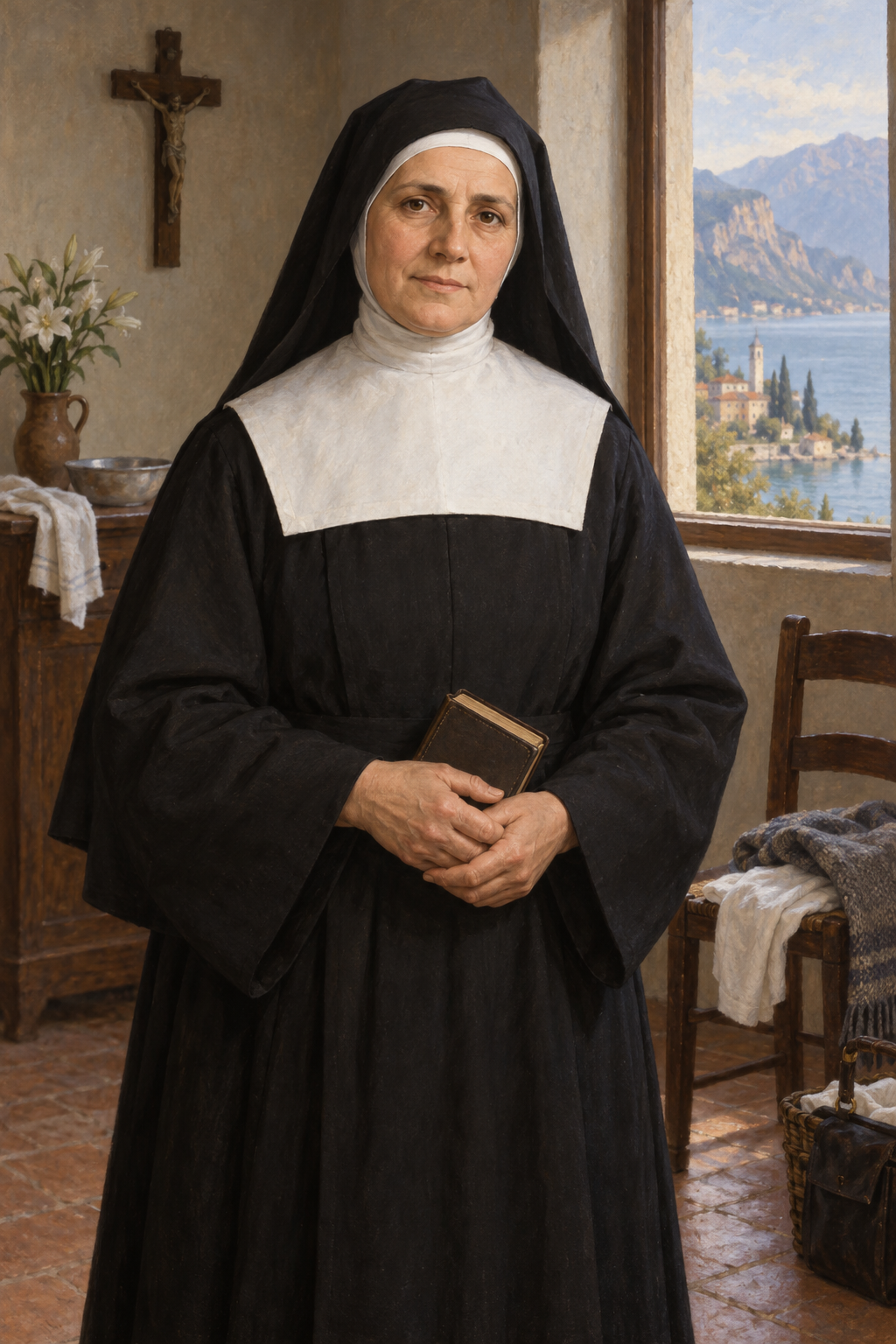
About Maria Domenica Mantovani
Maria Domenica Mantovani was born at Castelletto di Brenzone, a village on Lake Garda in the diocese of Verona, on 12 November 1862. She was the eldest of four children of Giovanni Battista Mantovani and Prudenza Zamperini. Her family had limited means, and her formal schooling ended after the elementary years. The diocesan archive emphasizes her upbringing in a household shaped by work and religious practice. Those circumstances did not give her advanced education, but they placed her within the village and parish where most of her later work would take place.
Giuseppe Nascimbeni arrived in Castelletto in 1877, as a teacher and parish assistant and later as pastor. The sisters' institutional history records Mantovani's work with him teaching catechism and visiting poor and sick neighbors. She was fifteen when the collaboration began. The visits brought the parish into households where illness or poverty made participation difficult. Mantovani's role grew through this practical service, rather than appearing suddenly when a religious institute was founded years later. It gave her knowledge of families the new sisters would serve.
On 8 December 1886 Mantovani made a private vow of perpetual virginity. The distinction matters: this was a personal commitment made before the sisters' formal community existed, not the profession of a congregation already founded. The *New Catholic Encyclopedia* describes her devotional life as centered on Mary and records Nascimbeni's spiritual guidance. Those relationships shaped her decision to enter a shared religious life. They also put her in a position to help other village women move from occasional parish service into a durable institution.
The need for a local institute grew from the work already being done in Castelletto. Nascimbeni sought women who could assist families, children, people without means and those who were ill. Mantovani accepted a leading part and became cofounder and first superior general. In his 1992 centenary address, John Paul II described the institute as arising from the pastor's effort to serve families in the spirit of the Holy Family of Nazareth. He explicitly named Mantovani as cofounder and first superior. That later address is an interpretation of the congregation's purpose, but it also confirms the church's recognition of her leadership.
The apostolic letter for her beatification dates Mantovani's religious clothing in Verona to 4 November 1892 with the other women of the new group. It says the community reached Castelletto the following day. The sisters themselves celebrate 6 November as their formal foundation, a date John Paul II also used when marking the centenary. The arrival and anniversary dates differ. A small group was formed in Verona, returned to Castelletto and began common parish service under Mantovani's direction.
The Little Sisters of the Holy Family call 6 November 1892 their foundation day at Castelletto. Their own history names Nascimbeni as founder and Mantovani as collaborator, cofounder and first superior general. The phrasing reflects distinct roles within a shared undertaking. Nascimbeni brought the pastoral plan and local authority; Mantovani organized the women and their daily life. The sisters' work reached beyond one age group. Parish teaching, care of sick and elderly people, and help for families required regular visits and trusted relationships. A permanent community made that service less dependent on the availability of any one volunteer.
Mantovani's circular letters show how much work lay behind her title of superior general. She wrote to sisters in the expanding houses about parish service, discipline, formation and the institute's rules. In 1932 she told them that Rome had approved the institute and its constitutions, then gave practical directions for reading and observing the new text. The letters reveal a leader who had to communicate decisions across separate communities and adapt shared practices to their work. They are her own words, though they do not by themselves establish how much of the original constitutions she drafted.
The New Catholic Encyclopedia's later supplement independently identifies Mantovani as cofounder and superior general, and recalls the early catechism teaching and sick visits encouraged by Nascimbeni. It is a concise reference rather than a diary of individual houses. Read alongside the Vatican records, it supports the broad outline of her role: preparation within the parish, leadership of a new religious family, and service to neighbors with limited resources. The institute did not spring from an isolated vision of charity. It grew from repeated tasks performed by Mantovani and other women in a particular village.
Nascimbeni died in 1922, leaving Mantovani to guide the congregation without its original priest founder. The papal letter for her beatification notes that she continued as superior general. Her leadership had already shaped the sisters' formation and rules. She tried to preserve the institute's purpose as it expanded. Later cause literature praises her prudence; her continued leadership is an institutional fact. The women serving in the new houses also carried responsibility for making the original commitments real.
In 1992 John Paul II addressed the sisters on the centenary of their 6 November foundation day. He named the range of people they had served over the century: children, older people, families in difficulty and the sick. Much of that later global work belonged to successors rather than directly to Mantovani, who died decades before the centenary. Still, the address shows how the institution remembered its founding purpose and its first superior. It should be used as a retrospective account of a developing congregation, not as proof that every later service already existed in 1892.
Mantovani died at the Castelletto motherhouse on 2 February 1934. John Paul II beatified her in 2003; Francis canonized her in 2022. The Dicastery lists 2 February as her memorial; older sources differ.
Wondering how to weigh the stories and sources? Learn how to read a saint biography.