Biography
Maria Domenica Mazzarello
About Maria Domenica Mazzarello
Maria Domenica Mazzarello was born on 9 May 1837 in Mornese, a farming community of the Monferrato hills in Piedmont. Her parents, Giuseppe Mazzarello and Maria Maddalena Calcagno, worked the land. She helped in the fields and at home, with little formal schooling. The number of children in the family differs between later accounts, so an exact figure is not needed to understand her place in a rural household. Work, religious practice and the responsibility of caring for others shaped the skills she later brought to a girls' workshop and a community of women teachers.
Grazia Loparco places Mazzarello's youth in a time of political unification and contested relations between the Italian state and Catholic institutions. Rural girls had fewer opportunities for schooling than boys, and new state rules gradually raised expectations for teachers and school facilities. These pressures affected women who wished to teach without the credentials or resources available in a city. Mazzarello's later institute grew in that world. Its sewing and school work addressed practical needs while also providing religious formation. Seeing the wider setting helps explain why a small local workroom could become a significant educational undertaking.
In the middle 1850s Mazzarello joined the Daughters of the Immaculate, a local association that gathered women for religious formation and service. The priest Domenico Pestarino guided her spiritual life. This association was distinct from the Salesian congregation founded in 1872. It gave Mazzarello a setting in which to learn cooperation and work with young people before Bosco chose her to lead the new institute. The distinction matters: a long period of local practice lay between her first association and her later public role as cofounder. The Mornese women's work was already under way when the Salesian plan took shape.
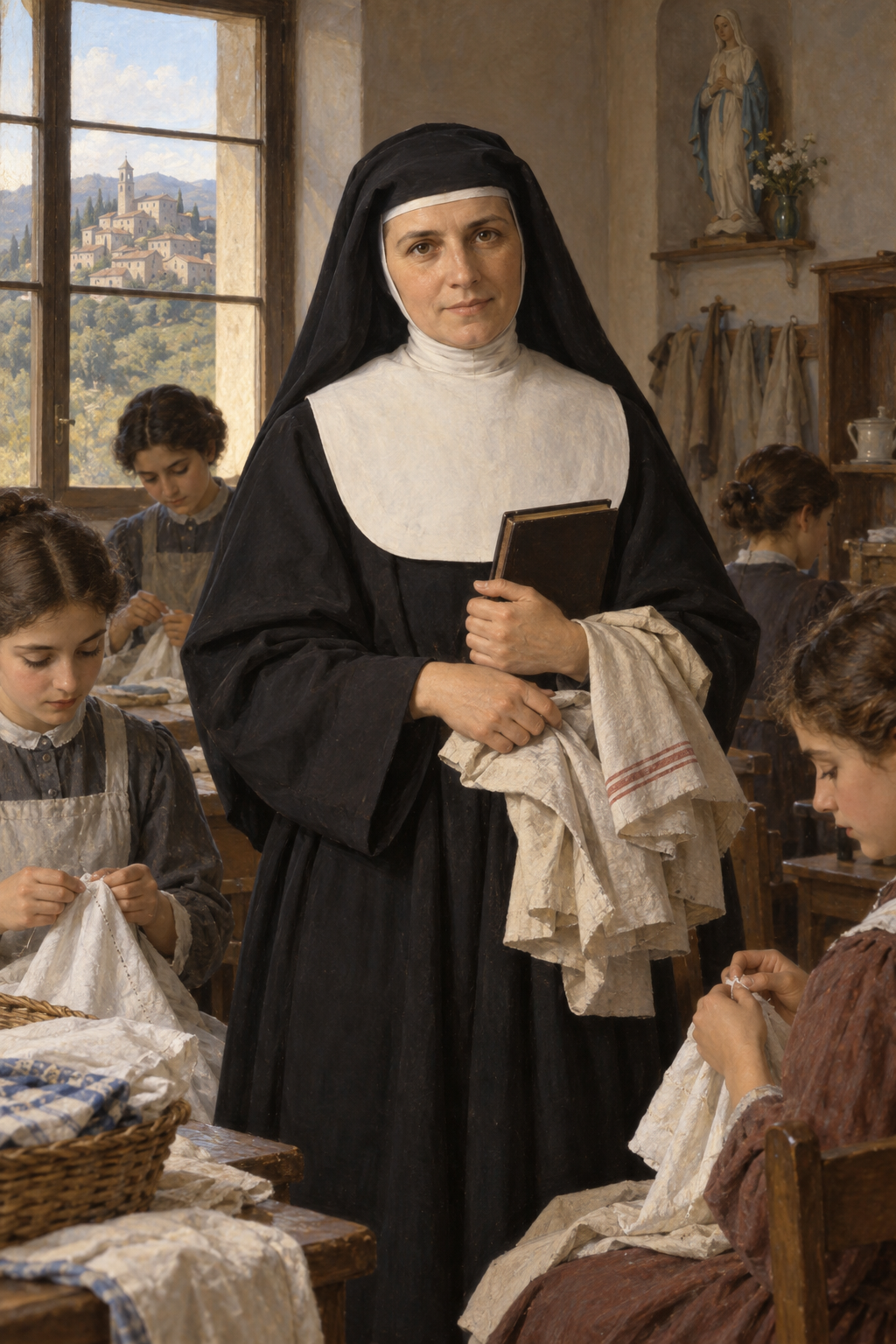
Typhus struck Mornese around 1860. Storca's study recounts Mazzarello's care for sick relatives and her own severe illness. Her weakened health made her former heavy field work difficult. She and her friend Petronilla Mazzarello turned toward learning and teaching sewing, opening a workroom for girls. The change was practical as well as spiritual: a woman unable to return to the same farm labor found a way to train younger women in a trade. Later stories supply dialogue around her choice, but the workroom and its growth are more securely documented than the exact words spoken there.
The workroom became more than a place to learn stitches. The congregation's account describes sewing instruction, a festive oratory and a home for girls without family support. Petronilla and other women joined Mazzarello in welcoming and teaching them. Its value lay partly in the skills the girls could use and partly in the relationships built around them. This educational work preceded John Bosco's decision to form a women's Salesian institute. The women's existing experience helps explain why the Mornese group was ready for a wider mission; their work had already taken practical shape in response to local girls' needs.
Bosco visited Mornese in October 1864 and saw the women's educational work. Salesian Missions dates the visit to that year, agreeing with the detailed Italian biographical record. He was considering a religious institute devoted to girls; Pestarino helped connect his plans to the existing Mornese group. Bosco provided a broader Salesian structure, but Mazzarello and her companions had already been instructing local girls. The meeting joined projects formed in different places. The new congregation would draw on Bosco's educational ideas while relying on women who knew the community and had practiced teaching within it.
On 5 August 1872, Mazzarello and ten companions received the habit and made their first vows as Daughters of Mary Help of Christians. The date marks the formal beginning of a congregation, but it did not erase the girls' earlier workroom or the local women's association. Mazzarello became the first leader of the sisters, while Bosco provided the institute's rule. The women taught girls, especially those from families with limited means, combining practical preparation with religious instruction. An educational purpose that had begun in a village could now be carried by a community with common commitments.
The *New Catholic Encyclopedia* describes Mazzarello as the first superior general and notes Bosco's role in drafting the institute's rule. It also records the shift from field work to sewing instruction. Its dates for Bosco's visit and the first overseas mission differ from more detailed local and historical accounts, so those two years are taken from the latter. The reference remains useful for a broad view of the new sisters' purpose: education of poor girls through a Salesian method. Mazzarello had to lead people, supervise houses and sustain a common spirit, even while learning skills that her own limited schooling had not given her.
The institute soon moved beyond Mornese. The sisters' local history records diocesan approval of constitutions in 1876 and a first departure toward Uruguay in 1877. The latter was an extension of the group's educational purpose, carried out by women Mazzarello had helped form. It should not be confused with later houses in Argentina or Patagonia, which arose at different times. New foundations also made training, letters and visits more important. A cofounder in a village had become responsible for sisters working across large distances, with the same concern for girls whose educational opportunities were limited.
The first sisters arrived at the Nizza Monferrato house in September 1878. Mazzarello herself settled there on 4 February 1879, when the new site became the congregation's motherhouse and administrative center. Its early work included an oratory and a workshop, followed by schools and teacher preparation. She visited communities and corresponded with sisters working away from the center. She died at Nizza on 14 May 1881, aged forty-four. Later growth belongs also to her successors. The earlier Mornese workroom and first professions remained the institute's point of origin even after the leadership moved to a different town.
Pius XI beatified Mazzarello on 20 November 1938 and Pius XII canonized her on 24 June 1951. The Dicastery records her memorial on 14 May, the date of her death; a Salesian proper uses 13 May. The 1951 canonization declaration mentions 14 May, supporting the current index's value. Later church recognition did not create the educational work for which she was remembered. That work began with women in Mornese and continued through the Daughters of Mary Help of Christians after Mazzarello's death.
Wondering how to weigh the stories and sources? Learn how to read a saint biography.