Biography
Maria Francesca di Gesù
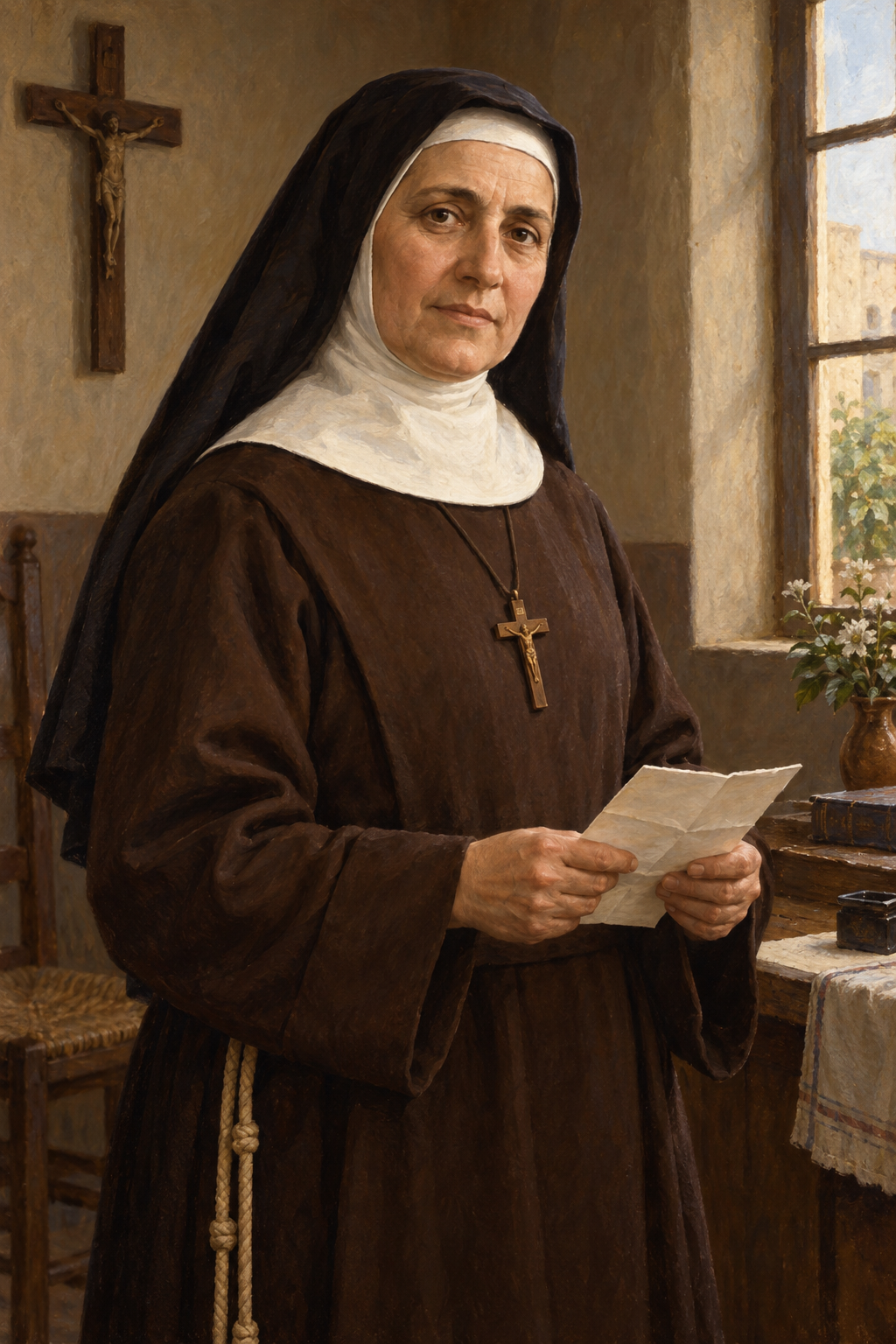
About Maria Francesca di Gesù
Anna Maria Rubatto was born on 14 February 1844 in Carmagnola, near Turin. Her father died when she was a child, and her mother died while Anna Maria was still young. She moved to Turin, where she spent years in the household of Marianna Scoffone. The *New Catholic Encyclopedia* describes her as having little formal education but considerable ability. She taught catechism, visited sick people at the Cottolengo and helped those in need. These were sustained commitments before she entered a religious institute.
The Uruguayan historian Mario Cayota places this period of lay service within the Catholic charitable life of nineteenth-century Turin. He connects her work among sick and poor people with the Cottolengo and the oratories associated with Don Bosco. His account helps explain why later sisters remembered Rubatto as a woman already practiced in service, rather than someone whose concern for others began at the foundation. Her role was practical: teaching, visiting and caring for people in institutions and neighborhoods. It also made her able to lead a new community when the invitation came.
In 1883 Rubatto was in Loano on the Ligurian coast. An account says she tended a worker injured at a building site, attracting the attention of a Capuchin friar who was looking for a leader for a women's community. The Vatican canonization booklet repeats the scene, but it is a later vocation narrative rather than a dated contemporary testimony available for independent checking. What can be said firmly is that Rubatto entered the developing Capuchin tertiary institute after a period of discernment. She took the religious name Maria Francesca di Gesù and became its first superior.
The institute began common life at Loano on 23 January 1885. Its early communities combined prayer with nursing, catechesis and other direct service. The Dicastery for the Causes of Saints records its spread to several Ligurian towns within a few years, including the Genoa area, Sanremo, Porto Maurizio and Levanto.
Accounts differ whether five or six women made up the first group, so the number remains unsettled. What matters to Rubatto's work is that she had to train sisters and hold together a growing community, while its houses responded to local requests.
The first move to South America came in 1892. The Archdiocese of Montevideo records that Rubatto arrived there with three other sisters on 24 May to care for poor immigrants at the Italian Hospital. Their work soon extended into homes, teaching and other institutions. Montevideo was a major center of Italian migration, so the sisters' language and nursing experience mattered to families far from home. Rubatto did not simply send a distant group of missionaries: she accompanied the first foundation and continued to visit communities on both sides of the Atlantic. Uruguay became central to her last years.
The congregation's archival house register records the sisters' direction of the Montevideo Italian Hospital in late May 1892. The register also includes many later foundations and episodes, which belong to the history of the institute after Rubatto's death and must not be attributed to her personally. During her own leadership, nursing was joined by work with children and families. The institutions needed administrators as well as bedside carers; Rubatto's service included choosing sisters, answering requests and maintaining links between houses. Her leadership thus took place in letters, journeys and daily decisions, as well as in the more visible act of opening a house.
Expansion also reached Argentina and Brazil. An account published by the Uruguayan bishops describes repeated Atlantic crossings and a network of houses established within two decades. Numbers vary among institutional accounts, so a single total would suggest more precision than the sources warrant. Travel in the 1890s took time and exposed a superior to separation from communities that depended on her. The geographic spread of the institute meant that local sisters had to carry responsibility, not merely wait for instructions from Italy. Rubatto's regular visits nevertheless held the communities in relationship with one another.
In 1899 the sisters opened a house at Alto Alegre in Maranhão, Brazil, alongside a Capuchin mission. A girls' boarding school became part of that project. Historian Maria Aparecida Corrêa Custódio finds in mission records and Tentehar testimony that the colony occupied land claimed by Indigenous families and that girls were separated from their relatives, sometimes against family wishes. Illness, coercion and punishment aggravated resentment. These findings make the setting more complex than the older religious story of a peaceful mission suddenly attacked without cause. They also require attention to the Tentehar as historical actors with families, land and political aims.
On 13 March 1901 a Tentehar uprising destroyed the Alto Alegre colony. Seven of Rubatto's sisters died, along with friars, other residents and Indigenous people. A later Vatican account gives a precise count of non-Indigenous victims; a scholarly review of Mércio Pereira Gomes's history records deaths and subsequent militia repression. Sousa and Pereira's interviews with Tentehar descendants show that the Catholic account is not the only memory of what happened. The sisters' deaths were a grave loss for Rubatto and her institute, but the conflict cannot be told responsibly by erasing Indigenous families' experience or reducing their actions to alleged outside incitement.
John Paul II addressed the congregation in 2002 and cited letters attributed to Rubatto, including a message to novices about joyful service and another describing missionary work as a grace to the community. His address shows how the sisters understood their founder's spirituality a century after her death: prayer and Eucharistic devotion joined to nursing, education and care for people often overlooked. This is a later church reading of her life, but the quoted letters give a glimpse of the instructions she offered to her own sisters. It is possible to describe her religious purpose without treating every later anecdote as a documentary fact.
Rubatto undertook a final voyage from Genoa to Montevideo in 1902. The intended visit lasted much longer than expected, and she died in Montevideo on 6 August 1904. The place of death reflects a life divided between her Italian foundations and the South American communities she helped establish. It also explains why Uruguay remembers her as part of its own Catholic history, despite her Italian birth. The congregation continued after her death, carrying forward hospitals, schools and other works through the labor of its sisters rather than through the founder alone.
The Catholic Church beatified her on 10 October 1993, during John Paul II's pontificate, and Francis canonized her on 15 May 2022. These official recognitions concern Rubatto's life and the cult that developed around it; they do not resolve the historical dispute over Alto Alegre. A careful remembrance holds together her long service to poor and sick people, her work as the first superior of a community of women, and the need to tell the mission's Brazilian history with the Tentehar perspective present.
Wondering how to weigh the stories and sources? Learn how to read a saint biography.