Biography
Maria Giuseppa Rossello
About Maria Giuseppa Rossello
Benedetta Rossello was born on 27 May 1811 at Albissola Marina, near Savona on the Ligurian coast. Her parents, Bartolomeo Rossello and Maria Dedone, made pottery. As a girl she learned to work with clay and helped care for younger children. The family's modest means placed work and household responsibility close to her daily life. Later biographies disagree about the number of children, so no exact count is needed. Her training was practical rather than designed for an institutional career. Those beginnings help explain why the school and charitable houses she later directed remained concerned with useful skills and with people whose families could not easily pay for care.
Rossello joined a Franciscan lay association while still young. She then spent years as a domestic worker and nurse, serving within a private household before any congregation bore her name. The *New Catholic Encyclopedia* describes this period as one of charitable work and places her later foundation within a concern for girls who had few sources of support. Her path into leadership was gradual. Care for an individual sick person demanded steadiness and close attention; founding schools would demand those habits on a different scale. The record does not require a story of instant certainty about her future. It shows work, a developing religious commitment and relationships that eventually made a shared project possible.
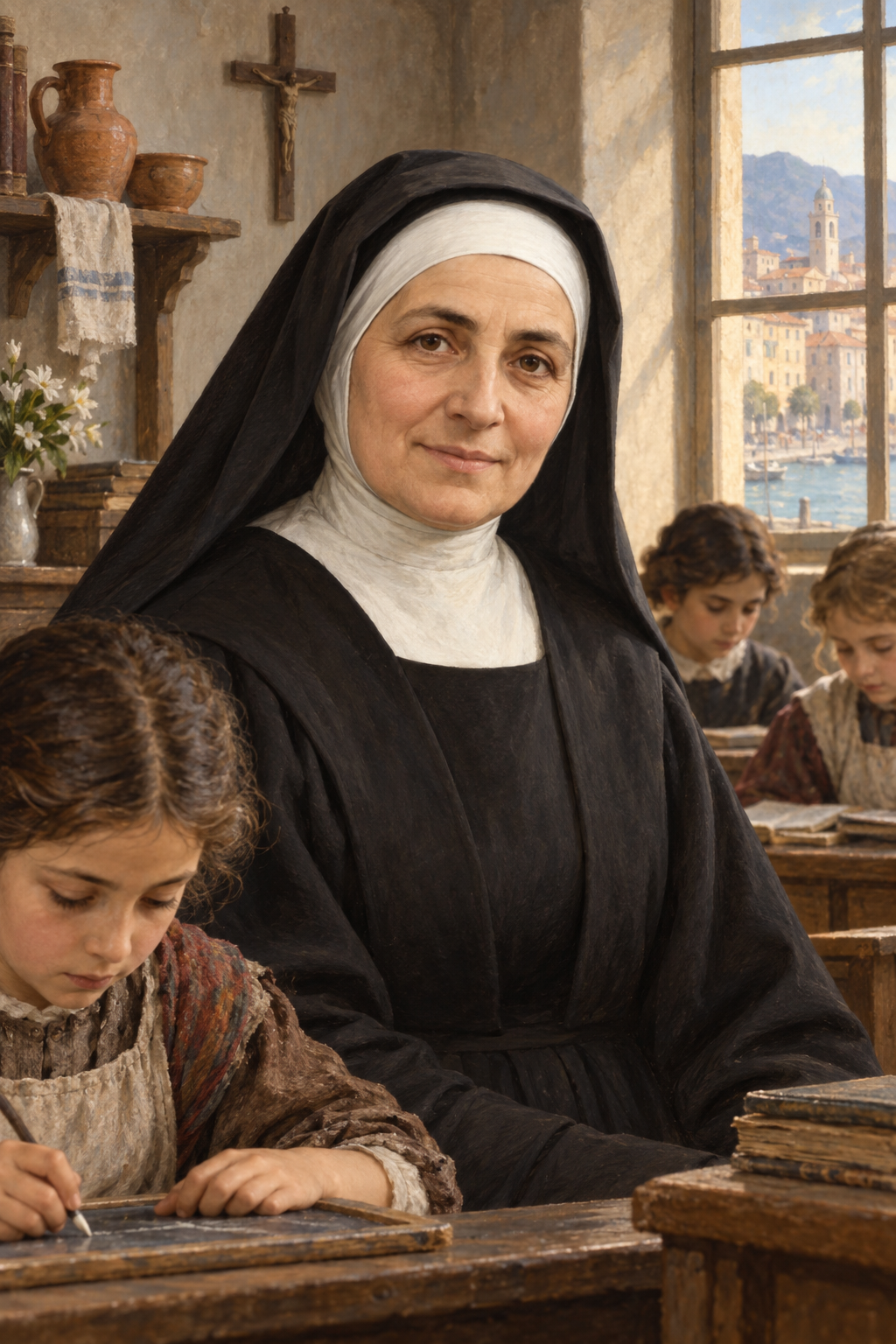
In 1837 Bishop Agostino Maria De Mari of Savona wanted care and instruction for poor girls. Rossello responded with three companions: Angela and Domenica Pescio and Paolina Barla. On 10 August they began in a rented house associated with the former commandery of the Knights of Malta.
Their resources were limited, and the work required teaching as well as organization. Rossello was given responsibility for novices, finances and support of the community, while Angela Pescio first served as superior. The foundation therefore grew through several women's labor and the bishop's sponsorship. It was neither a school built by Rossello alone nor simply an institution handed to her already complete.
On 22 October 1837 Benedetta received the religious habit and the name Maria Giuseppa. The new institute was called the Daughters of Our Lady of Mercy. Its early purpose joined education for girls with attention to sick people. Rossello and six companions made permanent vows on 2 August 1839; she became the sisters' superior the following year and continued in that leadership until her death. The first school and the later vows were distinct steps. As other women joined, the community needed places to teach and sisters able to carry out its care. The foundation grew through shared work over time, rather than through a single ceremony that settled every aspect of its future.
The sisters' work spread through Liguria as schools for girls and forms of nursing became part of their daily service. Their aim was to offer poor children education that families might otherwise struggle to obtain. The *Enciclopedia Cattolica* also records Rossello's help for priests engaged in redeeming girls from slavery on the African coast. The account does not place her in Africa; it describes cooperation in a network of people who carried out different parts of that work. The girls' histories were not one uniform story, and this brief record does not justify inventing what each experienced. Rossello's contribution was to make room for care and learning within an expanding institute.
The institute's account looks back on schools for girls in Savona and later work with poor young women, people who were sick, and children who needed protection. Its present activities cannot be projected unchanged into Rossello's lifetime. They do show how her early purpose was understood by successors: mercy was expressed through teaching and practical care. Each new house would require space, teachers or nurses, and leaders able to hold the community together. The first school was a local response to poverty; the work grew as more sisters joined and took responsibility in other settings. Rossello's role included preparing people for those tasks, beyond the public fact of founding a congregation.
Expansion eventually crossed the Atlantic. The institute's history dates the departure of fifteen sisters from Genoa to 14 November 1875, with their arrival at Buenos Aires about a month later. Rossello remained in Italy, directing women who would work far from Savona. Their journey marked a new stage for a congregation that had begun with local schools. The sisters would have to learn the needs of the communities they entered and maintain ties with their leader across a long distance. The record of their departure establishes a specific moment without requiring every later house to be assigned the same opening date.
Rossello's letter to the sisters in the Americas, dated Savona on 19 July 1880, shows how she tried to lead at a distance. She urged mutual care within the community, patience with one another's faults, and steady attention to the people they served. She referred to the sisters' ocean voyage and to their work beside sickbeds and children. The institute says the text survives only as a typescript copy, so its published wording should be handled with care. Even with that limit, the letter makes her priorities visible: distant houses were to remain connected by relationships and by practical service, not only by rules issued from Savona.
Rossello died in 1880, leaving a congregation that had moved far beyond its first rented rooms. Later approval of its constitutions and further expansion belonged to the generations that followed. Her cause proceeded in the twentieth century: Pius XI recognized heroic virtues in 1936 and beatified her on 6 November 1938; Pius XII canonized her on 12 June 1949. Those decisions belong to the Catholic Church's later assessment of her life. They should not obscure the earlier work of the women who opened the Savona school and sustained its service. The community's continued education and care give a concrete reason for remembering its founder.
When John Paul II addressed the Daughters of Our Lady of Mercy in 1998, he located their foundation in Savona and spoke of mercy as the institute's continuing purpose. His speech is evidence for how later members understood their tradition, rather than a source for every event in Rossello's lifetime. The distinction matters because her work was carried on and changed by successors in new countries. Rossello's own record is more concrete: a woman trained in household and craft work helped open a school, directed sisters and sustained correspondence with them across an ocean. The institute's later reach began with that small, demanding work in nineteenth-century Liguria.
Wondering how to weigh the stories and sources? Learn how to read a saint biography.