Biography
Maria Goretti
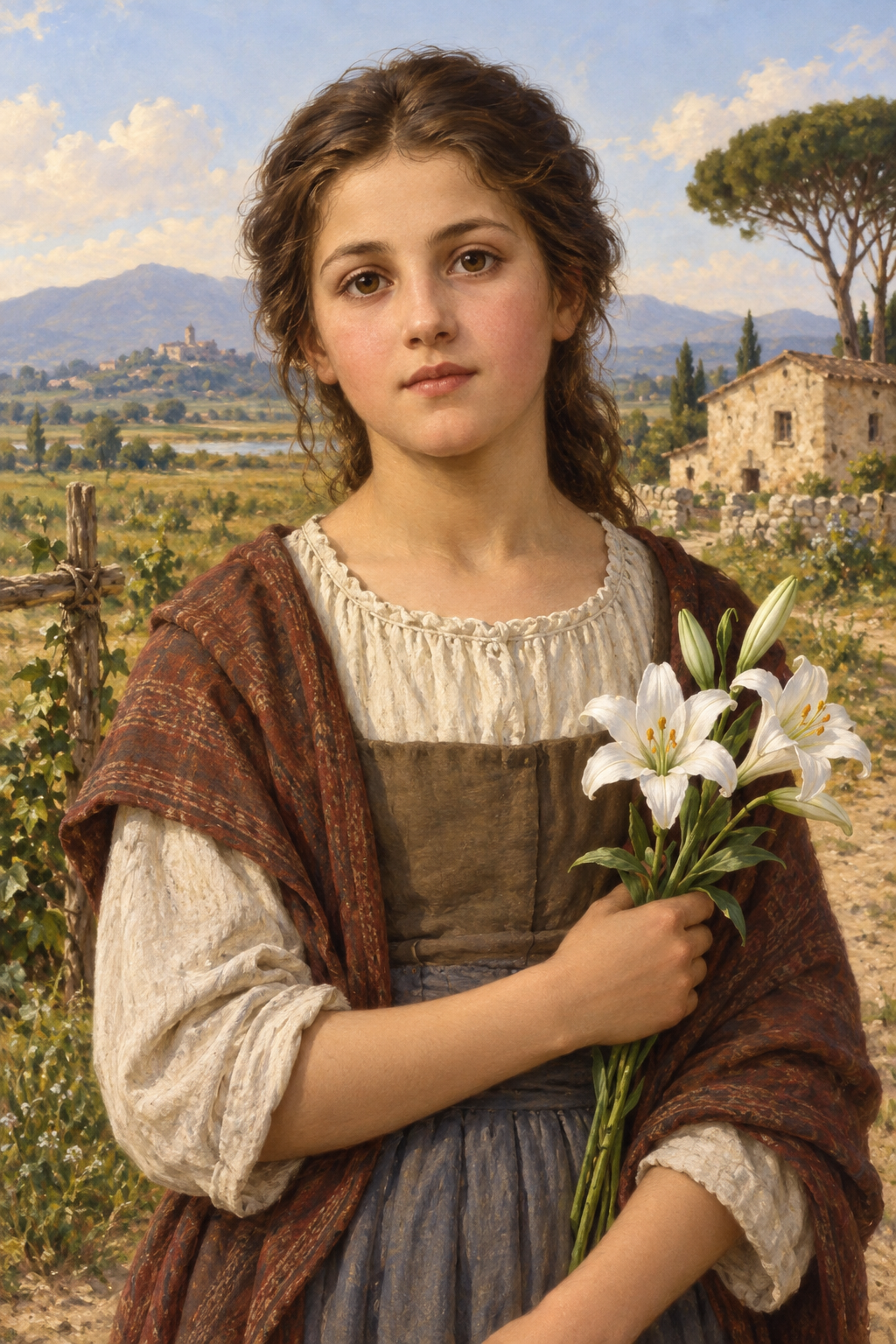
About Maria Goretti
Maria Teresa Goretti was born at Corinaldo in the Marche on 16 October 1890, the second child of Luigi Goretti and Assunta Carlini. The family were agricultural labourers. Poverty led them south first to the area around Paliano and later to Ferriere di Conca, in the Pontine plain near Nettuno. The move was part of a search for work, not a pilgrimage or a planned religious career. Maria grew up in a household where children shared domestic and farm responsibilities.
Luigi died of malaria in 1900, leaving Assunta to support the family. Maria helped care for younger children and assisted with ordinary household work while her mother laboured. The family shared a converted farm building with the Serenelli family. Their son Alessandro was an adult neighbour who made repeated sexual advances toward Maria. The surviving record should be stated plainly: on 5 July 1902 he attempted to assault her, she resisted, and he stabbed her. This was violence against a child; it was not a devotional trial that excuses the attacker or turns the assault into an ideal for victims.
Maria was carried to the hospital at Nettuno. She died there on 6 July from the wounds. Accounts preserved in the canonization tradition say that she forgave Alessandro and hoped for his conversion. That testimony became central to the later presentation of her as a martyr whose forgiveness did not deny the seriousness of the crime. The record does not require repeating graphic descriptions of the attack.
The Catholic Church opened a cause for her beatification in the twentieth century. Pius XII beatified Maria on 27 April 1947 and canonized her on 24 June 1950 in St Peter’s Square. Her mother Assunta attended the canonization, an event that made Maria’s family part of the public memory of the ceremony. The official tradition calls Maria a virgin and martyr and celebrates her liturgical memorial on 6 July.
Later biographies and devotional works shaped her image as a model of purity. Modern editorial treatment must distinguish that language from the historical facts. Maria’s age, poverty, and vulnerability matter. Her death must not be presented as proof that a victim should endure abuse silently, nor should forgiveness be confused with the removal of accountability. The record supports a child’s resistance to coercion and a reported decision to forgive; it does not support romanticizing sexual violence.
Maria Goretti’s memory also developed through the shrine at Nettuno and through the international spread of her name. A responsible account recognizes both the strength of that devotion and the critical history of how the killing was interpreted. She remains significant to Christians who see in her story a witness to human dignity, courage under threat, and mercy that does not erase justice.
Wondering how to weigh the stories and sources? Learn how to read a saint biography.