Biography
María Guadalupe García Zavala
About María Guadalupe García Zavala
Anastasia Guadalupe García Zavala was born on 27 April 1878 in Zapopan, Jalisco, to Fortino García and Refugio Zavala. Her father sold religious articles near the town's basilica, and the family had enough means to provide a stable childhood. The later name Madre Lupita belongs to her religious life. Brian Stauffer's study places her upbringing among lay and religious networks of western Mexico, where Catholic charities developed during the late Porfirian period. A maternal aunt, Librada Orozco, founded a Franciscan women's community and was part of that world. García Zavala's later nursing work grew within this local setting, not in an institution isolated from the city's other charitable projects.
Her family moved to Guadalajara when she was young. There she joined the Conference of Blessed Margaret in 1898, a lay association connected with the Saint Vincent de Paul tradition of visiting people in need. She had been engaged to Gustavo Arreola, but chose religious life and work with poor and sick people. Isabel Orellana's account also notes her aunt's place in her early religious formation. The record supports a choice made in the context of family, courtship and volunteer service; it does not require an invented scene of sudden revelation. The charity conference gave her an early way to see the needs of people who would later come to the hospital.
The priest Cipriano Íñiguez Martín del Campo shared her concern for the sick. Together they formed the Handmaids of Saint Margaret Mary and the Poor in Guadalajara in 1901.
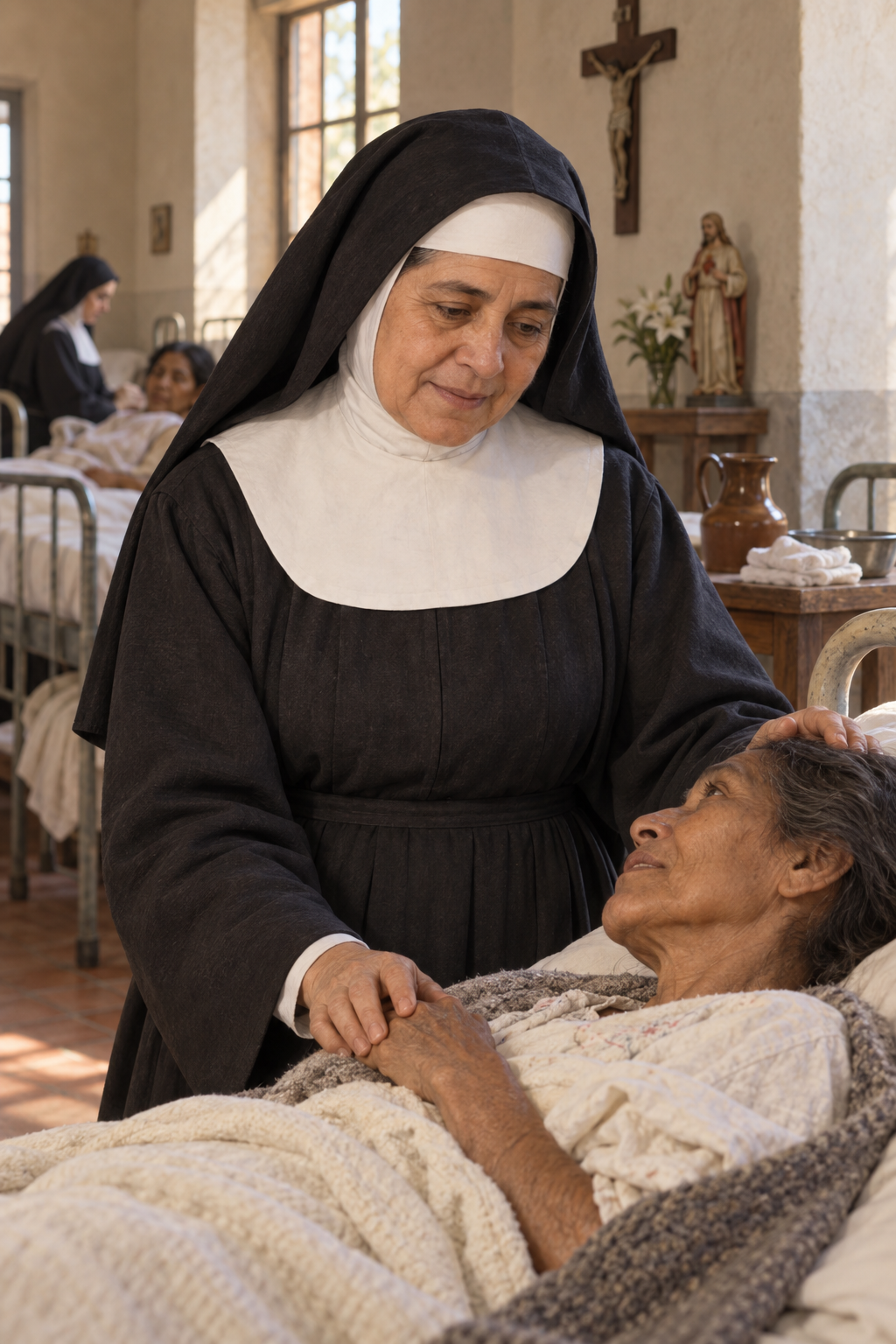
García Zavala worked as a nurse and later led the sisters at the hospital. Sisters who knew her recalled that she visited patients even when confined to a wheelchair and taught the community to put their care first. Her leadership joined bedside work with the daily task of keeping that care available.
Guadalajara had other Catholic works for sick and poor people before the sisters' community formed. An archdiocesan history describes hospitals and lay groups in several neighborhoods, then places García Zavala and Íñiguez in the development of the hospital later called Santa Margarita. It also recalls the earlier work of the priest José Salomé Gutiérrez Cornejo in that setting. The context helps keep the story proportionate: García Zavala was a cofounder whose decisions mattered greatly, but she and Íñiguez were building within a larger charitable network. The hospital was a real place of beds, staff and patients, sustained by many hands rather than by one person's reputation.
Stauffer's study follows the congregation through the Mexican Revolution and later conflicts. It records a first chapel in 1907 and a turn toward formal nursing instruction in the 1930s. Sisters who had learned at bedsides began receiving training through a nursing school. That change could improve care while the hospital continued to serve poor patients. The study contains errors about García Zavala's later canonization, so its account of institutional development is read alongside official church records and is not used for her life dates.
Religious conflict intensified in Jalisco during the 1920s. Orellana's history records that García Zavala and her sisters sheltered clergy, including Archbishop Francisco Orozco y Jiménez, within the hospital. They also fed and treated soldiers who opposed the Church. One action protected people from arrest; the other gave medical help to adversaries. Both occurred in a place whose first duty was care for the sick. Later retellings include dramatic dialogue, but the hospital work is substantial without it. The sisters made these decisions amid coercion and danger.
Francis's later canonization letter also records the shelter given to priests and the archbishop and the care extended to wounded soldiers. It notes that the Guadalajara archdiocese approved the congregation in 1935 and that García Zavala served as its superior general. Institutional recognition did not itself supply food, medicine or trained hands; the sisters still had to make a workable hospital from limited means. The same letter recalls that García Zavala chose a spare life despite her more comfortable family background. These details connect her religious commitments with everyday choices about money and labor. They do not prove every anecdote told about the conflict, and the letter's own chronology has a few errors requiring comparison with contemporary records.
At her beatification in Rome on 25 April 2004, John Paul II recalled that García Zavala had given up marriage to serve poor and sick people. He connected her work with the congregation she founded and the spiritual tradition of the Sacred Heart. His homily gives direct evidence for the date and nature of the ceremony, although it is a later assessment of her life rather than a witness to each day in the early hospital. The pope summarized a pattern that the documented history also shows: personal service became a shared institution, and the sisters continued to serve patients over many decades. Her former engagement is part of that story, without making marriage and charity opposing callings for everyone.
García Zavala died in Guadalajara on 24 June 1963, after illness in her final years. Sisters who knew her remembered taking turns caring for her in her final days.
The congregation had opened eleven Mexican houses during her lifetime; later international expansion also belonged to the sisters who followed her.
John Paul II beatified her on 25 April 2004.
Francis canonized her on 12 May 2013. These recognitions express the Catholic Church's assessment of a life of care for poor and sick people. Her years of nursing and leadership gave the Guadalajara hospital its lasting public shape.
At the 2013 canonization, Francis spoke of García Zavala kneeling beside people who were sick and abandoned. His homily interprets that posture as service offered with tenderness, not as proof of every story subsequently attached to her name. The enduring picture is practical: a nurse and superior working among patients, sisters who kept the hospital operating, and a community that served across a period of profound political change. The congregation's present description still places service to people in need at the center of its identity. García Zavala matters because the hospital work she helped establish made sustained care possible for people whose poverty could otherwise leave them without it.
Wondering how to weigh the stories and sources? Learn how to read a saint biography.