Biography
María Soledad Torres y Acosta
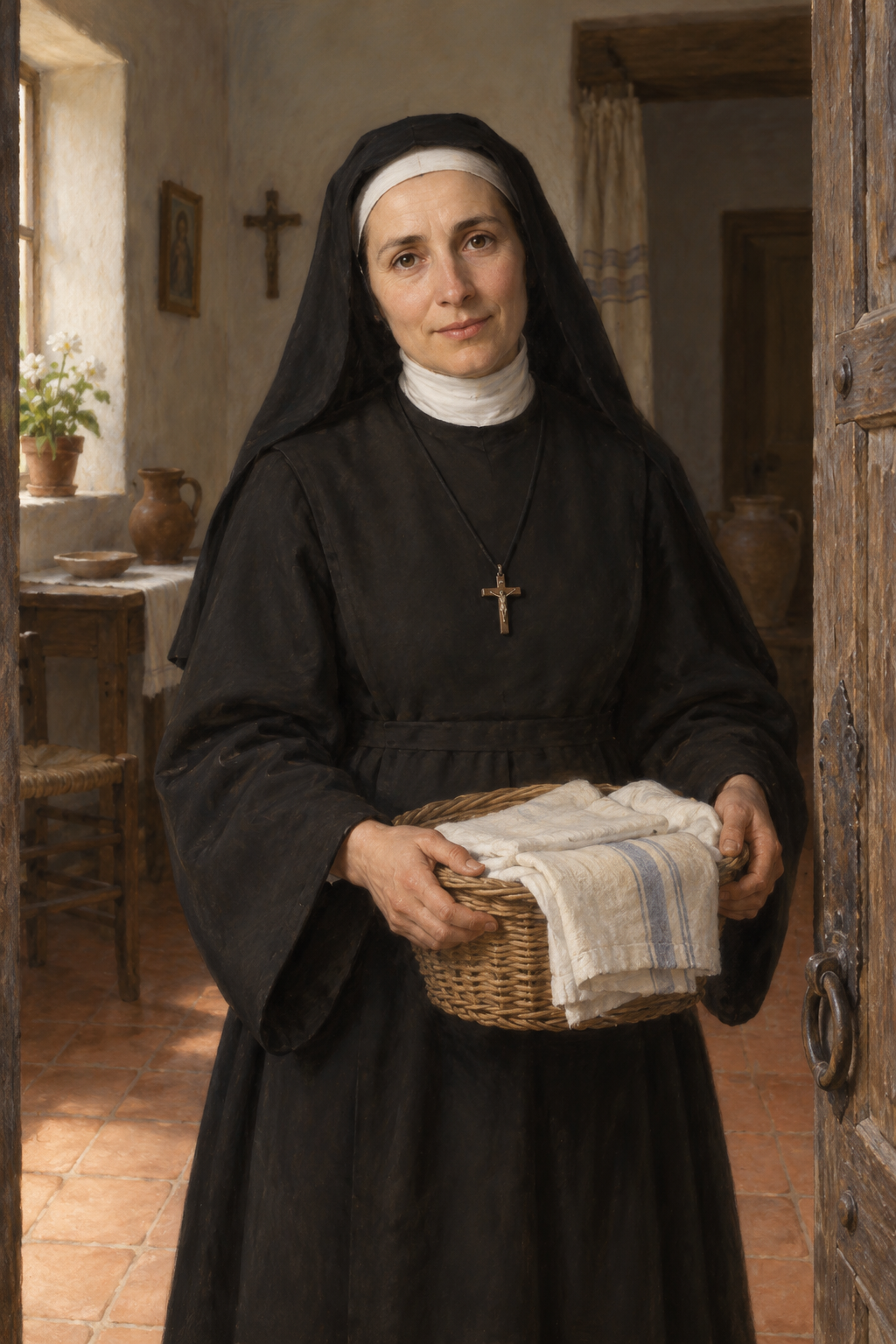
About María Soledad Torres y Acosta
María Soledad Torres y Acosta was born at Madrid on December 2, 1826, and given the baptismal names Bibiana Antonia Manuela. Her family called her Manuelita. Her parents kept a small business, and she grew up in a modest neighborhood. She attended a school run by the Daughters of Charity. Visits with an aunt to a Dominican convent encouraged her interest in religious life, although the enclosed community she first considered did not become her home.
Her vocation took a different direction through Miguel Martínez y Sanz, a priest concerned about sick people neglected in the homes of his Madrid parish. He gathered women to undertake their care. On August 15, 1851, seven made religious commitments and received the habit of the new community. Manuela took the name María Soledad, expressing her devotion to Mary in sorrow. A life she had once imagined within a convent was now directed toward people who needed care at home.
The first years brought both useful work and uncertainty about the community’s future. The congregation’s regional history records that Soledad assumed leadership after Martínez left for missionary work. A new parish priest removed her from office and sent her to Getafe. She returned to Madrid as superior in 1857 with support from Gabino Sánchez. The interruption was a substantial trial for a young community still trying to establish a stable religious life around its service to sick people.
At the first general chapter in 1861, the sisters elected her superior general. Foundations extended the work to other Spanish cities, and papal approval followed in 1876. In 1875 sisters went to Santiago de Cuba, the first foundation overseas. Havana and Puerto Rico followed during her lifetime. The expansion required the same balance as the original work in Madrid: a shared religious household had to support women whose duties regularly took them outside it and into the needs of other families.
The congregation’s account of the cholera epidemic of 1885 shows the pressure this service could involve. Requests for assistance multiplied as the disease spread. Soledad gave out clothing, food and the little money available in the convent. She and several sisters rested on mattresses near the entrance so that urgent calls could be answered at night. The arrangement also provided somewhere for sisters returning late to rest before they were needed again.
She was attentive to the sisters’ return from their visits, opening the door, listening to their concerns and looking after their need for rest. The same biography describes practical instructions concerning food, symptoms and treatment during the epidemic. She urged energy and charity, allowing the urgency of exceptional cases to shape the application of ordinary rules. Her care for the community and its care for patients were therefore connected in the daily organization of the work.
The historian of nursing María Elena González Iglesias emphasizes the distinctive responsibility involved in this form of home care. In her published account, Soledad helped shape a practice that attended to physical and spiritual needs through convalescence or until death. The nurse remained responsible for care rather than leaving necessary tasks to a patient’s family or servants. This perspective places the foundation within the history of nursing as well as the history of religious communities.
González Iglesias also traces a later professional legacy. She notes that the first women awarded an official nursing certificate by Madrid’s Central University in 1915 included thirty-six Servants of Mary. That development came after Soledad’s lifetime. It belongs to the continuing history of the community whose work she had organized. Remembering the qualification alongside household nursing helps make visible the practical knowledge and responsibility involved in a vocation often described chiefly in religious terms.
Soledad died at Madrid on October 11, 1887. Pius XII beatified her in 1950. When Paul VI canonized her on January 25, 1970, he recalled a life characterized by humility and charity. His homily connected the work of foundation with prayer, common life and service to sick people. He presented these elements as parts of one vocation, rather than treating nursing as an activity detached from the religious community that sustained it.
The homily also placed her among the women whose foundations had expanded Catholic service during the nineteenth century. Paul VI emphasized the demands of poverty, chastity and obedience, together with a sustained interior life and generous works of charity. Speaking to the gathered pilgrims, he recalled the sisters’ presence in communities beyond Spain. The founder’s recognition thus drew attention to both a particular woman and the many households and communities reached through the work her sisters continued.
At the Angelus that day, Paul VI again announced her canonization and mentioned the congregation’s international presence and its central house in Rome. The public celebration remembered a life spent answering the needs of sick people, carried forward through a religious family whose service continued beyond the founder’s death.
Wondering how to weigh the stories and sources? Learn how to read a saint biography.