Biography
Mariam Baouardy
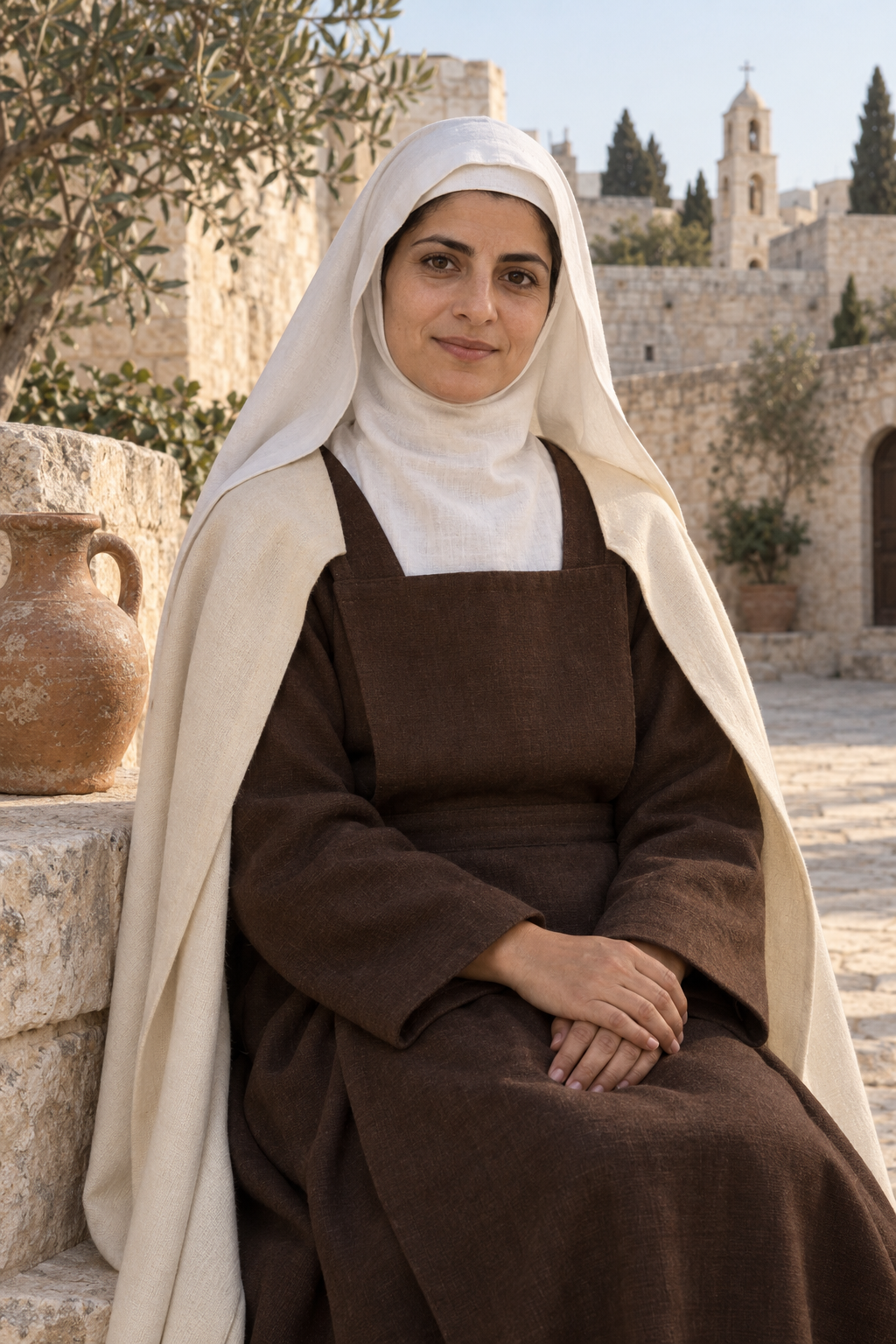
About Mariam Baouardy
Mariam Baouardy was born on 5 January 1846 at Abellin in Galilee, into a poor Arab Greek Melkite Catholic family. Her parents died while she was a small child. She grew up under an uncle’s care and later refused an arranged marriage because she wished to dedicate her life to God.
The account preserved by the Causes of Saints describes a childhood divided by bereavement. Mariam and her brother Boulos were taken into different relatives’ households, and her uncle eventually brought her to Alexandria. She received little education. The same religious account tells of a violent assault that left her with a throat wound and of an unknown woman who cared for her afterward. Mariam later understood that caregiver to have been the Virgin Mary. This episode belongs to the remembered religious narrative of her early life.
Domestic service took her through several cities before she entered religious life. Lodovica Maria Zanet describes her seeking out families in difficulty, tending sick people and begging on their behalf. At Marseille she entered the Sisters of Saint Joseph of the Apparition, but the community did not admit her to profession. Reports of unusual spiritual experiences had unsettled the sisters. Mother Veronica, who had understood and supported her, was preparing to transfer to Carmel at Pau and helped open that possibility for Mariam as well.
She entered the Carmel at Pau in June 1867 and received the religious name Mary of Jesus Crucified. The community’s account describes her preference for the work of a lay sister. Reading the Divine Office was difficult for her, while practical service suited her. Her work and her prayer continued alongside the experiences that made her unusual among the sisters. The account speaks of ecstasies and other extraordinary phenomena, understood by her community within its religious life.
Zanet’s portrait includes a woman who sometimes spoke when silence was required and whose vigorous work could disturb those around her. She had a fiery temperament. In letters recalled by Zanet, Mariam criticized her own impatience and lack of humility. She also insisted on remaining a lay sister with a white veil, serving the other women.
In 1870 she went to Mangalore in India to help establish a new Carmelite community. She returned to Pau two years later amid misunderstandings surrounding her spiritual experiences. The official canonization booklet places this difficult period within her religious formation, rather than presenting an uncomplicated mission success. It also records her conviction, after her return, that a Carmel should be founded at Bethlehem. The project eventually brought her back to the land of her birth. She arrived at Bethlehem on 11 September 1875, with the generous support of Berthe Dartigaux.
The Bethlehem foundation demanded practical work as well as prayer. As the only Arabic speaker in the group, Mariam took particular responsibility for following the construction. The sisters were able to occupy the building on 21 November 1876 while work continued. She also pursued plans for a Carmel at Nazareth and traveled there in August 1878 to arrange land. Back at Bethlehem, she fell while bringing water to the workers and broke an arm. Gangrene developed, and she died on 26 August 1878, aged 32.
Her memory reached beyond the communities in which she had lived. Dorothy C. Buck traces the interest of Louis Massignon, who repeatedly mentioned Mariam in letters to the Badaliya prayer community. For him, her life embodied compassion, hospitality and the willingness to bear suffering for others. His community’s concern for relations between Christians and Muslims gave her memory a further setting. Buck also describes Mariam’s devotion to the Holy Spirit and her petition to Pius IX for wider attention to that devotion. Her religious legacy included counsel and prayer as well as the monasteries associated with her.
Formal investigation of her cause began in Jerusalem in 1919. The Causes of Saints records an extended process, interrupted after 1944 and renewed in 1978. Her heroic virtues were approved in 1981, before her beatification.
John Paul II beatified her in 1983. Addressing pilgrims the following day, he emphasized the different Christian communities represented in her life: the Greek Melkite church of her baptism and upbringing, the Latin church of her Carmelite vocation, and communities in the Middle East, France and India. He presented her as an example of service, joy and peacemaking. Speaking to Christians living alongside Jewish and Muslim neighbors, he connected her return to Bethlehem with their own attachment to the Holy Land and their responsibility to practice reconciliation.
Francis canonized Mariam on 17 May 2015. In his homily he drew attention to her ability, despite poverty and little education, to offer clear spiritual counsel. He attributed that clarity to her prayer and openness to the Holy Spirit, and he described her as a means of fellowship with the Muslim world. Her public recognition thus recalled both her contemplative life and the relationships through which her faith had taken practical form.
Wondering how to weigh the stories and sources? Learn how to read a saint biography.