Biography
Marie Alphonsine Danil Ghattas
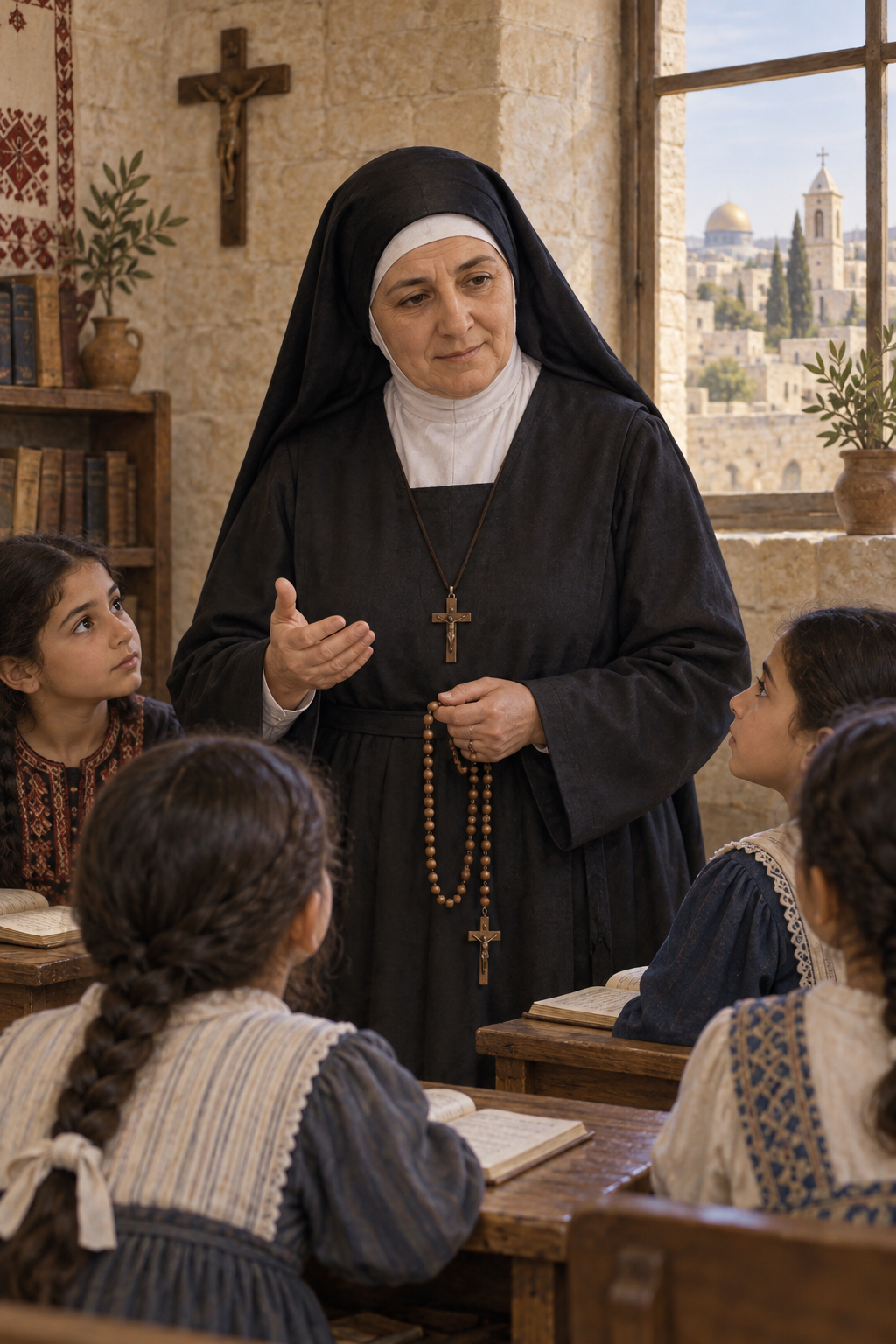
About Marie Alphonsine Danil Ghattas
Marie Alphonsine Danil Ghattas was born in Jerusalem on 4 October 1843 to a devout Palestinian Christian family. Called Soultaneh Marie as a child, she attended the Sisters of Saint Joseph of the Apparition's school. In 1858, still a teenager, she entered their community. Her religious name, Marie Alphonsine, belongs to this later stage of her life. Her parents' household and the sisters' school formed the setting of her earliest religious life. She first learned to serve in an established teaching congregation, and only later became involved in founding a local one.
She took the Sisters of Saint Joseph habit on 30 June 1860 and made her first vows in 1863. The Vatican's later liturgical profile records these steps before turning to the congregation she would help form. They matter because she was already bound to an established institute when the new project emerged. Leaving it required ecclesiastical permission, and the booklet describes a dispensation from her vow of obedience. The sequence also shows that founding the Rosary Sisters was not her first act of religious service. Years of formation and teaching lay between her entry as a young woman and the gathering of the new Jerusalem community.
Later biographies say that Ghattas reported Marian visions and understood them as a call to found a community for local women. Her accounts were recorded in a diary but became publicly known after her death. They matter as testimony about her religious self-understanding, although private experience cannot be verified in the same way as an institution or a profession. Historian Maayan Karen Raveh studies how subsequent church writers selected and framed such episodes for different audiences. Her analysis encourages a careful distinction between Ghattas’s own reported experience, what later biographies say it meant, and the documented creation of the congregation.
The first Rosary Sisters gathered in Jerusalem in 1880. The Latin Patriarchate now tells the foundation story by naming Ghattas as the woman behind it and Joseph Tannous as the priest who rented a house and guided the early members. Their roles were different and both mattered. The new institute welcomed local, Arabic-speaking women, giving them a form of religious life rooted in the communities they served. Ghattas could not immediately join them while her earlier vows were being resolved. A founding date therefore marks the beginning of the group, not the date on which she first lived with its members.
Ghattas left the Sisters of Saint Joseph and joined the Rosary Sisters. Official accounts differ on her transfer year, but agree on her vows of 7 March 1885. Her later entry helps explain why contemporary accounts named Tannous as founder.
In 1890 Ghattas joined the Dominican Third Order in Jerusalem. She taught and offered religious instruction with the Rosary Sisters in Jaffa of Nazareth, Beit Sahur and Salt. The Dominican friars also recall that she established an orphanage in Ain Karem. These assignments show a mobile ministry rather than a life spent solely at a motherhouse. Teaching girls and supporting young people required time, rooms, books and other sisters willing to share the work. Ghattas lived within these practical demands even as the public story of the institute’s origin often centered on Tannous. Her daily service and the work of other sisters made the community durable.
Archival photographs from Zababdeh and Jaffa of Nazareth show Rosary Sisters with pupils in the 1920s and 1930s. Historians Neveu and Sanchez Summerer use these images to trace the congregation’s reach into rural communities. They find that its schools taught subjects in Arabic, extending the opportunities available to girls. The study’s passing foundation date and sole-founder attribution conflict with the fuller church records, so they are not used here. Its school evidence shows why a local women’s institute mattered beyond its Jerusalem beginning: sisters could teach in the language of their pupils and live among families across the region.
Marie Alphonsine died in Ain Karem on 25 March 1927. Her diary became known after her death, and later accounts increasingly acknowledged her agency in the foundation. Historian Maayan Karen Raveh compares biographies written in 1936, 1989 and 2012–15 and finds that their presentation of the saint changed with the concerns of the patriarchate and its communities. This does not erase the institute's founding or her years of service. It reminds readers that a saint's life reaches us through choices made by later narrators. The safest account distinguishes documented institutional milestones from retrospective interpretations of her private experiences.
Francis canonized Ghattas in Rome on 17 May 2015 alongside three other women, including another woman from the Holy Land, Mariam of Jesus Crucified. The Catholic Church’s recognition came long after Ghattas’s death and after the institute had grown beyond its first Jerusalem house. At the canonization Francis spoke of remaining in Christ’s love and serving others. The liturgy honored religious lives; it did not independently settle every detail of nineteenth-century accounts. For Ghattas, the public history behind the celebration includes a locally founded community, years spent teaching and a later recognition of the role she had kept largely hidden during her life.
The day after the canonization, Francis met Rosary Sisters and Carmelites from the Holy Land. His address placed these women and their communities in the living Church of Jerusalem. Ghattas's legacy is tangible in that community: women from the region teaching, praying and serving through an institute that began in Jerusalem. Her reported visions belong to her spiritual testimony, but the public history also includes classrooms, journeys between houses and the gradual organization of a local congregation. Remembering both the founder and her companions makes the history more accurate. It also lets readers see why an Arabic-speaking sister's work mattered in the place where she lived.
Wondering how to weigh the stories and sources? Learn how to read a saint biography.