Biography
Marie-Eugénie de Jésus
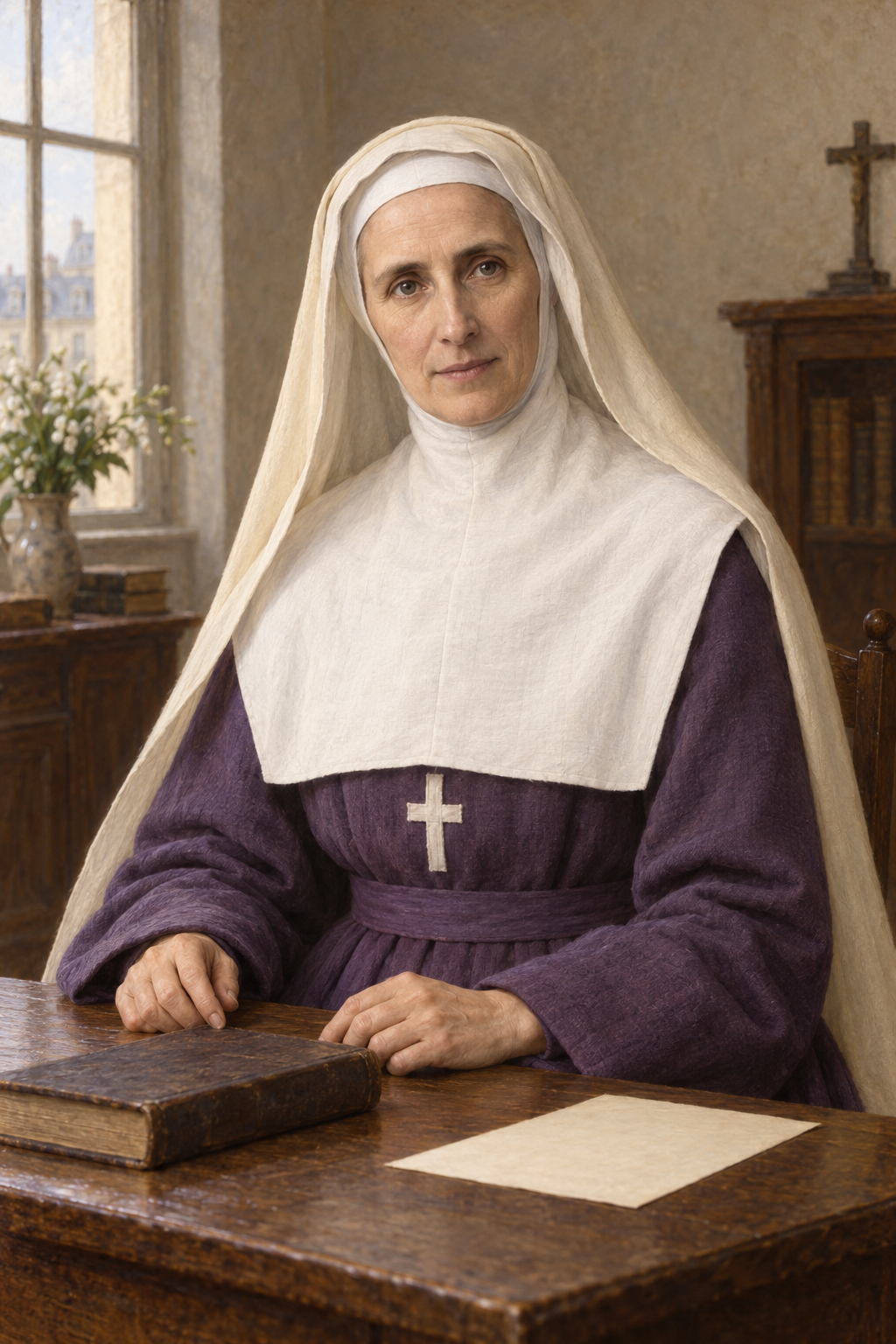
About Marie-Eugénie de Jésus
Marie-Eugénie de Jésus was born Anne-Eugénie Milleret at Metz in August 1817. Her childhood combined material comfort with intellectual curiosity and a strong sense of duty encouraged by her mother. The family’s security collapsed when her father’s financial affairs failed and her parents separated. She went to Paris with her mother, whose death from cholera left her facing a profound loss. The questions raised by these experiences became part of her search for a faith she could understand and live.
Lacordaire’s Lenten preaching at Notre-Dame in 1836 gave that search a new direction. She later remembered the sermons as decisive for her vocation. Reading, prayer and discussion helped her work through questions about God, the Church and her own future. Through the priest Théodore Combalot, she encountered a project for a women’s religious community devoted to education. He hoped that the formation of young women could contribute to the Christian renewal of society, a purpose that spoke to her own concerns.
On April 30, 1839, she and Marie Augustine began living together in a small apartment on Rue Férou in Paris. The Religious of the Assumption date their foundation to that beginning. Kate O’Neill, later Mother Thérèse Emmanuel, joined them that summer. Poverty and the need for patience marked the early years: families did not immediately entrust their daughters to an unfamiliar congregation. The project needed a workable household, willing companions and the confidence of parents as well as an educational ideal.
Relations with Combalot became increasingly difficult, and the sisters separated from his direction in 1841. The archbishop of Paris provided support through his vicar general. Marie-Eugénie continued the work, combining religious study with the preparation needed for teaching. Emmanuel d’Alzon became an enduring friend and adviser. The foundation developed through these relationships and disagreements, as the sisters sought a form of common life capable of sustaining both contemplation and the education of girls.
Education meant more to her than the acquisition of accomplishments suitable for polite society. Sister Clare Teresa Tjader’s study describes a vision joining intellectual development with character and social responsibility. Kindness, truthfulness, generosity and sincerity mattered alongside the subjects taught. Teachers were to understand their students and the world in which they lived. Study could broaden a person’s judgment, while the community of a school could help that person learn how to use freedom and responsibility.
Tjader also emphasizes the practical quality of this teaching. Much of Marie-Eugénie’s educational thought survives in letters responding to particular difficulties, rather than in a single complete system. The early Counsels on Education and a report prepared for an 1848 inspection provide more organized accounts. The principles call for teachers to explain and inspire, to use sound modern methods and to continue their own formation. The founder’s educational vision developed through the actual work of a new school.
The work was shared. In her historical study, Danguolė Gervytė draws attention to Marie Augustine Bévier’s role in the daily running of the first school and in preparing its curriculum. Marie-Eugénie’s leadership therefore belonged to a community in which different women contributed expertise. The school sought to give girls both a strong academic education and a moral foundation. Its first setting was the education of daughters from prosperous families, whose later responsibilities within family and society shaped the project’s aims.
That setting also placed limits around the undertaking. Gervytė notes the importance given to sciences and social commitment within an education still directed toward the roles expected of women of a particular class. As schools spread to other countries, the transfer of a French model could create tensions with local cultures. The history contains both an effort to broaden girls’ education and the assumptions of its time. Its later development required continuing attention to the different circumstances of the people being taught.
The motherhouse moved to Auteuil in 1857. Communities serving schools or houses of adoration had also developed at Richmond, Sedan and Nîmes. By the time Marie-Eugénie died, the congregation was present on three continents. Its history remembers this growth alongside the friendship with d’Alzon that connected the sisters with other branches of the Assumption family. What began in a small Paris apartment had become an international community with a continuing work of education.
The surviving archive gives a sense of the work behind that expansion. The congregation describes a collection containing 12,000 original letters by Marie-Eugénie, together with records of vows, spiritual notebooks and work on the constitutions. Papers from the foundations include plans, travel documents and correspondence crossing oceans. These materials preserve the practical organization of a religious family as well as its spiritual concerns, and make possible the continuing study of the founder and her first companions.
Marie-Eugénie died on March 10, 1898, at the Auteuil motherhouse. Paul VI beatified her in 1975, and Benedict XVI canonized her on June 3, 2007. The canonization homily linked her Eucharistic devotion with the intellectual, moral and spiritual education of young women. Benedict recalled a mission sustained by prayer and by the continuing union of contemplation and action. Her recognition as a saint brought public attention to a life spent forming both a congregation and an educational tradition.
The congregation’s present account of its charism continues to connect prayer with the dignity of each person and the building of a just society. Schools remain part of that mission alongside professional formation, work with women, migrants and local communities. Religious and lay collaborators share the undertaking. The forms have widened, while the purpose remains recognizable: education should help people think, act and contribute to the world with greater freedom, faith and responsibility.
Wondering how to weigh the stories and sources? Learn how to read a saint biography.