Biography
Marie-Léonie Paradis
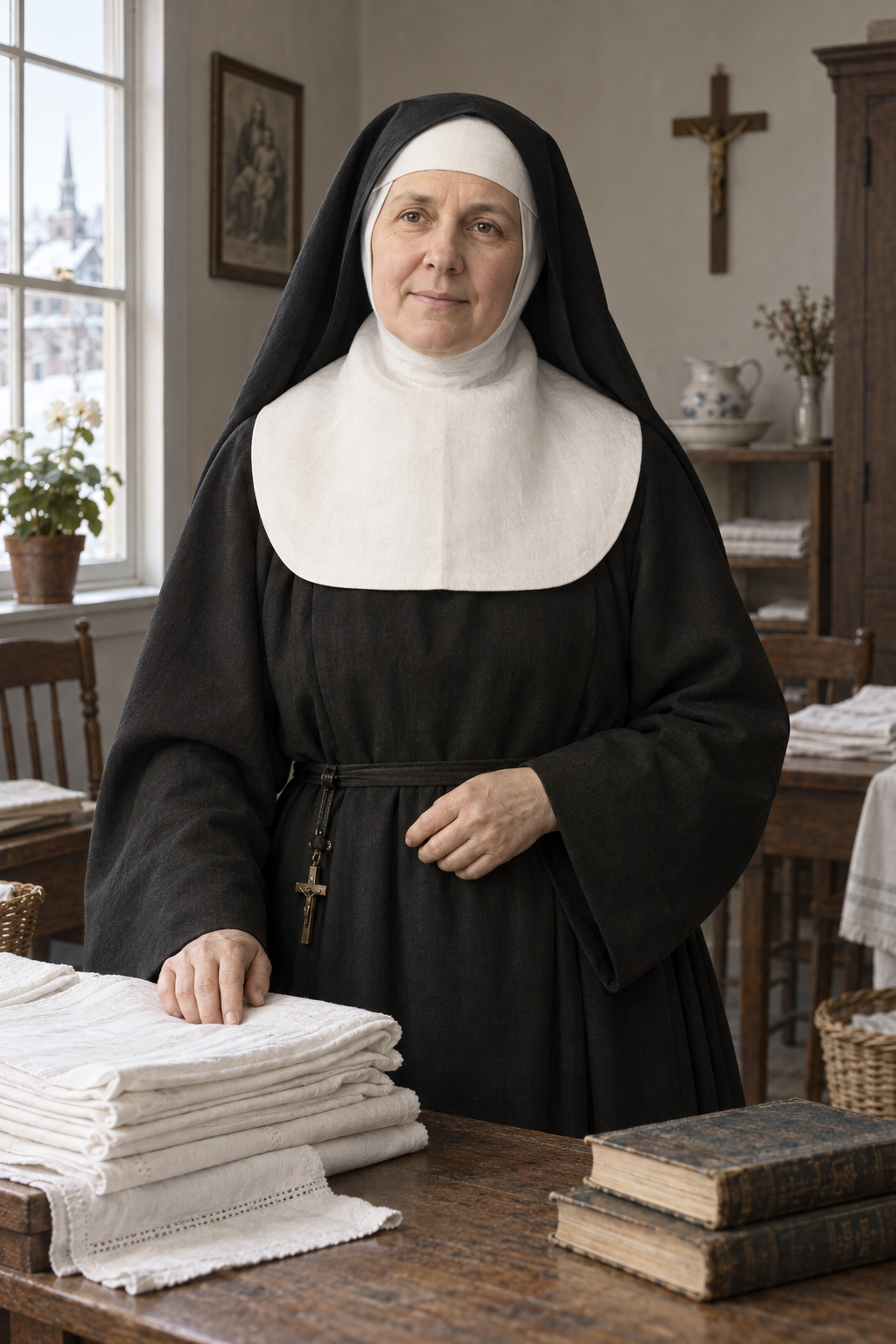
About Marie-Léonie Paradis
Marie-Léonie Paradis was born in L’Acadie, Lower Canada, on 12 May 1840, and baptized with names recorded in different orders as Alodie and Virginie. She grew up as the only daughter among six children. Her family later moved nearer Saint-Philippe-de-Laprairie. These details place her in a French Canadian household rather than in the Atlantic region that the English word “Acadia” may suggest. The name Élodie became familiar in accounts of her life; Marie-Léonie was her name in religious life. Her birth village is now in Quebec, while the historical record calls its jurisdiction Lower Canada.
At thirteen, Paradis entered the Marianites of Holy Cross near Montréal. She received the habit in 1855 and professed vows in 1857 as Marie-de-Sainte-Léonie. That earlier affiliation later required formal resolution as the Little Sisters developed.
Her assignments took her to several Canadian houses and then to New York, where she spent eight years. In 1870 she joined a province in Indiana that had separated from the Marianites. Four years later she was sent to Saint Joseph College in Memramcook, New Brunswick. The Holy See's canonization booklet treats this transfer as a decisive stage in her vocation. It describes young women gathering around her and a desire to assist priests both spiritually and materially. These were years of changing institutional ties, travel, and ordinary labor, rather than a sudden beginning in 1880. The foundation would grow from service already being carried out at a college.
Memramcook's college needed support. Historian Denise Robillard describes a material situation, the need for household work, and limited opportunities for Acadian girls seeking religious life. Paradis directed a workshop for young women. Fourteen wore a distinctive habit in August 1877, before the institute was established. The women and their work existed before an official foundation date. Domestic tasks were integral to the college's survival. Their contribution is obscured by accounts centered on priests.
The Little Sisters of the Holy Family date their foundation at Memramcook to 31 May 1880. The Dicastery's account instead names 13 May as the institute's official beginning, while scholarly biography supplies the year without settling the day. The difference may reflect separate acts or commemorative choices, but the consulted works do not explain it. The defensible public chronology is therefore the year 1880. The new community's purpose was to support priests' ministry, especially in educational houses. That support combined prayer with the labor required to feed people, maintain rooms, wash linen, and care for spaces used for worship.
The community's story also concerns women's opportunity. The Canadian bishops' profile observes that for women from modest backgrounds, the congregation offered a path to religious life and training beyond what their families could provide. Paradis had experience in an older institute, but the Little Sisters welcomed local women into a community shaped around needed work. This did not make every task visible or honored. It gave shared form to a service that colleges and seminaries relied upon. Her vocation took shape alongside the work of the women who entered with her, not merely through a personal plan carried out alone.
In 1895 sisters went to the diocesan seminary in Sherbrooke, Quebec. Bishop Paul LaRocque welcomed the institute's motherhouse and novitiate and approved it in January 1896. Memramcook's college was its starting place; Sherbrooke became an institutional center. Foundation was a process: young women gathered, a shared habit appeared, an institute was named, and later it gained a motherhouse and diocesan approval. These steps should not be compressed into one day in May 1880.
Pope Pius X released Paradis from her Marianite obligations after the Little Sisters had begun; she took the new institute's habit in 1905. The sisters expanded in Canada and the United States. She died in Sherbrooke on 3 May 1912, leaving the community to continue.
Quebec's cultural heritage register describes Élodie Paradis as founder and first superior of a community serving colleges, seminaries, bishoprics, and priestly formation houses. That description makes the character of the work concrete. The sisters did not replace teachers or priests; they sustained the institutions where others taught, studied, and ministered. Remembering that work avoids treating household labor as merely a background to more visible church activity. Paradis's contribution included organizing and protecting a shared vocation for women whose practical skills were essential. The provincial designation recognizes her place in Quebec history as well as in the Catholic history of religious institutes.
John Paul II beatified Paradis in Montréal in September 1984. Four decades later, Francis canonized her in Rome on 20 October 2024. At that liturgy he spoke of the newly recognized saints in terms of service and named Sister Marie-Léonie among religious figures whose work expressed it. The rite records a Catholic judgment about her life; it should not be used to erase disagreements among historical accounts of the institute's dates. Paradis remains significant because she organized a durable community around often unseen work and opened a form of religious life for women who could serve through that work.
Wondering how to weigh the stories and sources? Learn how to read a saint biography.