Biography
Marie of the Incarnation
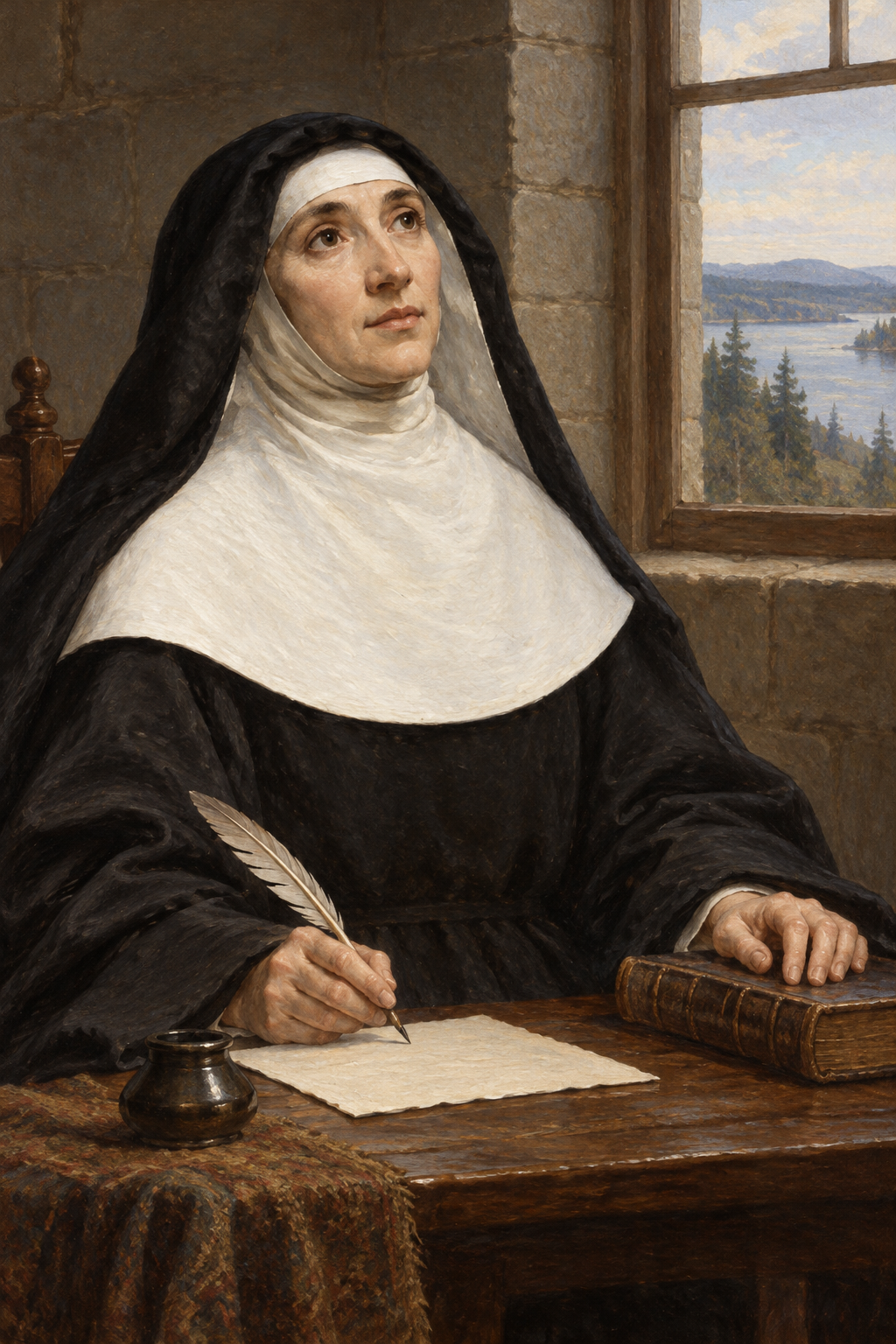
About Marie of the Incarnation
Marie of the Incarnation was an Ursuline nun, teacher and writer who helped establish her community in New France. Born Marie Guyart in Tours on October 28, 1599, she first lived as a wife and mother. She married the silk worker Claude Martin in 1617. After his death in 1619, she raised their infant son, also named Claude, and worked within her extended family.
Her practical responsibilities were substantial. The Colonial America Reference Library describes work in her brother-in-law’s transport business that included caring for horses, keeping accounts and handling correspondence. At times she supervised the operation. When she prepared to enter religious life, her brother-in-law agreed to provide for Claude and became his guardian. The financial arrangement acknowledged the contribution her business skills had made to the family’s prosperity.
She entered the Ursuline novitiate at Tours in January 1631. The separation caused deep pain to mother and son. Marie-Emmanuel Chabot’s biography recounts Claude running away, then joining other boys outside the convent to demand his mother’s return. Marie later described the decision as an experience of profound loss. Her religious vocation did not remove the human cost of leaving her child in the care of relatives. She professed her vows in 1633. At Tours, she taught Christian doctrine and prepared explanations of the faith, including a commentary on the Song of Songs. Teaching and writing were therefore part of her religious work before the Atlantic crossing and the responsibilities of establishing a new community.
Marie understood her vocation through prayer and experiences she described as mystical. She believed that God was calling her to Canada. With support from Madeleine de La Peltrie, she crossed the Atlantic in 1639 with other religious women. She would never return to France.
The first years in Quebec required persistent practical work. After makeshift accommodation in the lower town, the Ursulines moved into a stone monastery in 1642. A fire destroyed it on the night of December 31, 1650. Marie undertook the work of rebuilding, raising support and attending to contracts and property rights. Her experience in business became part of the community’s survival.
The sisters received both Indigenous and French girls. Claire Gourdeau’s account for the Canadian Museum of History describes shared dormitories, meals and recreation, alongside separate instruction for Indigenous pupils intended to assist their conversion. The school’s aims were religious and cultural as well as educational. It belonged to a colonial project that expected Indigenous children to adopt Christianity and French ways of life.
Those expectations encountered resistance. Gourdeau explains differences between French disciplinary assumptions and Indigenous approaches to childhood. Marie’s own correspondence records parents taking their daughters home when the children became unhappy. These families made decisions about their children’s welfare rather than simply accepting the missionaries’ plans. The account helps preserve the agency of pupils and parents within a history often told mainly through the founders of the school.
Historian Dominique Deslandres likewise emphasizes the limits of the effort to turn Indigenous pupils into French women. Marie eventually recognized that Christian conversion would not necessarily produce the cultural change she had expected. Learning local languages made communication possible, but it did not erase the unequal assumptions of the colonial mission. Her writings record both a sustained desire to evangelize and the persistence of Indigenous cultural identities.
Her correspondence is also a major historical legacy. Deslandres describes letters addressed to relatives, benefactors and others in France, including intimate exchanges with Claude. Accounts of conversations in the convent parlor preserve perspectives on relations between Indigenous people, settlers and missionaries. After her death, Claude helped make her known by publishing her letters and a biography. His editorial work is part of the history through which readers now encounter her voice.
The bishops of Canada describe a spirituality that joined contemplation with everyday work. In the writings they discuss, Marie speaks of approaching God with trust and asking for help amid many responsibilities. Her prayer was not confined to moments apart from work; it accompanied administration, building and teaching. This relationship between interior prayer and practical action remains central to the church’s remembrance of her.
Marie died in Quebec on April 30, 1672. Pope Francis canonized her on April 3, 2014, through equivalent canonization. Her feast is April 30.
Her surviving manuscripts receive recognition beyond church commemoration. Quebec’s heritage council records that five original letters, written between 1645 and 1670 and preserved by the Ursulines, were classified as heritage documents on April 12, 2018. The decision recognized their importance for understanding her life and the history of New France.
At Chambray-lès-Tours, the school named for Marie explicitly honors her as its patron saint. Its account of the 350th anniversary of her death describes pupils meeting Ursulines, visiting places connected with her memory and joining celebrations. This local patronage links her birthplace’s region with the educational vocation she carried across the Atlantic.
Wondering how to weigh the stories and sources? Learn how to read a saint biography.