Biography
Marie Rivier
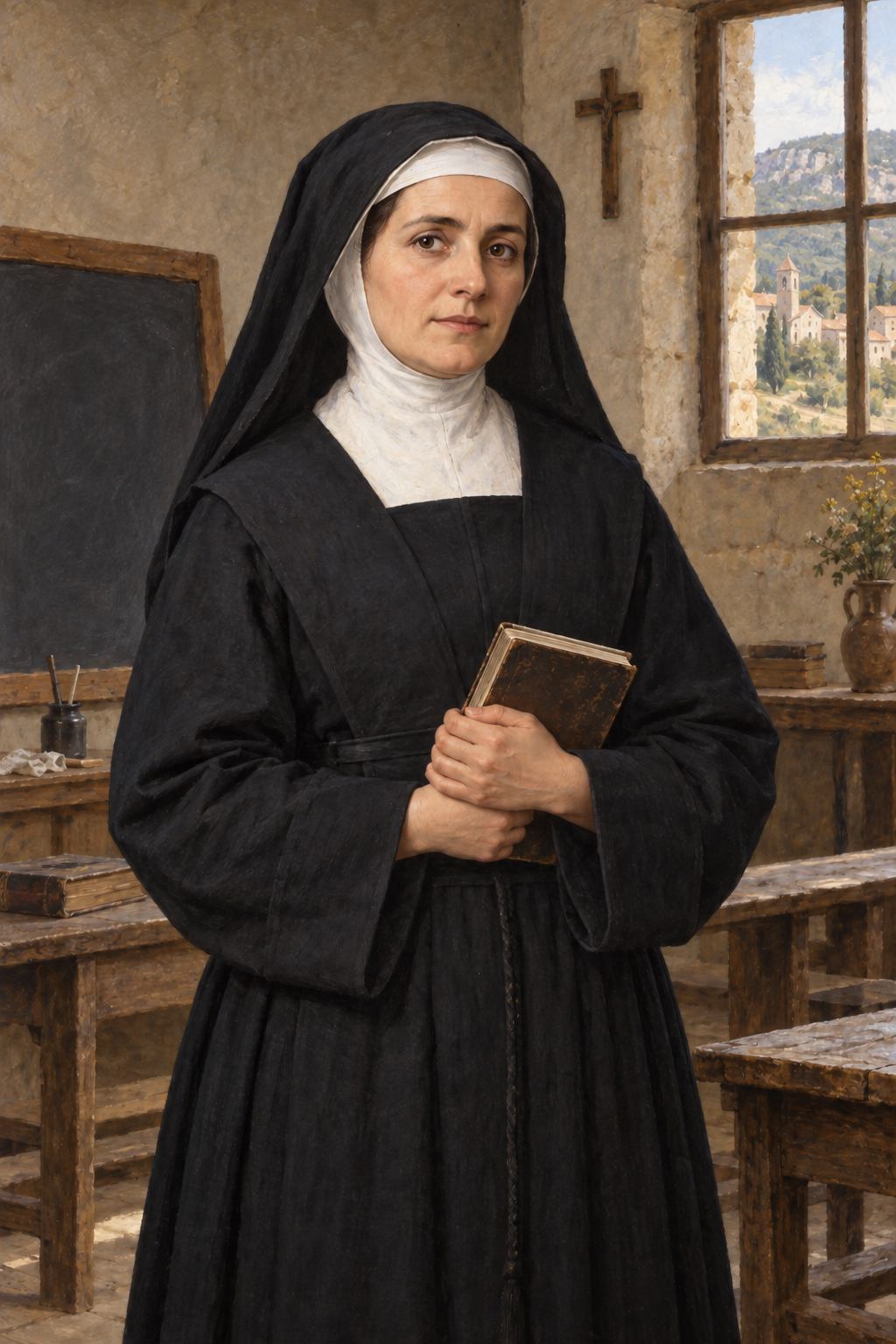
About Marie Rivier
Marie Rivier was born on 19 December 1768 in Montpezat-sous-Bauzon, a village in the Ardèche region of France. As a small child she lost the ability to walk easily after a fall. The community's later memory places her and her mother before an image of Mary holding the dead Christ, known as a Pietà, and links her recovery to prayer there. Accounts distinguish partial improvement from fuller recovery. The lasting historical point is that childhood illness or injury shaped her early years; a specific miracle cannot be established from the later stories alone.
Rivier pursued education despite poor health. The Dicastery's life describes a period of study with the Sisters of Notre-Dame at Pradelles and a request to join a convent that was refused because of her frailty. She then taught children in Montpezat. By 1786 she had opened a school there and was helping young women learn as well.
Visiting sick and poor neighbors joined her teaching. Those tasks were not incidental to a later religious institute; they were the work through which she learned to organize instruction, draw helpers together and respond to people who had few opportunities.
The French Revolution disrupted schools and religious institutions in the region. John Paul II's beatification homily recalls Rivier arranging religious instruction and Sunday gatherings when ordinary church structures were under strain. Such activity had different risks in different years, and the pressures of the 1790s should not be flattened into one continuous period of terror. Education remained her most practical way of reaching children and families. Her work also depended on local priests, women willing to teach, and households that accepted the school, not on a founder acting alone against an undifferentiated state.
In 1794 Rivier moved from Montpezat to Thueyts to continue teaching. The town's heritage account identifies a girls' school in the former Dominican house there, followed by the sisters' move to a convent on rue Haute. This local record distinguishes the school from the formal religious foundation in 1796. It also shows that Rivier did not begin with a purpose-built institution: she used rooms already present in the town as pupils and collaborators gathered. The move to Thueyts widened the reach of her work while retaining the village setting in which she had learned to teach.
The municipality of Thueyts identifies the old convent building associated with Rivier's foundation. It remains a local place of memory, with rooms and a chapel linked to the early sisters. Buildings can locate a community's work even when they cannot prove the words of every story later told about it. At Thueyts, Rivier had space for a school and for the women who were joining her. Teaching children, gathering women for common life, and adapting available rooms made the emerging institute visible within the town. The foundation would take an explicit religious form in November 1796.
On 21 November 1796 Rivier and four companions dedicated their common work under the title Presentation of Mary. The congregation's French history says they acted with the permission of the diocesan vicar general. Their aim was to educate young people in faith and ordinary learning, particularly those otherwise neglected. The dedication date became the community's foundation day, though common practices and rules continued to develop. Their decision is striking for the unsettled revolutionary period, but its importance lies also in the ordinary structure they built: women living together, teaching, and relying on one another to keep schools open.
The sisters' historical pilgrimage recalls that they added a small dispensary for sick and poor neighbors at Thueyts. Over the following years their houses combined teaching with other forms of care. Its totals of schools and houses are not identical to those in church and encyclopedia accounts; some count facilities while others count communities. The steady expansion is clear without treating one total as definitive. Rivier's leadership was therefore both educational and organizational. She had to help new sisters learn their responsibilities and maintain a shared purpose as the work spread beyond the village where it began.
Kearney traces a second stage of the institute's rules under Régis Vernet, another Sulpician adviser. A provisional rule was presented in 1801 and later endorsed by a bishop; a more developed text took shape as the sisters' schools grew. Kearney argues from manuscripts and the sisters' archive that Rivier participated in these decisions rather than simply receiving a finished rule from priests. This helps explain her role as founder and superior: she had to translate a broad desire for education into a workable way of life. Rules for schools, prayer and common responsibilities developed through experience and revision.
The congregation eventually made its motherhouse in the former Visitation convent at Bourg-Saint-Andéol. Its histories give several years for buying the building, moving there and treating it as the established center. The *New Catholic Encyclopedia* places the motherhouse in 1819. These distinctions have not been reconciled against a single deed and occupancy record, so the move's year remains open. Bourg-Saint-Andéol gave a growing institute more room for sisters and pupils. The move also signaled that the community had become larger than its first house in Thueyts.
John Paul II, speaking at her beatification in 1982, singled out Rivier's energy for teaching the faith during and after the Revolution. That is a later church assessment, not an eyewitness account of each classroom. It nevertheless makes clear which aspect of her life the Catholic Church chose to honor: persistent education in difficult circumstances. The congregation's work depended on sisters who taught, visited and served in places that could not sustain a large institution. Rivier died before any overseas foundation, so later global growth belongs to her successors even as they understood themselves to be continuing her purpose.
Rivier died at Bourg-Saint-Andéol on 3 February 1838. The *New Catholic Encyclopedia* gives both place and day; the motherhouse there remained a center of remembrance. Claims about her childhood healing, exact house totals and the move's year need source qualification, but her long work as a teacher and community leader is clear. The school at Montpezat, the Thueyts foundation and a growing institute of women provide a traceable outline of her life. She had begun with local children and died after seeing other sisters carry that work across a broad part of France.
John Paul II beatified Rivier on 23 May 1982, and Francis canonized her on 15 May 2022. The canonization decree records both acts. Official recognition did not make every inherited story into a verified event; her historical contribution remains the founding and direction of an institute centered on education. The sisters later crossed seas she never crossed, extending a community whose first rules had been shaped by practical experience in the villages of Ardèche.
Wondering how to weigh the stories and sources? Learn how to read a saint biography.