Biography
Martin Luther King Jr.
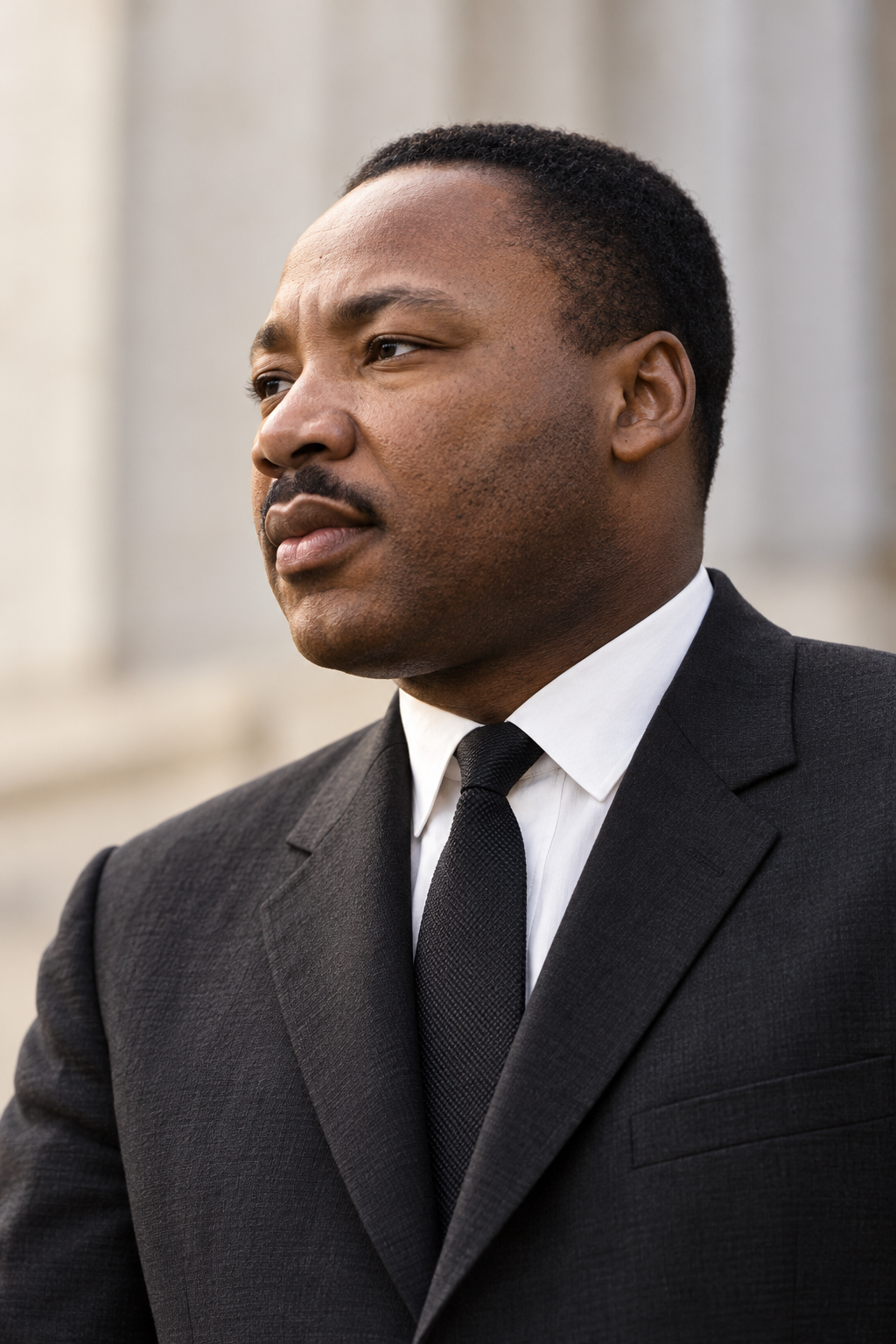
About Martin Luther King Jr.
Martin Luther King Jr. was a Baptist pastor who helped lead the American movement against racial segregation. His ministry joined preaching with organized protest and, increasingly, with campaigns against poverty and war.
Born in Atlanta in 1929, King was ordained at Ebenezer Baptist Church in 1948. He studied at Morehouse College, Crozer Theological Seminary, and Boston University, completing his doctorate in 1955. He married Coretta Scott in 1953 and became pastor of Dexter Avenue Baptist Church in Montgomery the following year. After Rosa Parks’s arrest in December 1955, Jo Ann Robinson and the Women’s Political Council distributed notices calling for a bus boycott. King was elected president of the newly formed Montgomery Improvement Association.
At its first mass meeting, held in Holt Street Baptist Church, King explained why the protest belonged within Christian life. He defended Parks and the dignity of the people subjected to segregation. He insisted that protest need not involve violence or hatred, while rejecting the idea that Christian love required accepting injustice. Love and justice belonged together in his argument. The meeting also called for unity and sustained action: persuasion alone was insufficient when authorities refused to change. King spoke as a pastor addressing a community already organizing its response, not as someone acting in isolation. Hymns, prayer, and a reading from the Psalms formed part of the gathering. Loudspeakers carried the proceedings to people outside the church, extending the meeting beyond those who could fit inside.
His home was bombed in January 1956; Coretta and their daughter escaped injury. He continued to urge nonviolence. Montgomery’s buses were integrated that December. In January 1957, he became chairman of the organization that developed into the Southern Christian Leadership Conference.
Birmingham became another major test of nonviolent action in 1963. King worked there with Fred Shuttlesworth and other local leaders. Their campaign confronted segregation through demonstrations that drew national attention to the city.
Arrested during the campaign, King answered eight clergy who had criticized the demonstrations. His April 16 letter described a sequence of investigation, negotiation, personal preparation, and direct action. Protest was intended to make negotiation unavoidable after ordinary appeals had failed. He also challenged advice to wait, arguing that those enduring injustice could not indefinitely postpone their freedom to suit others’ convenience. His criticism extended to religious moderates who valued public calm more than the work of securing justice. The letter circulated in several forms, and King revised it for his book Why We Can’t Wait. Its argument presented nonviolence as disciplined resistance rather than passive acceptance. He distinguished just laws from unjust ones and defended civil disobedience by drawing on biblical and historical examples. His appeal addressed fellow clergy through the religious language and moral responsibilities they shared.
At the August 1963 March on Washington, organized by a coalition led by A. Philip Randolph and Bayard Rustin, King delivered his best-known speech.
The movement helped bring about the Civil Rights Act and the Voting Rights Act. King received the Nobel Peace Prize in 1964. Yet legal gains did not end his concern with the conditions in which people lived, and he increasingly addressed poverty and the Vietnam War.
In April 1967, speaking at Riverside Church in New York, King explained his opposition to the war. He argued that military spending drained resources from efforts to relieve poverty, while poor families bore an unequal share of the fighting. He also questioned the consistency of urging nonviolence at home while accepting destructive warfare abroad. The address asked Americans to consider Vietnamese civilians and to listen even to those their government called enemies. For King, Christian ministry carried responsibilities beyond national loyalties. He proposed steps toward ending the war, including a ceasefire and withdrawal, and called for changes to economic priorities.
The address drew criticism from major newspapers and some civil-rights leaders who feared that opposing the war would damage the struggle for racial equality. Vincent Harding and other collaborators helped prepare it; King had already spoken against the war before this occasion.
In his final year, King helped plan the Poor People’s Campaign. Its proposed coalition included Black, white, Indigenous, Mexican American, and Puerto Rican communities. The campaign sought economic security through measures such as jobs, fair wages, and unemployment protection. Some SCLC colleagues questioned the plan’s scope and practicality.
King went to Memphis in support of striking sanitation workers and was assassinated there in April 1968.
The Poor People’s Campaign continued after his death under Ralph Abernathy’s leadership. Coretta Scott King joined its Mother’s Day demonstration, and participants established Resurrection City in Washington. Its results were limited, but the campaign carried forward demands for material security alongside civil and political rights. Those demands help explain the breadth of King’s final work, which extended beyond desegregation to the distribution of opportunity and resources.
Episcopalians commemorate him on April 4.
Wondering how to weigh the stories and sources? Learn how to read a saint biography.