Biography
Mary MacKillop
About Mary MacKillop
Mary Helen MacKillop was born in Melbourne on January 15, 1842, to Scottish immigrant parents. The Dicastery for the Causes of Saints presents her early life within the practical pressures of family responsibility and the young Australian church.
As a young woman, Mary helped support her family. That fact should not be treated as incidental. Her later ministry among poor children grew from personal knowledge of work, uncertainty, and the need for education that could reach families outside comfortable urban settings.
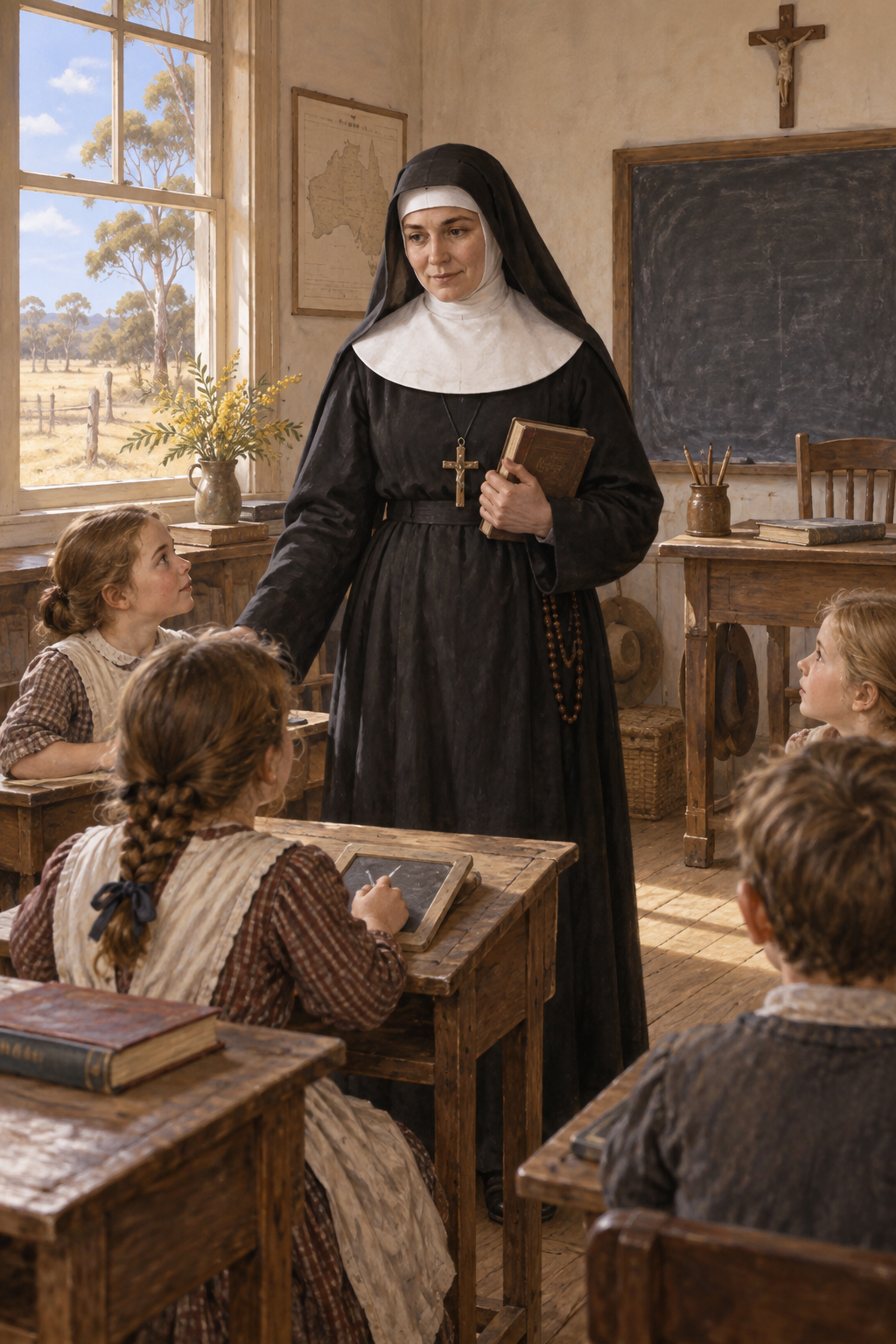
Mary worked as a governess at Penola in South Australia, where she met Father Julian Tenison Woods. Together they discerned a practical response to the needs of children who had little access to schooling. In 1866 they opened Saint Joseph's school at Penola.
From that beginning came the Sisters of Saint Joseph of the Sacred Heart. The new congregation was meant to be simple, mobile, and close to poor rural families. The page should describe this as educational mission rooted in faith, not as a modern school network with retrospective institutional polish.
The Josephite model mattered because it allowed sisters to go where children were rather than wait for families to reach established schools. In the public profile, describe this as a concrete response to distance, poverty, and rural isolation. Avoid implying that every later practice was already fully settled in 1866.
Mary moved to Adelaide in 1867 and made vows as Mary of the Cross. Her religious life carried the ordinary demands of teaching, travel, fundraising, and community formation, but it also required unusual resilience because the congregation's structure and independence brought conflict.
Those early years should keep Father Woods in view without making Mary secondary to him. The sources support collaboration at Penola and in the founding, while Mary's later leadership and suffering became central to the institute's survival. The biography should hold both truths together.
In 1871 Bishop Sheil excommunicated Mary; she was restored in 1872. The final page should state those facts carefully, without speculating beyond the reviewed sources about motives or assigning theatrical blame. The episode matters because Mary remained faithful under ecclesial suffering.
This paragraph is also where restraint is most important. The page may say that the excommunication was lifted and that Mary continued to seek the Church's approval for the sisters' rule. It should not use the episode as a weapon against named persons, nor should it hide the pain by making the conflict sound administratively tidy.
After restoration, Mary traveled to Rome in 1873 seeking approval for the rule. That journey shows both courage and ecclesial loyalty. She did not respond to conflict by abandoning the Church; she sought a stable way for the sisters' mission to continue within it.
The Rome journey also helps explain why her sanctity cannot be reduced to local Australian perseverance. Mary worked from colonial schoolrooms, but she wanted the congregation's life to be securely Catholic and accountable beyond local pressure. That wider communion is part of the story.
The congregation's work grew around the education of poor children, especially in rural communities. The sources support a portrait of schools that were plain, practical, and close to families. This draft avoids current school counts or modern statistics unless a fresh dated source is added.
Her work should be described in a way that honors children and families as neighbors, not as background proof of the founder's greatness. Simple classrooms, basic literacy, religious instruction, and reliable adult presence were the ordinary tools by which Mary and the sisters served.
Mary MacKillop Place summarizes her memory as a teacher and founder whose life remains tied to North Sydney, where pilgrims still remember her.
Her later years included governance burdens, illness, and the long labor of holding the sisters together. The public biography should not make controversy the center of her life. It should show a foundress whose steadiness made education possible for children who might otherwise have been missed.
Mary died on August 8, 1909. The reviewed sources support North Sydney and Alma Cottage as the death context, but this deferred packet leaves the database death place unchanged until the final normalization step can verify exact field wording.
She was canonized in 2010, becoming Australia's first canonized saint. The page should use that distinction briefly and then return to the substance of the life: faith, education, poverty, perseverance, and fidelity through hardship.
Because that national distinction is easy to overemphasize, the final profile should keep it as a closing historical fact. The core of the profile belongs to Mary's long fidelity: taking responsibility young, teaching where schools were scarce, accepting misunderstanding, and rebuilding trust without abandoning the mission.
Mary's witness is not simply that she founded schools, but that she trusted God enough to keep serving when ecclesial conflict, distance, financial pressure, and illness might have narrowed her work. Her sanctity is visible in patient, local, practical charity.
Artwork should show Mary in a simple Josephite habit in a rural colonial schoolroom, with slate, books, desks, and Australian daylight. Avoid turning the excommunication into a visual theme, and avoid rendered text, logos, halos, modern props, or exact-likeness claims.
Wondering how to weigh the stories and sources? Learn how to read a saint biography.