Biography
Matiya Mulumba
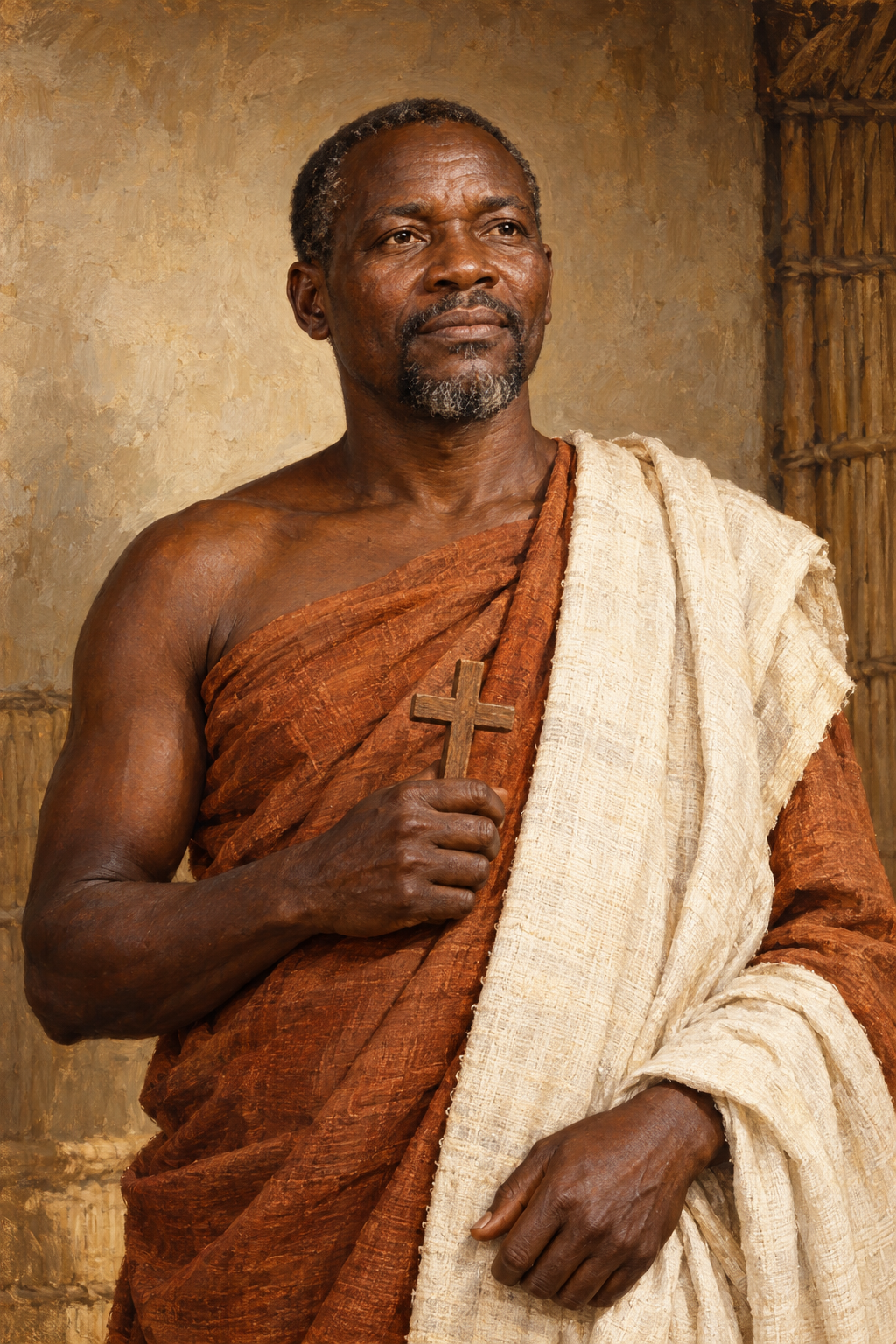
About Matiya Mulumba
Matiya Mulumba, also known as Matthias Kalemba, was a Soga-born lay Christian leader in Buganda. Captured with his mother in childhood, he was sold into slavery and later treated as a free member of his adoptive household. He entered the service of a chief in Ssingo and became a senior official. His religious search led through Islam and Anglican instruction before Catholic baptism in 1882.
His conversion changed his household and conduct. According to Aylward Shorter, he made provision for the women of his former household while remaining married to Kikuvwa. He still participated in his chief’s military raids, although he refused a share of the plunder. Shorter also records his refusal to accept bribes. These details complicate any portrayal of a life entirely separate from the violence and inequalities around him.
During the missionaries’ absence, he helped sustain Mityana’s Christian community. Arrested in May 1886, he was condemned for acknowledging his faith. He suffered mutilation at Old Kampala and died after a prolonged execution; Shorter places his death probably on May 30.
His teaching reached people whose work continued after the persecution. Maria Matilda Munaku learned the catechism from Mulumba and from her brother, Noe Mawaggali. Shorter’s account of Munaku places her within the Mityana community led by Mulumba and Luke Banabakintu. She survived captivity, was baptized in July 1886 and later helped care for girls and support seminarians. Her story shows that this community’s history includes women’s work and the lives of survivors, as well as the men remembered as martyrs.
Benedict XV’s 1920 beatification letter describes Mulumba teaching his children and others. It also records that people heard him asking for water after his executioners had left. The account remembers a prolonged death, not an immediate killing.
Paul VI canonized him with Charles Lwanga and twenty other Catholic martyrs on October 18, 1964. The official record names Mulumba alongside Lwanga in the group’s title. His recognition is therefore part of a shared martyrdom cause, while his own history remains distinct from the deaths at Namugongo.
Catholic patronage connects his memory with leadership and family life. Brother Tarcis Nsobya’s list, reported by New Vision, names him as patron of chiefs and families. These are documented devotional associations; they should not be taken to mean that every action of a historical chief or household was beyond criticism.
His patronage extends to the Knights of Saint Mulumba in Nigeria. In a 2015 reflection, Deputy Supreme Knight Myke Mary Nwosu explicitly named him as the order’s patron. Nwosu connected the example of the martyr with the work of Saint Mulumba College at Ogbede, established by the Onitsha Metropolitan Council in 2014. He urged teachers to join education with integrity and service.
The order’s own history dates its foundation to June 14, 1953, through Father Abraham Anselm Isidahome Ojefua. It describes a fraternal association supporting Catholic life and the wider community, and records its later extension to Uganda and Cameroon. This is a modern expression of devotion to an African lay saint, developed long after his lifetime.
In Old Kampala, a parish bearing his name was established in 1984 after the laying of its foundation stone in 1981. The archdiocesan account describes worship and ministries serving nearby residential and business communities. This local church gives his remembrance a continuing place in the city associated with his death, without requiring every detail of the execution narrative to be treated as equally certain.
Writing for the sixtieth anniversary of the canonization in 2024, missionary Richard Nnyombi reported a pilgrimage of relics associated with Mulumba and Lwanga through Kampala’s parishes. He also challenged Christians to carry remembrance beyond the large annual gatherings on June 3. For Nnyombi, the martyrs’ example called for sustained mercy and responsibility in ordinary life.
Wondering how to weigh the stories and sources? Learn how to read a saint biography.