Biography
Maximian of Ravenna
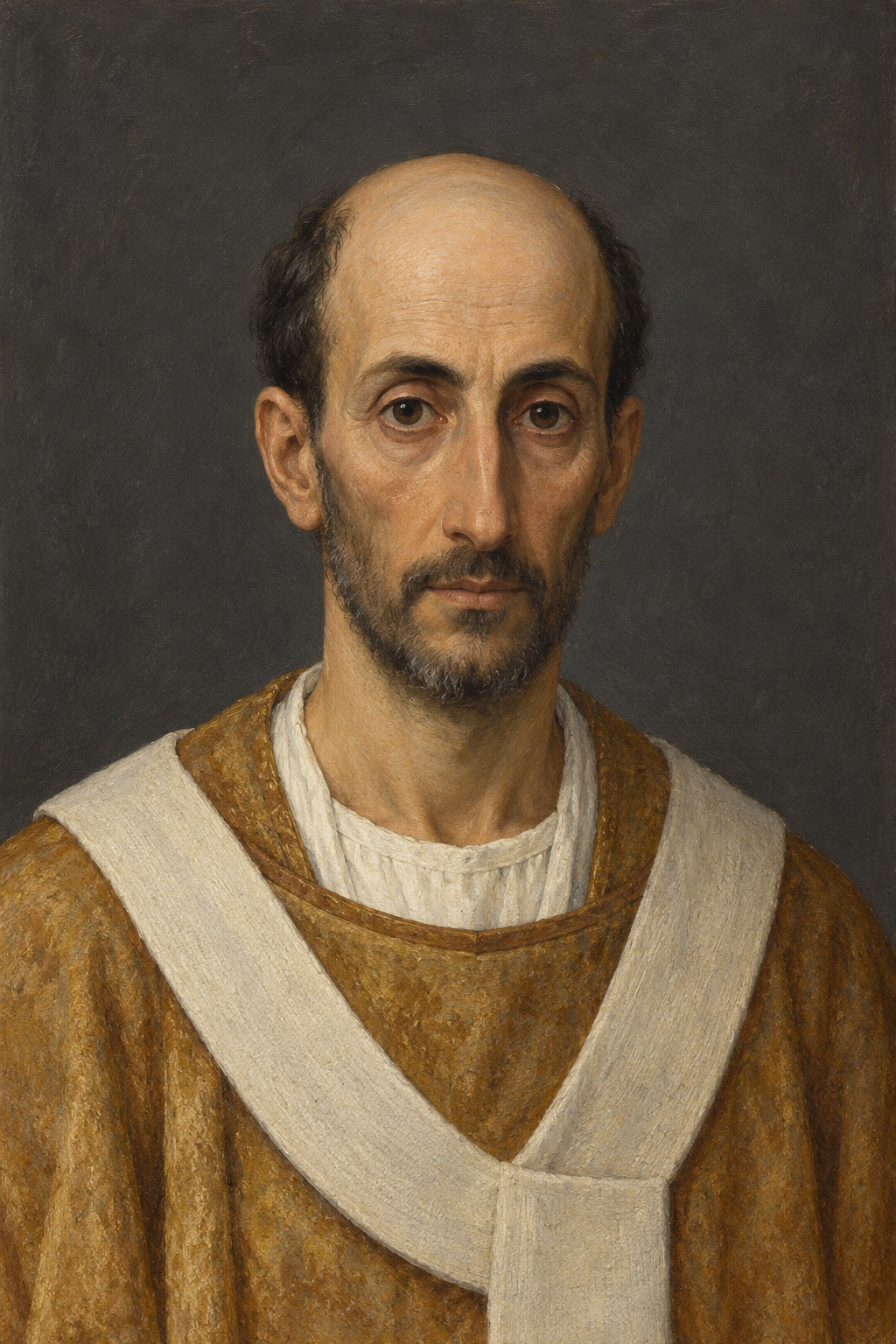
About Maximian of Ravenna
Maximian served as a deacon at Pola before becoming bishop of Ravenna. Protected by Emperor Justinian, he was consecrated by Pope Vigilius in 546. He became an influential church leader in Italy during the absence of both Vigilius from Rome and Dacius from Milan.
His appointment also provoked resistance. Maria Cristina Carile describes Justinian imposing him on Ravenna’s leading citizens, who eventually accepted him. As bishop, Maximian actively supported the emperor’s policies in the dispute over the Three Chapters and maintained close connections with Constantinople. His episcopate cannot be separated from that exercise of imperial authority.
He brought major building projects to completion, consecrating San Vitale and Sant’Apollinare in Classe. He also prepared a collection of liturgical formulas. Treccani suggests a possible connection between this work and the later Leonine Sacramentary, rather than treating that relationship as certain.
San Vitale had begun before Maximian’s episcopate. Scholar Sally Morgan traces the project back to Bishop Ecclesius, while Ravenna remained under Ostrogothic rule, and places its consecration by Maximian in 547. Her reconstruction suggests that much of the construction followed the imperial capture of the city in 540. His role was therefore the culmination of work spanning several bishops and a change of government.
The building’s double shell and octagonal plan connect it with contemporary churches in Constantinople. Morgan emphasizes the workshops that made bricks, laid masonry and created mosaics, rather than treating the monument as the achievement of one patron alone. Ravenna’s craftsmen produced bricks resembling those used in the imperial capital. The finished church brought materials, labor and religious ceremony into a setting that also expressed Byzantine authority.
Maximian appears beside Justinian in the sanctuary mosaic, with his name identifying him above the portrait. Carile discusses evidence that his likeness probably replaced an earlier image of Bishop Victor. Elsewhere in the church, Ecclesius remains visible presenting a model of the building to Christ, while Victor’s monograms survive on architectural elements. These separate traces preserve the contributions of successive bishops, even where a later portrait asserted the authority of the reigning one.
The placement of these images also mattered. Carile notes that the imperial panels on the sanctuary’s sides were less readily visible from the main body of the church than the central image of Ecclesius. Their modern familiarity in photographs can obscure that difference. She reads the arrangement in relation to the bishop’s performance of the liturgy and the standing of Ravenna’s church within the Christian order.
At Sant’Apollinare in Classe, the earlier bishop Ursicinus had initiated another major project. The state museum guide dates Maximian’s consecration of the basilica to May 9, 549. The apse places Apollinaris, Ravenna’s founding bishop, in a green landscape beneath a jeweled cross. Sheep represent the faithful gathered around him, while other figures and symbols evoke Christ’s Transfiguration. This imagery linked the worshipping community with its remembered first bishop.
The church preserved an older architectural tradition while incorporating forms associated with the eastern Mediterranean. Its broad interior is divided by columns of Greek marble. The surviving decoration also includes work added after Maximian’s lifetime, such as seventh-century mosaic panels. Reading the building requires attention to those successive phases: the monument seen today is not an untouched record of a single ceremony or commission.
The ninth-century writer Agnellus also credits Maximian with building Ravenna’s church of Saint Stephen. He describes a portrait of the bishop in its apse and mosaic decoration in adjoining chapels. This later account preserves evidence of a further foundation and its decoration, but it is not contemporary eyewitness testimony to Maximian’s own actions.
The ivory chair associated with Maximian bears a monogram identified through comparison with other monuments of his patronage. Scholars have proposed either an imperial gift or a commission from the bishop himself. Carile reads its imagery as an expression of his theological and political position. Its early movements remain uncertain: a chair presented to Otto III in 1001 may have been this one, but that identification is not assured.
The chair survives in Ravenna’s Archiepiscopal Museum. Its wooden framework is covered with carved ivory panels depicting biblical scenes and ornamental designs; twenty-seven of the original thirty-nine panels remain. The city’s museum guide notes that its original location is unknown.
The guide attributes the carving provisionally to at least four artists, emphasizing the range of hands behind the surviving ivory object. It also records a later setting in a room adjoining the old cathedral’s choir, removed in 1773 to make way for a sacristy. Those later movements are distinct from the chair’s uncertain original placement.
Vatican News lists Maximian’s feast on February 22. The parish of San Massimiano at Punta Marina Terme is dedicated to him. The diocesan directory records its foundation in the second half of the twentieth century and lists a local patronal feast on February 20.
Wondering how to weigh the stories and sources? Learn how to read a saint biography.