Biography
Maximos of Kapsokalyvia
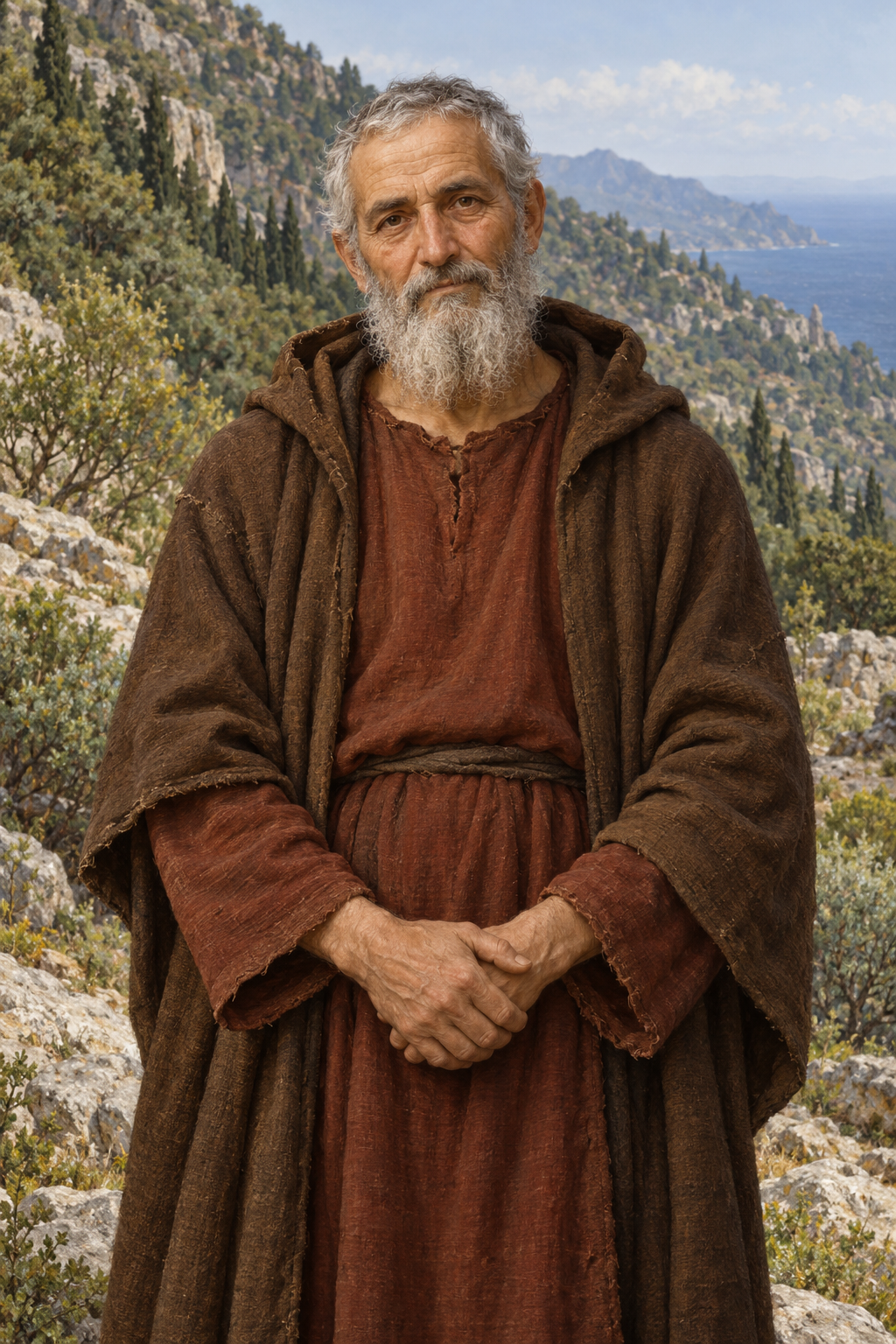
About Maximos of Kapsokalyvia
Maximos of Kapsokalyvia was a monk from Lampsacus who spent much of his life in the wilderness of Mount Athos. He became known for leaving his temporary shelters and burning them when visitors discovered where he was living. His name, often translated as Hutburner, remembers that unusual practice. The surviving biographies describe a man who first sought concealment and later received people seeking spiritual guidance.
Born with the name Manuel, he left home as a young man when his parents were arranging a marriage. He went to the monastic mountain of Ganos in Thrace and placed himself under an elder named Mark. According to his biography, Mark checked his enthusiasm for severe fasting and sleeplessness, advising a more moderate beginning. After Mark died, Maximos traveled to Mount Papikion and then to Constantinople.
In Constantinople he spent time near the church of the Virgin at Blachernae. His biographers portray his apparent foolishness as deliberate: he wanted to avoid admiration for his religious life. This description belongs to the Christian tradition of holy folly. It does not establish a medical diagnosis. On Athos he entered the Great Lavra, where his duties included signaling the hours and singing in the choir. Communal obedience preceded his better-known years as a wandering hermit.
The Orthodox Church in America preserves the tradition that a vision of Mary led him to climb the mountain and spend three days in prayer. Its account describes heavenly food and a promise that he would become a guide to others. These are devotional accounts of a calling, not independently verified descriptions of an encounter. They explain how the tradition connected his solitary life with the care of people who later sought him out.
Gregory of Sinai eventually urged Maximos to stop moving and to remain where others could benefit from his experience. The church account remembers his acceptance of that counsel as a change in his way of living. The same tradition remembers visits by emperors and stories of extraordinary foresight; those claims remain part of the hagiographic record.
The two early biographies do not tell his story in identical ways. Niphon, his companion and disciple, emphasized the solitary ascetic; Theophanes developed the portrait of a holy fool concealing an experienced life of prayer. Theophanes also included a conversation with Gregory of Sinai that later circulated separately. Rodionov traces its transmission into the Philokalia and discusses the later biographies that reworked the earlier narratives. These related texts are not four independent eyewitness accounts.
In Ware’s reading, the conversation presents prayer as a gift rather than an achievement that can be forced. Its descriptions of warmth, light and stillness belong to the language of spiritual experience. Ware cautions that Theophanes’s account also reflects the biographer’s interpretation; it cannot simply be treated as Maximos’s recorded speech. His precise years of birth and death likewise remain uncertain, despite confident dates in some later notices.
Modern scholarship has made the differences between the biographies easier to examine. Nicholas Marinides notes that the 2016 edition of Holy Men of Mount Athos translates both Niphon and Theophanes, preserving their distinct presentations. He also draws attention to Niphon’s stories about monks hoarding property, suggesting that they reflect concern over private possessions within monastic life. Maximos’s remembered poverty thus appears within disputes about how monks should live together.
Theophanes’s account also preserves opposition to Maximos, not just admiration. As Seyhun Kılıç discusses in a study of spiritual kinship, an elder dismissed his reported vision as a delusion, and other monks then avoided him. The narrative later names hermits who changed their judgment after meeting and speaking with him. They include Gerontios, Kornelios, Isaiah and Mark, among others. The list makes the hermit’s acceptance within a wider community part of his story, even though the meetings cannot all be independently verified.
Kılıç reads these episodes as a defense of Maximos’s reputation through the support of respected religious figures. Gregory’s intervention mattered within that account because other elders agreed with his advice to settle. The change therefore concerned more than a dwelling: the biography presented a man once treated with suspicion as someone able to guide others. This is an interpretation of how Theophanes tells the story, rather than proof that every encounter happened as narrated. It also gives a social setting to a life often remembered only through its unusual solitude. Kılıç also notes that the visiting patriarch Kallistos was Gregory’s spiritual son, connecting that later encounter with the same circle.
Rodionov places his final dwelling near the Great Lavra, where he died and was buried.
His name later became attached to the skete of Kavsokalyvia, founded long after his lifetime. That community should not be described as his own foundation. The enduring record joins memories of an elusive hermit with texts that continued to shape Athonite discussion of prayer and monastic life.
Wondering how to weigh the stories and sources? Learn how to read a saint biography.