Biography
Menas
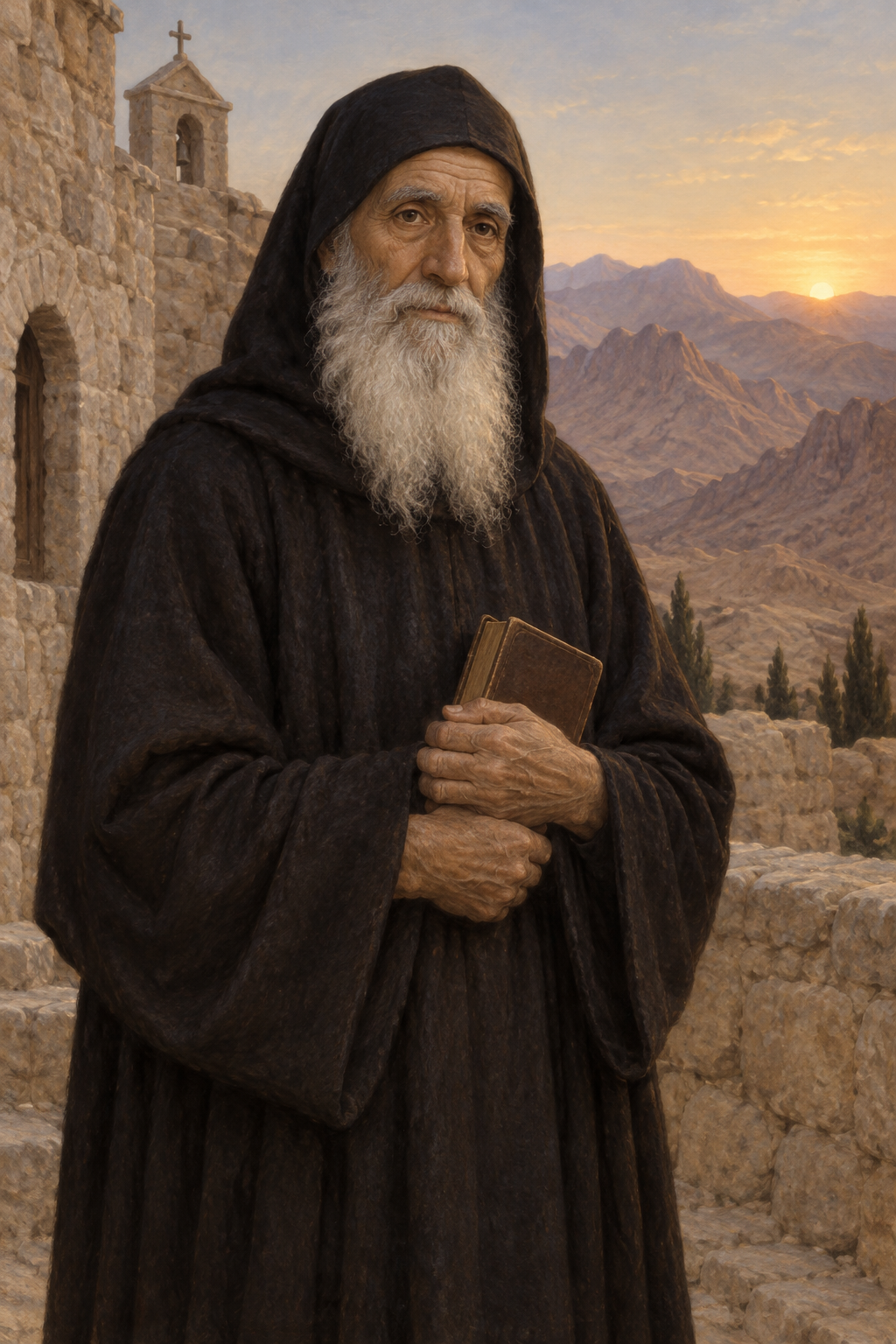
About Menas
The surviving account of Menas is short. The Orthodox Church in America remembers him as a monk of the Sinai monastery and dates his peaceful death broadly to the second half of the sixth century. Its entry also directs readers to John Climacus’s The Ladder of Divine Ascent, Step 4.34, the principal narrative source for Menas. These sources do not give his birthplace, family, early life, or a precise death date. “Of Sinai” describes his monastic association in the account; it is not evidence of where he was born.
John’s text presents Menas within the life of a monastic community. It says that he occupied the second place after the superior and had lived in the community for fifty-nine years, carrying out its various offices. This establishes how the text remembers his role: a long-serving monk trusted with senior responsibilities. It does not provide a list of those offices or enough information to reconstruct a sequence of events across his life. The passage is part of a work of spiritual instruction, and its purpose is to illustrate monastic obedience and communal life rather than to record a modern chronological biography.
The same chapter recounts a fragrant substance flowing from Menas’s body after burial and attributes further stories to the fathers of the monastery and to a disciple. Those details belong to the religious testimony preserved in the text. They cannot be independently confirmed from the sources reviewed here, so this profile does not present them as established historical events. John’s account remains valuable as evidence for Menas’s place in the memory of the Sinai monastic community, while its literary and devotional purpose calls for care in interpreting its extraordinary details.
The Orthodox Church in America commemorates Menas on January 5. That date is a liturgical observance; it does not establish the day on which he died. The available sources support no birth or death date precise enough for the catalog’s life-date fields, and they do not establish a birthplace or a separate death location. No events, patronage, or personal relationships are added. In particular, this monk should not be confused with the distinct martyr Menas of Egypt, whom the OCA commemorates on November 11. The limited evidence supports a modest account of a Sinai monk whose memory was preserved in John Climacus’s teaching on monastic life.
Wondering how to weigh the stories and sources? Learn how to read a saint biography.