Biography
Michael the Synkellos
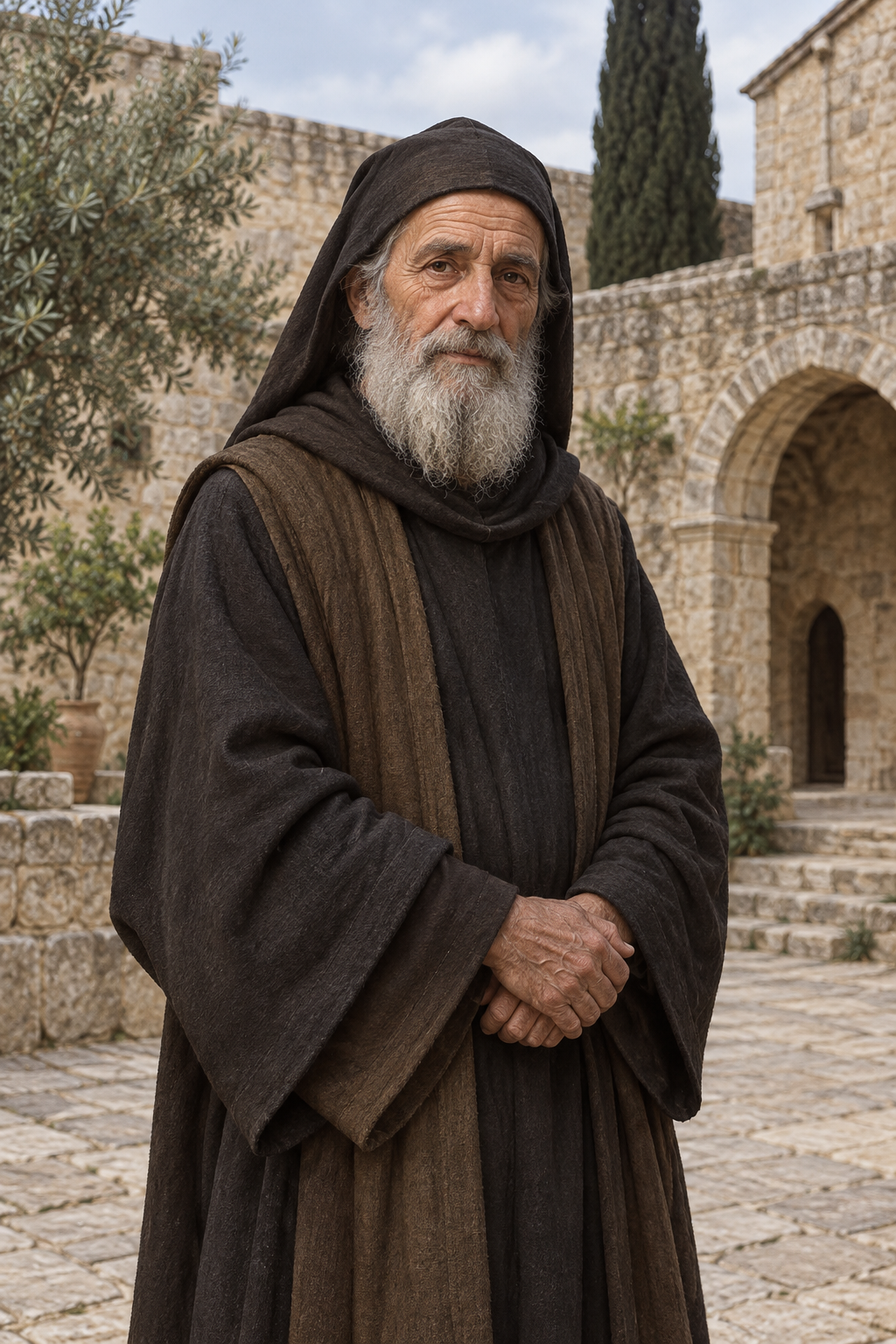
About Michael the Synkellos
Michael grew up in Jerusalem and became a monk at the monastery of Saint Sabas. His anonymous Life describes a substantial education before his entry into the monastery, including grammar, rhetoric and philosophy. It also presents him as a teacher of the brothers Theodore and Theophanes, later known as the Graptoi. The account provides a detailed sequence of ages and appointments, but those details do not all fit securely together. In particular, modern prosopographical research questions its identification of the patriarch who ordained Michael. His traditional title, synkellos, identifies a patriarchal assistant, although the details of his service in Jerusalem are disputed.
The Life also connects his decision with changes within his family. After his father died, his mother and sisters entered a women’s monastery. Michael gave part of his property to that community, sold what remained, and distributed the proceeds among poor people. This is the setting in which the narrative places his departure for Saint Sabas near Jerusalem.
The Life presents Michael and his companions as travelers on a mission intended to reach Rome. Christopher Walter, reviewing Mary Cunningham’s edition of the Life, emphasizes a problem in its explanation of their journey: they arrived in Constantinople before the renewed iconoclast policies that the author makes the reason for their presence. In the reconstruction discussed by Walter, the mission concerned the addition of the Filioque clause to the creed by Western monks. The discrepancy matters because it distinguishes Michael’s original assignment from the conflict in which he subsequently became involved. The Life remains an important witness to his memory, but its defense of icons shapes the way it tells his story.
There is evidence of Michael’s opposition to iconoclasm outside the anonymous Life. The modern prosopography identifies a letter addressed to him by Theodore the Studite between 821 and 826. Theodore praised his persistence and urged him to continue. The letter supports remembrance of Michael as a defender of icons without establishing every episode of his later biography.
The Life describes a particularly harsh period of imprisonment under Theophilos. In its account, Michael was confined in a dark cell and denied ordinary contact with Job, the monk who attended him. Age and illness made confinement harder. The author nevertheless preserves the name of a woman who helped: Euphrosyne, a nun, supplied food, drink and clothing, continuing her assistance after Michael moved to another cell. This episode places his survival within a network of practical care. The same narrative describes letters in which Michael encouraged acquaintances to remain committed to the veneration of icons, even as punishment threatened them. These details belong to the Life’s account, rather than to a neutral prison record.
One recipient was Stephen, a court secretary who had yielded under punishment. The Life says Michael sent encouraging letters and urged him to reverse that decision. Stephen again professed support for icons and was exiled, with his property confiscated. The story shows the serious consequences attached to this correspondence.
The received account places Michael at the Chora monastery in Constantinople after the end of iconoclast rule, serving as its abbot and as synkellos to Patriarch Methodios. He died there on January 4, 846. The Orthodox Encyclopedia attributes a statement of faith, a work on Greek syntax and an Arabic-to-Greek theological translation to him. It distinguishes him from a later namesake responsible for hagiographical works. These traditional attributions, however, are not all accepted in modern scholarship.
Maria Mavroudi reports a more extensive challenge by Claudia Sode: the author of the grammar and the translator associated with Patriarch Thomas may have been a different Michael from the saint remembered in the Life. Sode also questions the narrative of the Roman mission and the claim that Theodore and Theophanes were Michael’s disciples. Mavroudi accepts much of this caution while maintaining that the Palestinian background of the saint and the brothers remains secure. The disagreement prevents a confident reconstruction of his literary career from works bearing his name alone. It also calls for care in describing the relationships and offices that the Life assigns to him.
Warren Treadgold’s review of Sode’s study likewise accepts her objections to Michael’s supposed teaching of the brothers, the Roman mission and his patriarchal offices. He does not endorse every conclusion she draws about the brothers themselves. His distinction is useful: questioning an author’s chronology and unsupported accomplishments does not require dismissing every person or event in the narrative. Michael’s story can therefore be told as the memory of a Palestinian monk and confessor while acknowledging how much of its detailed shape depends on a contested Life.
The Orthodox Church in America commemorates Michael on December 18 as a confessor. Its account remembers both his imprisonment and his subsequent service to the Church. The title honors endurance under persecution; the account describes a peaceful death, not execution.
Wondering how to weigh the stories and sources? Learn how to read a saint biography.