Biography
Miguel Febres Cordero
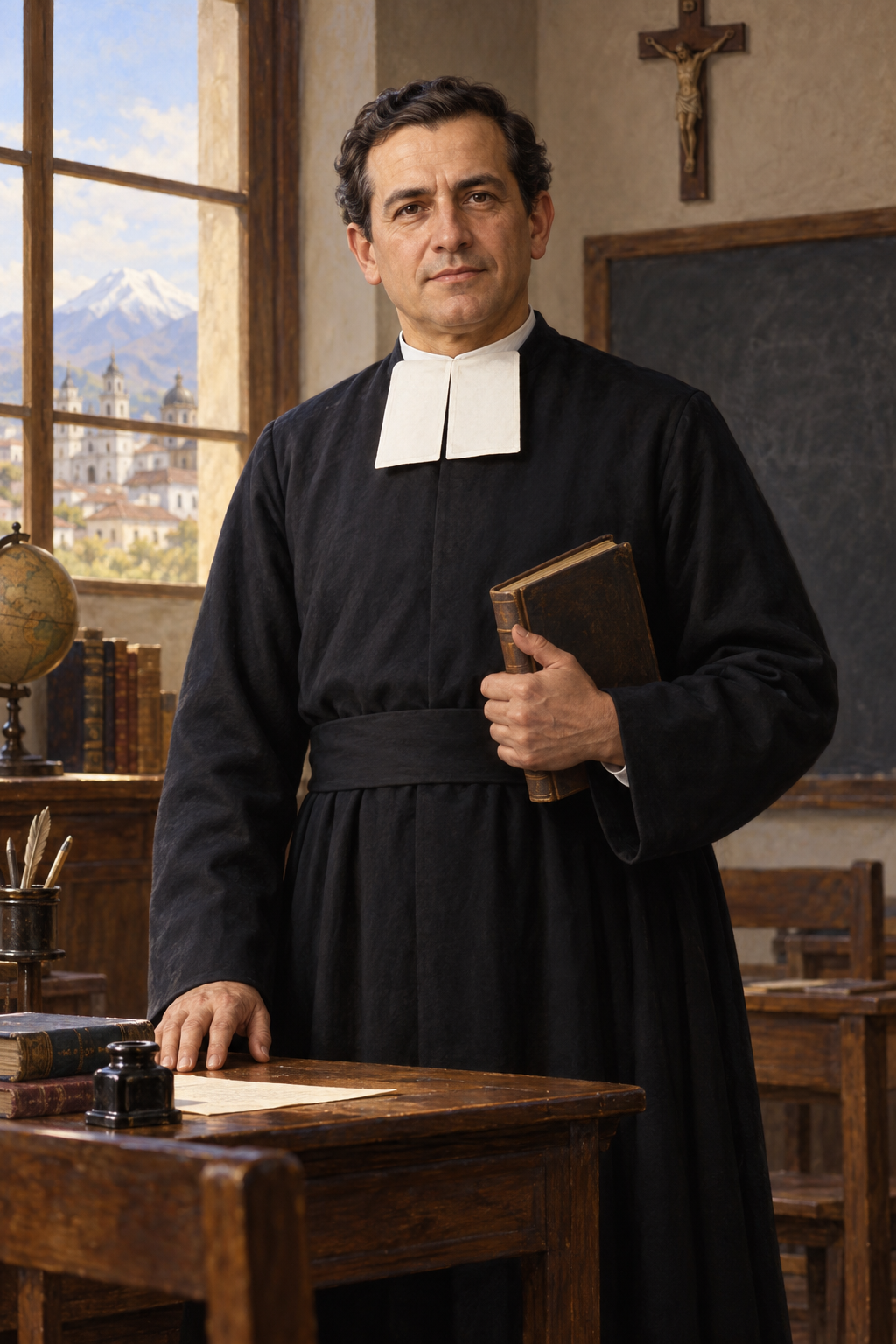
About Miguel Febres Cordero
Francisco Febres Cordero was born in Cuenca on 7 November 1854. After studying with the Christian Brothers, he entered their novitiate on 24 March 1868 and took the name Miguel.
His vocation was shaped by practical limits as well as ambition. Lasallian accounts describe a congenital problem with his feet and frail health. They also recall a family with influence in public life, uncertain about a vocation that offered neither ordination nor a conventional career. Brother Miguel became the first Ecuadorian admitted to the institute. The distinction matters because the Brothers' work in Ecuador had begun only recently. His entry showed that a local pupil could become a teacher within the same community. His later achievements should not obscure this early decision to share a brother's ordinary rule and daily school work.
In Quito, Miguel taught Spanish language and literature. Schoolbooks suitable for his pupils were scarce, so he began to write them. His *Gramatiquilla infantil* appeared in 1885 and a larger grammar in 1887. Linguist Francisco Javier Satorre Grau has examined the manuals and an 1890 government notice adopting one as a school text. That public use meant his work could reach children he never taught personally. A textbook has a modest form: lessons must be ordered, examples must be clear, and pupils must be able to return to them. For Miguel, writing and teaching reinforced each other, from classroom need to printed lesson.
He taught at several levels, from elementary classes to more advanced students, and also prepared children for First Communion. La Salle's later account lists instruction of military cadets among his assignments. This range explains why his interests crossed ordinary subject boundaries. He was not a scholar working apart from pupils. He encountered students with different ages and needs, and his publications were part of that wider educational labor. The surviving institutional account celebrates the breadth of his work, but its varying totals for books do not support a precise number. The secure point is that he produced many teaching texts while continuing to teach.
Miguel's work in grammar and literature gained recognition beyond his school. The Academia Ecuatoriana de la Lengua records his admission as a member in 1892. Its later account emphasizes both his knowledge of Spanish and his ability to explain language as a form of expression. Membership in an academy was an honor, but it did not replace his work as a Brother. He continued to write for learners and to teach. The academy record also helps place his achievement in Ecuadorian intellectual history: a classroom teacher contributed to debates about the language used in classrooms and books, rather than merely receiving material prepared elsewhere.
A modern historical study of Ecuadorian textbooks explains the wider setting of this work. The Brothers' system asked pupils in a class to use the same reading material, making appropriate manuals especially important. The study identifies Miguel as a major producer of such books and traces the influence of Lasallian manuals beyond his lifetime. This evidence adds a useful perspective to celebratory accounts. Textbooks were not simply a measure of one person's productivity; they helped organize classroom instruction and made lessons repeatable across schools. Their long use shows a concrete educational legacy, while the study's differing estimate of his total output advises against attaching a precise count to his name.
In 1907 Miguel's superiors sent him to Europe. French Brothers displaced by laws affecting religious congregations needed Spanish language materials for work in Spain and Latin America. Miguel spent time in Paris and at the Brothers' generalate in Belgium before moving to Premià de Mar near Barcelona. The assignment changed his setting but drew on the expertise developed through decades of teaching in Ecuador. He was asked to make another language accessible to fellow educators. The transfer was difficult for a man whose health was delicate, yet he continued the work of teaching and preparing texts within the institute.
Violence during Spain's 1909 anticlerical unrest reached the area around Premià de Mar. Lasallian accounts describe a move to Barcelona for the Brothers in formation and the young people entrusted to them. Miguel helped keep watch over the group. Later retellings also recount his care for the consecrated hosts in the chapel. These details belong to the institute's memory of a dangerous episode; they do not need dramatic embellishment to show what was at stake. School and formation work depended on the safety of students and teachers. When the community returned, Miguel's health declined. He contracted pneumonia near the end of January 1910.
Brother Miguel died at Premià de Mar on 9 February 1910. The Brothers' account says that news of his death brought a national mourning declaration in Ecuador. His students and fellow Brothers remembered him as a teacher whose learning remained joined to catechesis.
Paul VI beatified Brother Miguel in 1977, and John Paul II canonized him in 1984. His documented teaching and publications underlie his later recognition.
The Lasallian family observes his memory on 9 February. Schools named for him and later accounts of his life remember a brother who joined scholarship to the routine work of helping children read, write and understand their faith. The strongest public evidence of that legacy lies in the books and teaching practices that traveled beyond his own classrooms. His story also preserves a particular path into education: a boy taught by a new local school became one of the institute's teachers and writers. His significance rests in that sustained work, not in a claim that every later story about him can be verified.
Wondering how to weigh the stories and sources? Learn how to read a saint biography.