Biography
Nazaria of Văratec
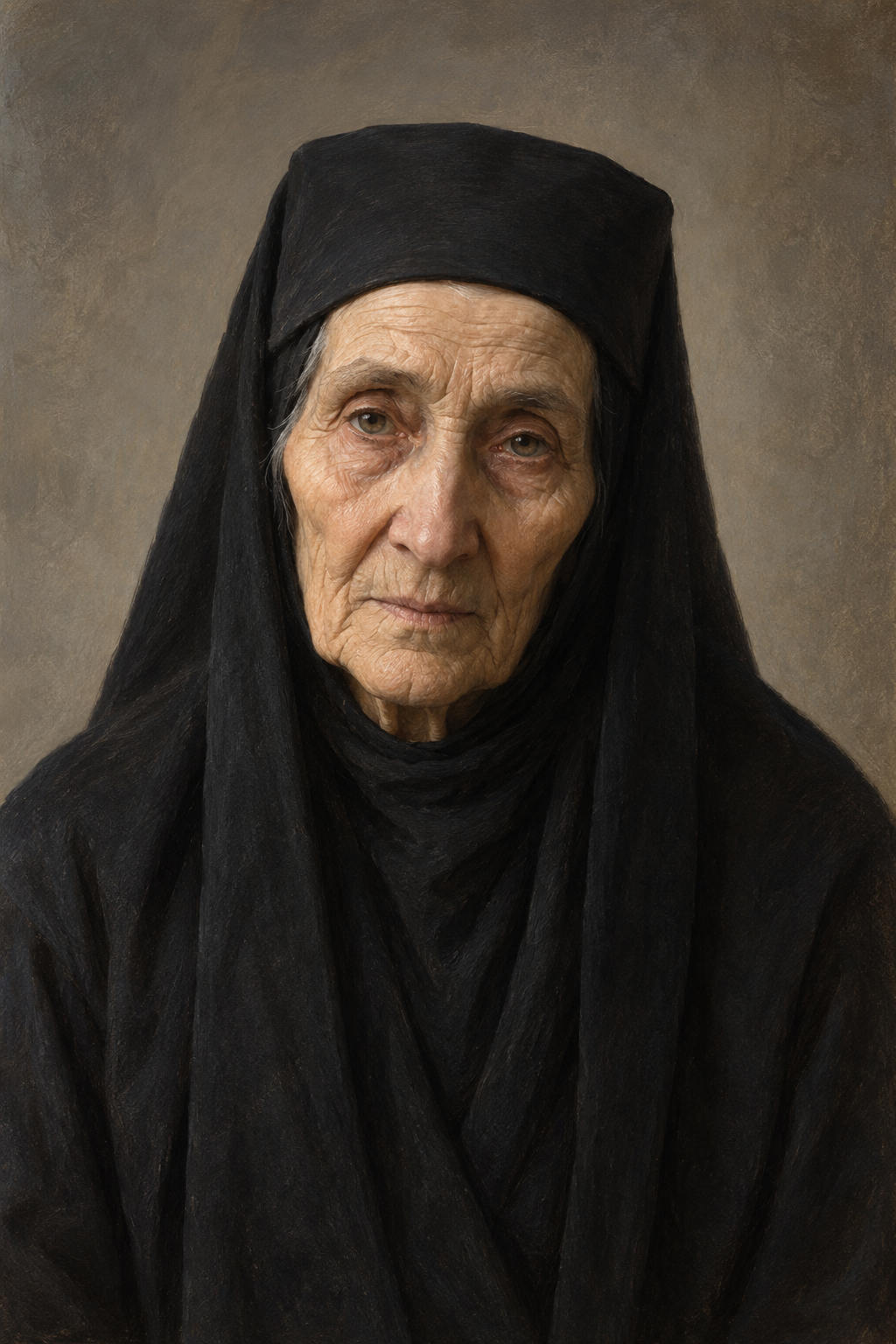
About Nazaria of Văratec
Nazaria of Văratec was an Orthodox widow who became a leader of women’s monastic communities in Moldavia. The church’s life places her birth in the Brașov region in 1697. After losing her husband and two children, she entered religious life, first receiving the name Natalia at Scânteia and then Nazaria at Bonțești.
Her unusually long lifespan rests on a reported grave inscription. Historian Romeo-Valentin Muscă explains that a brick discovered during work in 1973 bore the years 1697–1814; he accepts those dates while noting that publications have given differing birth years. He treats dates for her early movements between monasteries as approximate. The inscription is therefore the stated basis for the tradition that she lived 117 years.
Nazaria became a disciple of Paisie of Neamț and knew the spiritual guide Iosif. After leading nuns at Durău, she was called to Văratec in 1788. There she helped organize a growing community and oversaw the building of its stone church, consecrated in 1812.
Leadership was not an easy continuation of her earlier solitude. A letter from Paisie, transcribed by Muscă, answers her distress over disorder among the sisters and her regret at leaving her quiet cell. He reassured her that he had not abandoned the community, gave practical directions, and sent men to help settle its troubles. The correspondence preserves a troubled working relationship as well as spiritual encouragement.
Her responsibilities also extended to Agapia. Philologist N.A.Ursu points to a manuscript note from 1807 naming Nazaria as abbess there, correcting an older account that had reduced her stay to a few weeks. His discussion places her leadership within the combined administration of Agapia and Văratec after 1803.
Nazaria died on December 18, 1814, and was buried in Văratec’s main church. Her remains were moved to the monastery’s ossuary in 2014. The Romanian Orthodox Church canonized her in 2025 and established August 17 as her feast.
She is honored with Olimpiada and Elisabeta as one of Văratec Monastery’s protectors.
Wondering how to weigh the stories and sources? Learn how to read a saint biography.