Biography
Nerses the Great
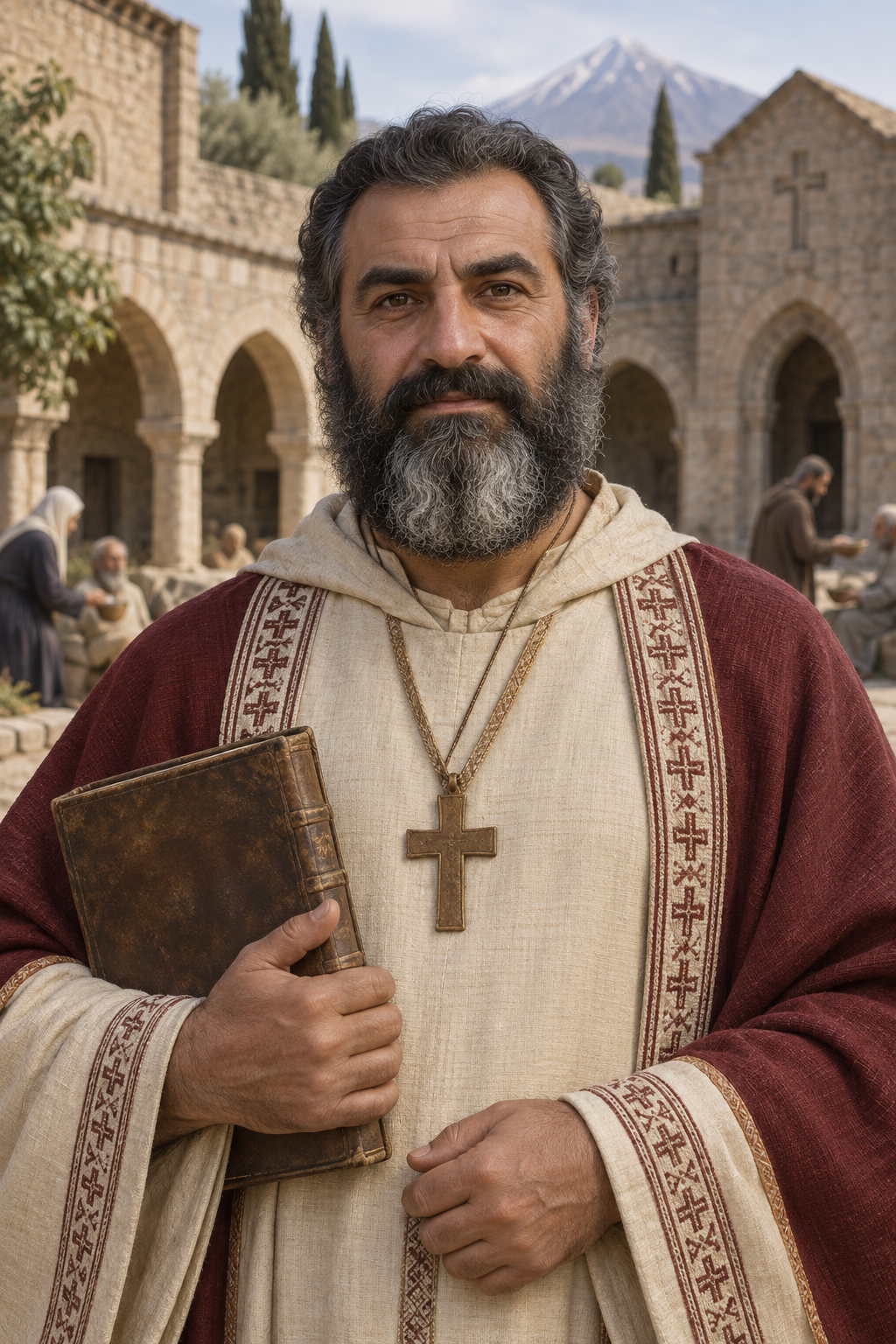
About Nerses the Great
Nerses the Great led the Armenian Church during the fourth century, when a bishop's responsibilities could reach from worship and public charity into the affairs of kings. His career joined service to vulnerable people with difficult confrontations at court.
The Armenia in which he worked was a kingdom contested by Rome and Sasanian Persia, but its difficulties were not simply imposed from outside. Powerful noble families defended inherited authority of their own, while the crown sought to strengthen its position above them. Christianity did not remove those rivalries. A prince's religious allegiance and his political alliances could pull in different directions. Nerses' public responsibilities belonged within this aristocratic society, rather than within a modern division between religious institutions and government. The royal dynasty itself shared Arsacid roots with the ruling house that the Sasanians had displaced in Persia.
His birth is placed around 329 in a modern ecclesiastical reference; its approximate date should not be mistaken for a contemporary birth record.
He had been married before becoming a bishop. A later Life names his wife as Sanducht of the Mamikonian family and their son as Sahak, himself a future leader of the Armenian Church. It relates that she died in Caesarea three years after the birth of their son. This is a received account of his household, not a surviving contemporary family record.
Moses gives a different account of his marriage, naming his wife's father as Aspion rather than identifying a Mamikonian family.
The succession before his appointment remains disputed, and scholarly reconstructions do not agree on an uninterrupted sequence of bishops.
Nerses entered an office that carried responsibilities beyond preaching and the administration of sacraments. Armenian bishops belonged to the same world of hereditary families as the country's princes. Their jurisdictions followed family territories rather than a network of urban centers comparable to that of the Roman Empire. The chief bishop could exercise judicial authority and responsibility for poor people as well as spiritual leadership. This setting helps explain why the distribution of property and resources became part of his pastoral work, and why decisions made within the Church could concern the royal court.
Moses describes Nerses assigning estates to supply food and clothing, with Khad entrusted to oversee this continuing care.
He became bishop in the early 350s, though the precise year remains disputed. His charitable work is often compared with Basil's later foundation. The available chronology does not establish direct dependence; recent research places both within a developing tradition of Christian assistance.
The later Life also assigns Nerses a role in arranging the precedence of noble families at the king's table. Its detailed ceremonial account connects him with the organization of royal society, not only with withdrawal from it. The attribution belongs to that later tradition and should not be treated as a contemporary record of his administration.
Moses also preserves a more personal intervention after violence at Arshakawan. In his version, nobles killed the adult inhabitants, leaving infants to be carried away captive. Nerses arrived too late to prevent the killings, but secured the children's release and arranged shelter and wet nurses. The episode is a later historical tradition, not an independently documented rescue.
Nerses unsuccessfully pleaded with King Arshak for Gnel, according to the Epic Histories.
Nerses also spent years away from office. One scholarly reconstruction connects his removal with the council at Seleucia in 359 and places his return under King Pap; the exact chronology should remain qualified.
Maksoudian interprets the break with Arshak primarily as a political conflict: Nerses favored the Roman alliance, while the court's alignment shifted. On that reading, his removal from office was not simply punishment for condemning royal misconduct.
The political landscape had changed profoundly during these years. After Julian's death, Rome's agreement with Persia restricted Roman assistance to the Armenian king. Pap later returned to the kingdom with Roman support. Nerses therefore faced a different ruler on his return, but the tension between royal power, noble interests and the Church remained. The external alliances that helped a king recover his throne did not settle those competing claims within Armenia.
He is probably the Narses named among Basil's fellow bishops in a letter of 372.
The collective appeal asked bishops in Italy and Gaul to assist divided eastern churches. Its authors condemned the diversion of resources intended for poor people and called for agreement around the faith of Nicaea. It is not a personal letter or an autograph statement written by Nerses alone.
Nerses died in 373.
The circumstances of his death are disputed. Krikor Maksoudian considers a natural death probable and does not regard the familiar accusation against Pap as established. Conflict between king and bishop should therefore not be confused with proof of murder.
The Armenian Apostolic tradition remembers him especially for bringing the needs of ordinary people into the work of the Church. His enduring place in that tradition centers on organized care and the willingness to challenge powerful people, rather than on the possession of high office alone.
Wondering how to weigh the stories and sources? Learn how to read a saint biography.
Explore similar vocations
Prayers for Nerses the Great
Nerses excerpt
accept my soul