Biography
Nicephorus of Medikion
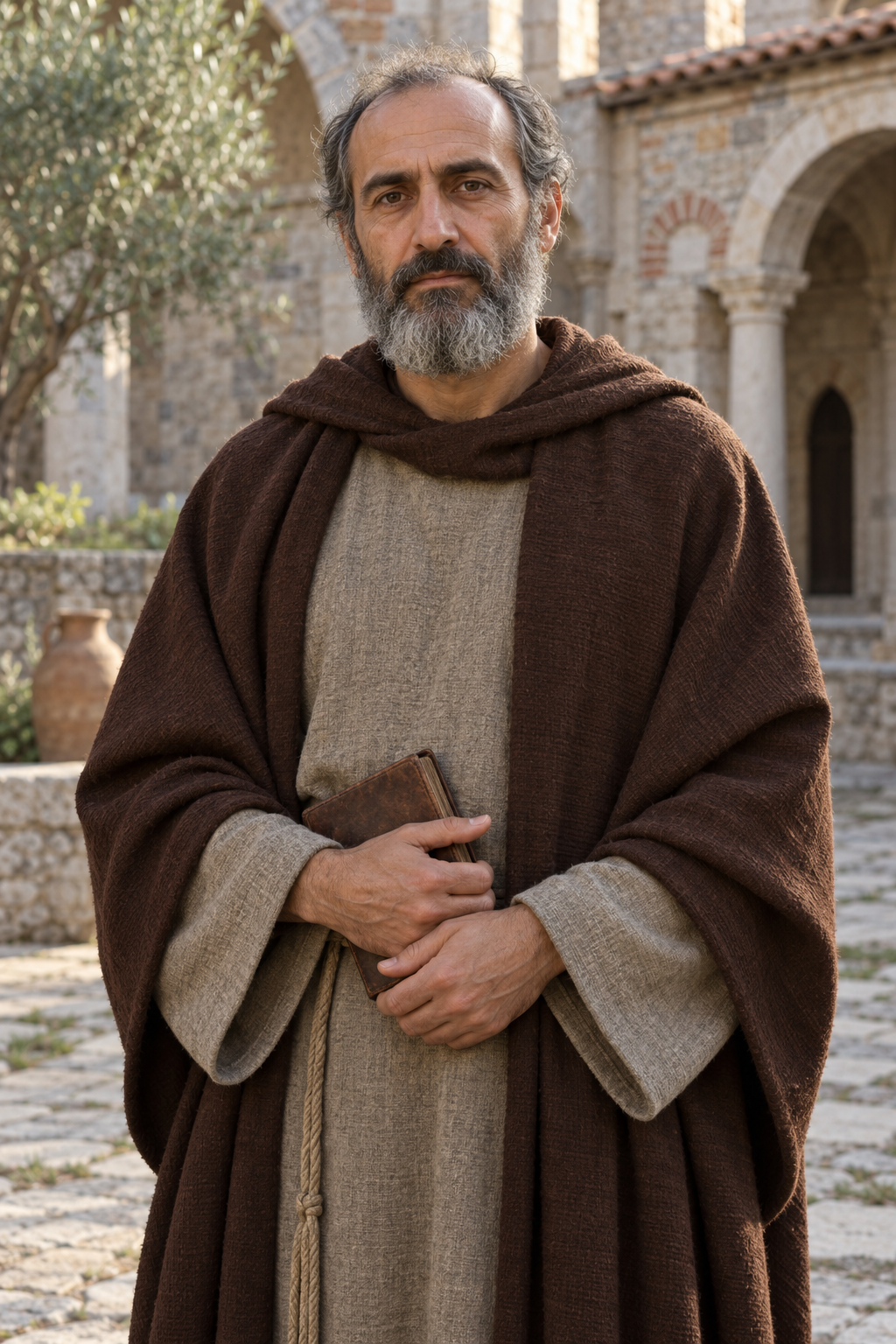
About Nicephorus of Medikion
Nicephorus of Medikion built and led monastic communities in Bithynia during the late eighth and early ninth centuries. The account of his life places his birth around 755 in a wealthy family associated with Constantinople. He entered the monastery of Herakleios as a young adult, then undertook the restoration of an older religious establishment. His work eventually led to the community of Medikion, where he served as abbot.
According to the biography summarized by the Orthodox Encyclopedia, his father died while the family was still young. His mother raised three sons, who received an education and later chose monastic life; she also became a nun. Nicephorus’s first superior, Joseph, encouraged him to establish a community elsewhere in Bithynia. The narrative connects his foundations with the growth of a group of monks seeking his guidance. These family details come through his religious biography rather than surviving household records.
The order in which the establishments developed is not entirely clear. The prosopographical study distinguishes an earlier foundation from the later monastery dedicated to the Archangel Michael. It also identifies firm evidence for Nicephorus’s participation at the council of Nicaea in 787: he signed during its fourth session as abbot of Saint Sergius of Medikion. That signature supports his role in the council’s defense of religious images. It does not settle every question about the monastery’s buildings or their chronology.
Archaeological research has added another perspective. A survey published in 2005 compared the Life’s description of two nearby establishments with remains in the landscape around Trigleia. The researchers identified a religious site above Medikion that they considered the earlier foundation. They reported architectural fragments and a location consistent with the written account. Their conclusion concerns the history of the monastic sites; it does not independently confirm every episode in the founder’s biography.
The same study describes a practical aspect of founding a monastery. According to the Life, Nicephorus acquired land containing a ruined church of the Archangel Michael and restored it. The narrative also associates the new establishment with a change in its taxation that displeased treasury officials. This detail places the foundation within the material affairs of landholding and administration, alongside its religious purpose.
His biographer also presents spiritual guidance through images of healing. Krausmüller explains that the illnesses in one passage represent moral failings, including greed and ambition. The author values the healing of souls above bodily cures.
The coastal setting has also attracted attention from historians of Byzantine maritime travel and navigation. Eleonora Kountoura Galaki discusses Nicephorus’s first foundation in a study of monasteries that may have assisted ships. She relates its position near Katabolos and west of Trigleia to the ability to watch surrounding maritime traffic. From that location, she suggests, the monastery could have served as a lighthouse. This remains a proposal about the use of the site, based on its geography and the interpretation of written descriptions. It is not direct evidence that Nicephorus personally maintained a beacon or that sailors regarded him as their patron. The possibility places his foundations within a coastal landscape of travel and commerce.
As his health declined, Nicephorus relied on Nicetas and Athanasius to help govern the community. His biographer describes a journey to Constantinople in search of treatment. When that brought no relief, he set out for home but died on the island of Chalke. His remains were returned to Medikion. The Orthodox Encyclopedia also warns that a later account mixes parts of his life with those of his successor Nicetas. The two abbots should therefore remain distinct, especially in accounts of persecution.
His final journey receives a fuller treatment in the anonymous Life, in a passage translated by historian Dirk Krausmüller. The biographer says that Nicephorus sensed his approaching death through a revelation and hurried from the capital, hoping to see his monks again. He left the outcome to God rather than promising that he would reach them. On Chalke his illness worsened, and he asked to receive communion before dying.
Krausmüller draws attention to the uncertainty preserved in this story. Although the Life attributes a revelation to Nicephorus, it does not give him knowledge of the precise date of his death. His hope of returning alive to his community goes unfulfilled. The historian contrasts this restrained account with biographies that give holy people detailed predictions of their deaths. The distinction concerns how the author portrays holiness; it does not establish the reported revelation as an independently verified event.
The prosopographical study dates his death to May 4, 813.
His commemoration continues in Greek Orthodox parish calendars. A May 4 bulletin from Holy Cross parish identifies him specifically as the founder of Medikion, preserving the connection between the saint and the community he established.
The Ukrainian Catholic Eparchy of New Westminster lists Nicephorus on May 5 as the abbot of Medikion.
Wondering how to weigh the stories and sources? Learn how to read a saint biography.