Biography
Nicephorus the Leper
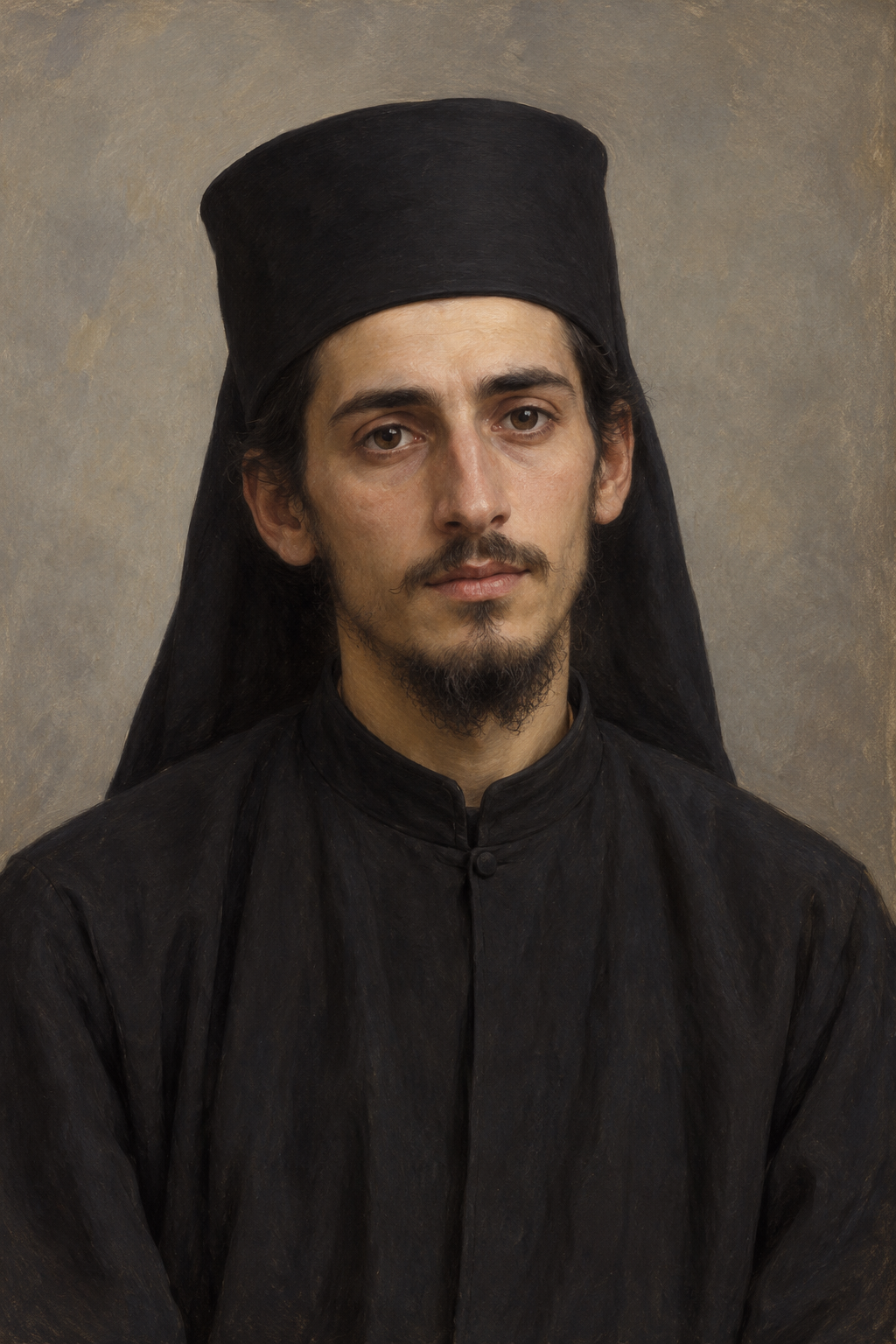
About Nicephorus the Leper
Nicephorus the Leper was born Nicholas Tzanakakis in Sirikari, Crete. He learned the barber’s trade while young. After developing Hansen’s disease, he left for Egypt to avoid compulsory isolation on Spinalonga. He later entered the hospital on Chios, where Anthimos guided him into monastic life.
The introduction to Neophytos’s account gives his birth year as 1887. The standard life instead gives 1890, leaving a difference that cannot be resolved from these sources.
Monastic life at the hospital took shape around its church of Saint Lazarus. Hieromonk Dimitrios Kavvadias describes other patients who also became monks there, placing Nicephorus within a small religious community rather than presenting him as an entirely solitary figure. His account remembers Nicephorus as a principal chanter who continued to take part after losing his sight, reciting the Epistle reading from memory. It also preserves the recollection of a nun at the monastery of Panagia Voitheia, where visits by Nicephorus and Anthimos brought the sisters together for conversation and a blessing. These recollections describe relationships sustained through worship and ordinary meetings, alongside the more dramatic stories of sanctity.
Nicephorus also helped preserve the memory of his teacher. Kavvadias describes him keeping a record of events he believed were miracles worked through Anthimos’s prayers. When impaired sight and touch made writing difficult, he dictated to others. This is evidence of his devotion and his participation in transmitting that tradition; the reported healings are not independently verified medical outcomes. His changing abilities affected how he carried out the task, but did not end his interest in preserving these memories.
At Chios, Nicephorus helped with the garden and sang in church. His illness progressively affected his sight and movement. In 1957, he was transferred to the Saint Barbara hospital near Athens. Eumenios Saridakis, who had also experienced the disease, cared for him there. The account remembers their relationship as one of service and spiritual companionship.
Nikodemos’s recollection emphasizes an unassuming manner of teaching: he remembered drawing encouragement from Nicephorus’s presence even when the monk offered few words.
Archimandrite Nikodemos Giannakopoulos later recalled meeting Nicephorus in 1961. He had belonged to a group of young visitors encouraged by the deacon Nikolaos Selentis to spend time with the patients. In his testimony, the visits were meant to bring companionship to people who had been socially isolated. He remembers Nicephorus’s severe physical limitations, but also the peace and affection he experienced in his company. The small hospital room became, for these visitors, a place of spiritual encouragement. Nikodemos presents his guidance as something conveyed through his manner of living and sometimes through silence, without elaborate instruction. This is a visitor’s personal testimony about the encounter and its meaning for him.
Another visitor, the future Metropolitan Euthymios of Achelous, left a dated recollection of their only meeting. While serving as a deacon in 1962–1963, he assisted at the hospital’s liturgy and afterward was taken to Nicephorus’s room. He remembered an animated conversation in which the bedridden, blind monk spoke with keen interest. A remark about clerical ambition struck the young deacon as unexpectedly close to his private thoughts. Writing in September 2002, decades after the encounter, Euthymios interpreted it as a sign of spiritual discernment. He also acknowledged that Nicephorus might already have heard about his work with the Orthodox youth organization Syndesmos. Preserving that qualification matters: the account records both the visitor’s conviction and his uncertainty about what the monk had known before they spoke. It offers a personal memory of attentive conversation, not proof of a supernatural explanation.
Nicephorus died on January 4, 1964. His life was remembered within the hospital community and by people who came to seek his blessing.
Memory of Nicephorus also passed through Eumenios to a younger generation. Metropolitan Neophytos of Morphou explains that he knew Eumenios during his student years and continued visiting him afterward. His account of Nicephorus therefore draws on Eumenios’s recollections rather than a claim to have met Nicephorus himself. A published introduction links the three figures through spiritual guidance: Anthimos taught Nicephorus, and Nicephorus in turn guided Eumenios. This chain of remembered relationships helps explain how the life of a monk in a hospital came to be told beyond the people who had visited his room.
His recognition as a saint followed a request from the metropolitan of his home region. The Cretan synod supported the proposal and sent it to the Ecumenical Patriarchate. Its encyclical records approval in 2012 and the establishment of January 4 as his annual commemoration. It also describes the first official celebration in Kissamos in January 2013.
The same letter reports that Christians invoke his help during illness and other difficulties. That practice supports his association with people seeking relief from illness. It records a devotional appeal, rather than a formal appointment as patron of a medical profession.
Wondering how to weigh the stories and sources? Learn how to read a saint biography.