Biography
Nicetas the Patrician
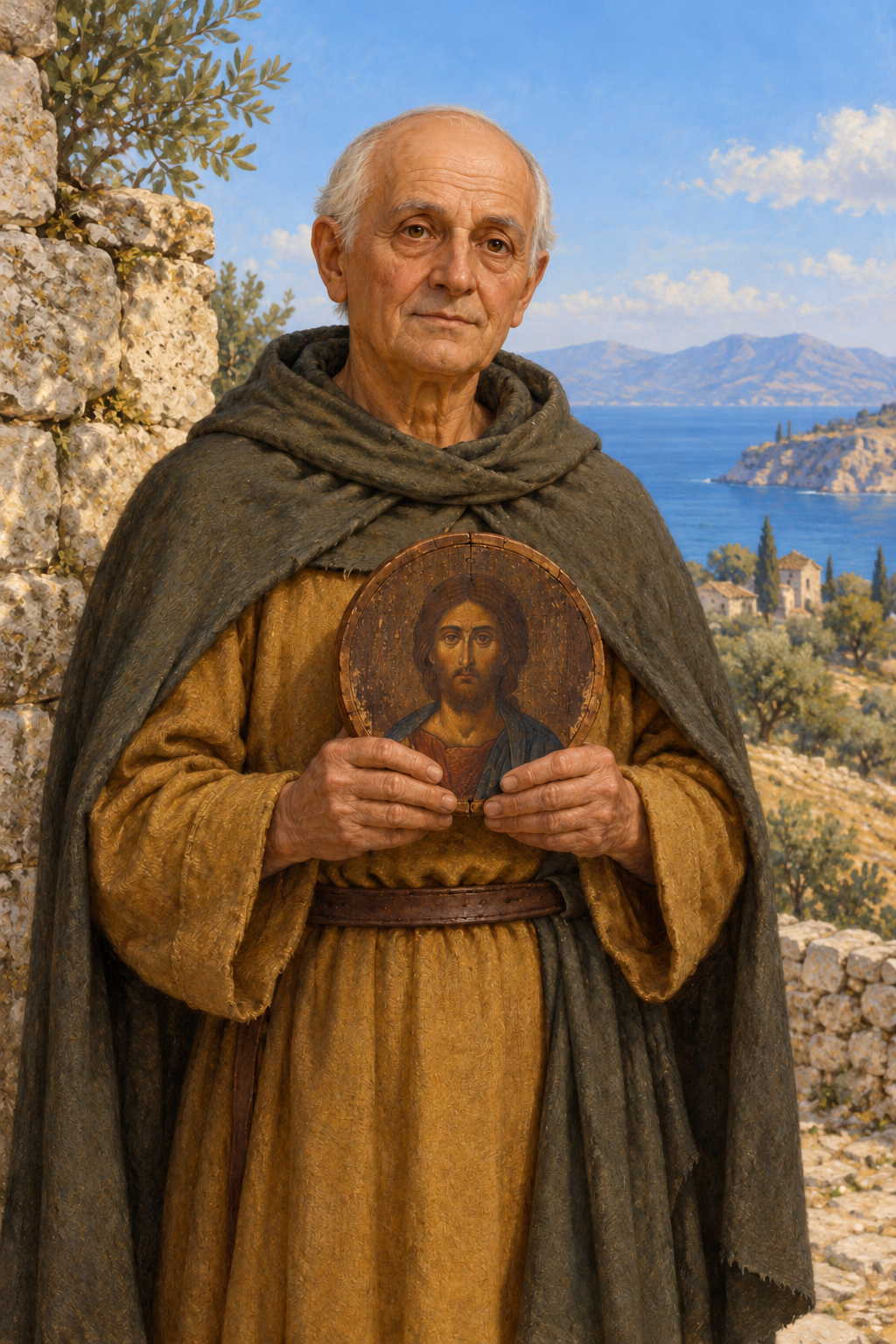
About Nicetas the Patrician
Nicetas the Patrician was a Byzantine court official who became a monk and resisted imperial opposition to icons. The Orthodox Church in America commemorates him as Nicetas the Confessor of Paphlagonia on October 13. Its account remembers a man who gave up public honors and later endured displacement for his religious convictions.
He was born in Paphlagonia around 761 or 762. His parents had him castrated as a child, possibly to improve his prospects in imperial service. The critical prosopography treats that motive as a possibility, not a known intention.
His hagiography names his parents as Gregory and Anna and says that he reached Constantinople when he was seventeen. In the account summarized by the Prosopography of the Byzantine Empire, he entered Irene’s service and rose within her household. The source’s description of his position is not precise enough to identify a particular office with certainty.
His early career is difficult to reconstruct. Accounts identify him with a governor of Sicily associated with an embassy to Charlemagne in 797, but connecting the Greek saint’s life with the Latin historical record remains probable rather than certain. The claim that he represented Empress Irene at the Council of Nicaea in 787 lacks confirmation in the council’s records.
The title by which he is remembered also needs its historical setting. As the Catholic Church in Norway’s account explains, patrikios was a high Byzantine honorific. It did not simply mean membership in the old ruling families of ancient Rome. The same account distinguishes this title from strategos, the provincial governorship usually associated with his Sicilian career.
According to the Orthodox Encyclopedia’s account of his life, earlier emperors refused his wish to become a monk. Michael I finally permitted him to enter Chrysonike, a monastery near Constantinople’s Golden Gate. His withdrawal from court did not take him beyond the reach of imperial policy.
The surviving accounts do not all place his withdrawal from court at the same point in his life. The Prosopography of the Byzantine Empire sets two versions alongside one another: one associates his renunciation with Leo V, while another says that earlier rulers prevented him from becoming a monk and that he entered monastic life at about fifty. This difference limits how confidently the transition can be narrated; the first version specifically describes his renunciation of rank and wealth.
After renewed opposition to icons under Leo V, he moved to a monastery outside the capital. His life tells of imperial servants demanding an icon of Christ that he would not surrender. Another monk disclosed its location, and the image was confiscated. Nicetas was then forbidden to leave the monastery.
Banev describes a continuing material connection between Nicetas and the monastery he entered. Nicetas gave Chrysonike an outlying estate, whose location is not securely identified. When renewed opposition to icons drove him from the capital, that property became a place of refuge. His later foundation at Katesia involved another purchase of land and the participation of his nephew, also a monk named Nicetas. The account thus links his movement between religious communities with property used to sustain monastic life, while leaving some of those places difficult to locate precisely.
Further pressure came under Theophilus. Nicetas refused to recognize the iconoclast patriarch Antony and was expelled. The account describes him leaving with three monks and eventually establishing a church dedicated to Michael and Gabriel. A monastic community grew there, and one of its members probably wrote his life soon after his death.
His travels brought him into the care of people who could offer temporary refuge. The Prosopography of the Byzantine Empire records a stay at Zouloupas, an estate belonging to a relative named Nikolaos, after visits to Panteichion and Eribolos.
The scholarly chronology traces several moves in Bithynia before his foundation at Katesia. In September 836, he left for a monastery near the sea, close to Daphnusia, where he died on October 6. The prosopography records his arrival there on September 11 and the onset of his final confinement to bed a week later, before his death in early October.
The Orthodox Church in America instead places his death around 838 and recalls miracles attributed to him during his lifetime and afterward. These belong to his devotional remembrance; they do not resolve the disagreement over his death year.
The account of Nicetas’s life has its own history of mistaken identity. Gencho Banev’s scholarly account reports that a surviving twelfth-century manuscript was once assigned to Nicetas of Medikion, a different monk. It describes the work as an anonymous composition from Nicetas the Patrician’s own community, drawing on notes by his nephew and disciple, who shared his name. This transmission matters because the narrative reaches later readers through a community that remembered him as its founder, rather than through an imperial record of his career.
Wondering how to weigh the stories and sources? Learn how to read a saint biography.