Biography
Nicholas of Myra
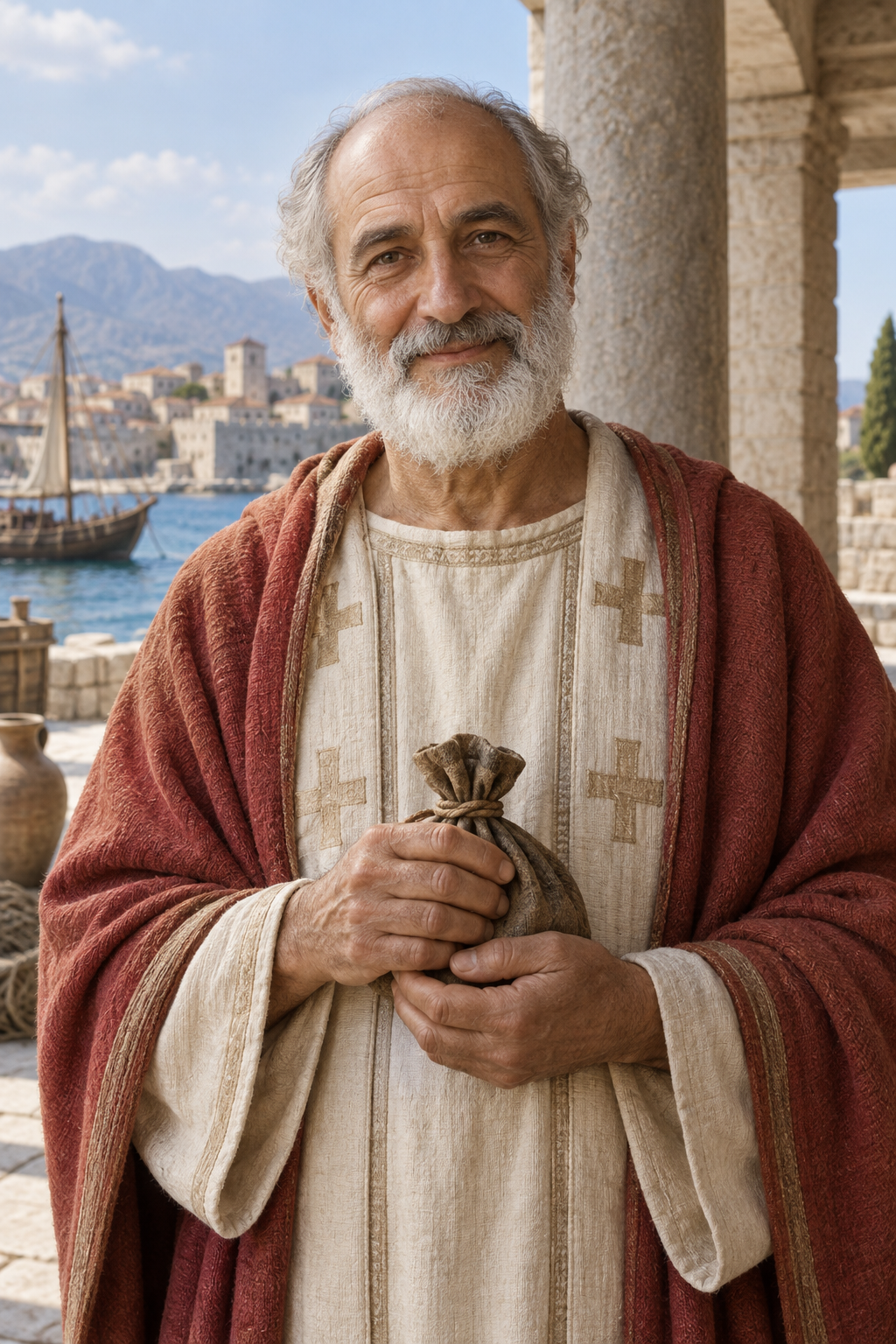
About Nicholas of Myra
Nicholas is remembered as a bishop of Myra in Lycia during the early fourth century. Much more can be said securely about the growth of devotion to him than about his childhood or episcopal career. The historical introduction published by the Basilica of Saint Nicholas in Bari acknowledges the disputed dating of the earliest narrative and the much later composition of Michael the Archimandrite's Life. It also distinguishes him from Nicholas of Sion, a sixth-century monk and bishop whose biography became entangled with his. The familiar detailed life of Nicholas of Myra is therefore a received portrait built from several periods, rather than a continuous contemporary record.
In Michael's medieval Life, a prosperous neighbor falls into poverty and considers exploiting his three daughters sexually. Nicholas intervenes with gifts of gold delivered secretly through a window. The gifts provide dowries, allowing the daughters to marry, while Nicholas tries to keep his generosity hidden. The story makes help effective without making public humiliation its price. In another episode, he intervenes when three men are about to be executed under an unjust sentence, freeing them from their bonds. These later legends portray a bishop concerned with the dangers facing ordinary households and with the abuse of public power; they do not supply verified dates for his actions.
By the sixth century, a shrine honoring Nicholas could be described in an account of the imperial capital. Procopius, writing about Justinian's buildings, names a sanctuary dedicated to Priscus and Nicholas beyond Blachernae in Constantinople. He describes worshippers honoring the saints and other visitors enjoying the precinct, whose foundations extended into the water. This is evidence of public devotion in the author's own world. It does not identify this Nicholas explicitly as the bishop of Myra.
A major change in the geography of that devotion came in 1087. Giovanni, an archdeacon of Bari, tells how men sailing on a commercial voyage went to Myra and removed bones from the saint's tomb. His account describes the breaking of its marble covering and the hurried collection of remains. Although he celebrates the expedition, his account describes a seizure of the remains. The relics reached Bari on May 9 and were entrusted to Abbot Elia. This event helps explain the saint's other familiar designation, Nicholas of Bari; it concerns the movement of remains venerated as his, not a journey he made during his lifetime.
His remembrance still invites practical generosity. The Evangelical Lutheran Church in America's guidance for December 6 connects stories of his care for children with later Santa Claus traditions and suggests marking his day through giving. The modern gift-bringer belongs to that reception, not to Nicholas's historical personal names. A church remembering the bishop can turn attention from acquiring presents toward people who need support.
Wondering how to weigh the stories and sources? Learn how to read a saint biography.
Explore similar vocations
Prayers for Nicholas of Myra
Nicholas: collect excerpt
make us mindful of the needs of others