Biography
Nicholas Owen
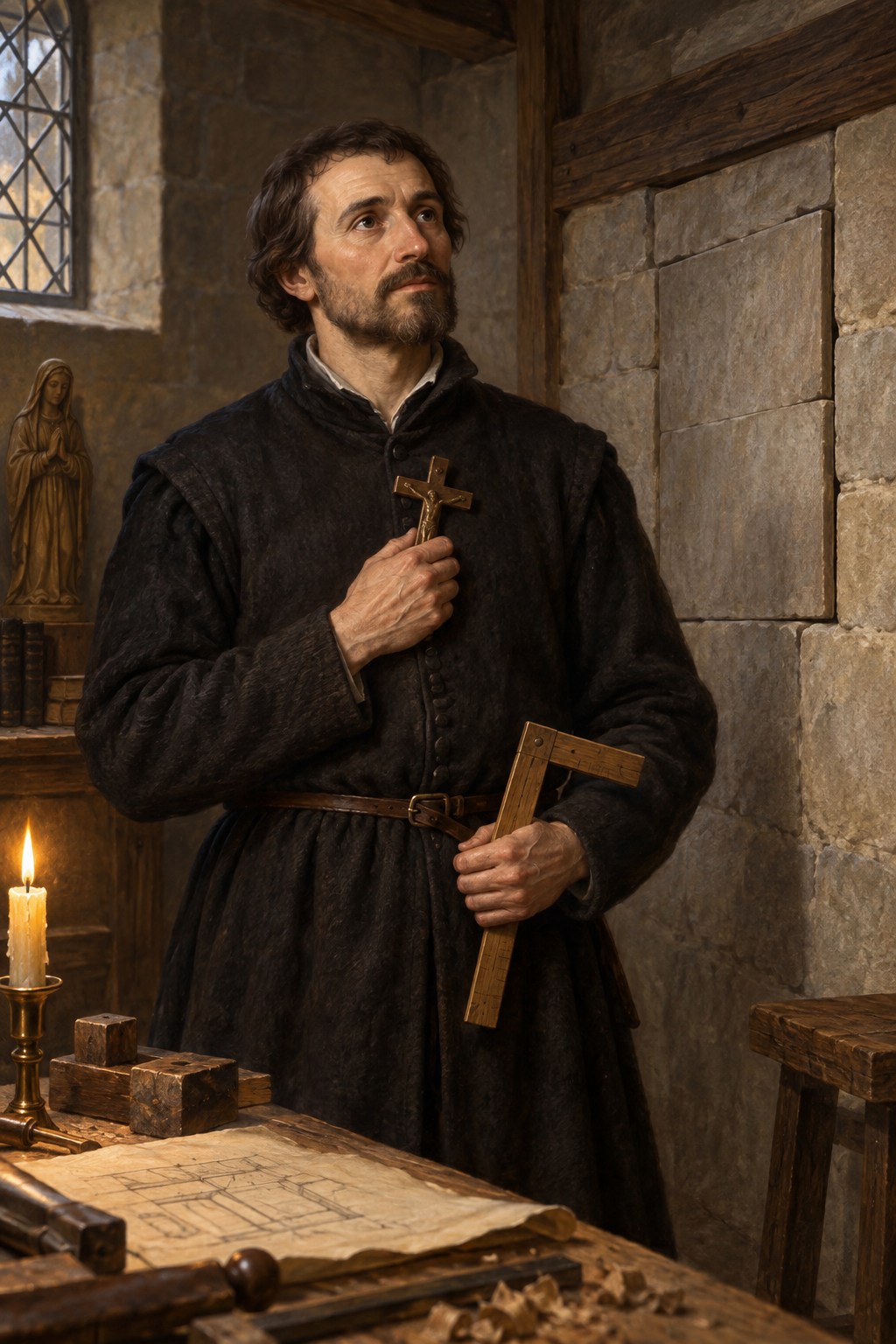
About Nicholas Owen
Nicholas Owen’s life is known chiefly through his service as a Jesuit lay brother, his work making hiding places for Catholic priests, and his death under torture in the Tower of London in 1606.
Pope Paul VI’s 1970 account says Owen was born in Oxford and entered the Society of Jesus as a lay brother, while the Vatican martyr list records his death on 2 March 1606.
The available sources do not establish an exact birth date or a detailed account of his childhood.
Parker says Owen’s parentage and birth date are unrecorded; the 1970 Vatican letter identifies Oxford as his birthplace.
The 1585 Act Against Jesuits and Seminarists made it a capital offence for an English-born Jesuit or seminary priest to remain in England after its deadline, part of the legal danger surrounding Catholic ministry.
The 1585 statute named in Paul VI’s account targeted members of the Society of Jesus and priests who had studied at seminaries abroad.
After the Gunpowder Plot of 1605, the government pursued people associated with the Jesuit mission, although the actual conspirators had been apprehended.
Owen worked as a mason and carpenter, skills that he put to use in Catholic households where priests needed places to avoid searches.
His hiding places were built into houses and could be concealed in walls or underground spaces, making them difficult to discover during a search.
The Society of Jesus account says he worked openly as a carpenter by day and secretly on hiding places at night.
Secrecy mattered because servants and other household members could be unaware of a hiding place’s position, reducing the number of people who could reveal it.
Owen’s work could protect priests, but the broader historical evidence cautions against assigning every surviving priest hole to him.
Hodgetts identifies errors in older accounts about Owen’s work and identity.
A contemporary account by Jesuit John Gerard, quoted by Hodgetts, describes Owen as knowing secret places in Catholic houses and the means by which hiding places could be found.
Parker says Owen first served Edmund Campion and was imprisoned after he publicly defended Campion’s innocence following Campion’s execution in 1581.
Owen subsequently served the Jesuit mission under Henry Garnet, who was the superior of the English Jesuits.
The Jesuit account says that the date of Owen’s formal entry into the Society remains unknown.
Hodgetts warns that a 1580 letter attributed to Owen may instead refer to another Nicholas.
Hodgetts notes that the evidence does not securely date Owen’s formal entry into the Society.
Gerard’s memoir recounts an earlier arrest with Owen, when authorities did not yet know his importance as a maker of hiding places.
Gerard says that after Owen’s release, Catholics paid to secure his freedom and he returned to making hiding places.
The network relied on more than a skilled builder: Catholic households gave priests shelter and made space for secret rooms within homes.
In late 1605 Owen accompanied Garnet to Hindlip Hall near Worcester, where Jesuits sought concealment during the crisis after the Gunpowder Plot.
The Jesuit account says Owen, Garnet, Edward Oldcorne, and Ralph Ashley hid in separate concealed spaces while the sheriff’s party searched the house.
The brothers were eventually discovered after a prolonged search; later accounts differ over the search’s length and the precise circumstances in which Owen and Ashley left their hiding place.
Gilbert’s study confirms the search led to the discovery of Owen and Ashley as well as the priests hidden at Hindlip, while warning that popular chronology often follows Gerard’s less reliable version.
Owen and the others were taken to London; Owen was first held at the Marshalsea and then transferred to the Tower.
The government wanted information about concealed priests and the hiding places that Owen knew, making him a target for interrogation.
The Vatican’s canonization letter says Owen revealed nothing about priests or other Catholics during severe torture in the Tower.
The accounts agree that Owen died under severe torture, though details of his final injuries vary.
Older sources disagree about the exact day: Parker notes that a letter from Garnet still had Owen alive on 3 March and reports another date in the Jesuit menology.
The official Vatican list gives 2 March 1606; Hodgetts places his death during the night of 1–2 March.
Owen died in the Tower of London, where the government had held and tortured him.
Paul VI canonized Owen with the Forty Martyrs of England and Wales on 25 October 1970.
The Vatican martyr list assigns the group’s commemoration to 1 December, a liturgical date distinct from Owen’s death date.
Owen is remembered for practical skill used in the service of people at risk and for withholding information under torture.
Hodgetts cautions that surviving hiding places cannot all be assigned to Owen.
Owen’s work is well attested, but many details of his personal life remain unknown.
Wondering how to weigh the stories and sources? Learn how to read a saint biography.