Biography
Nicodemus of Kellarana
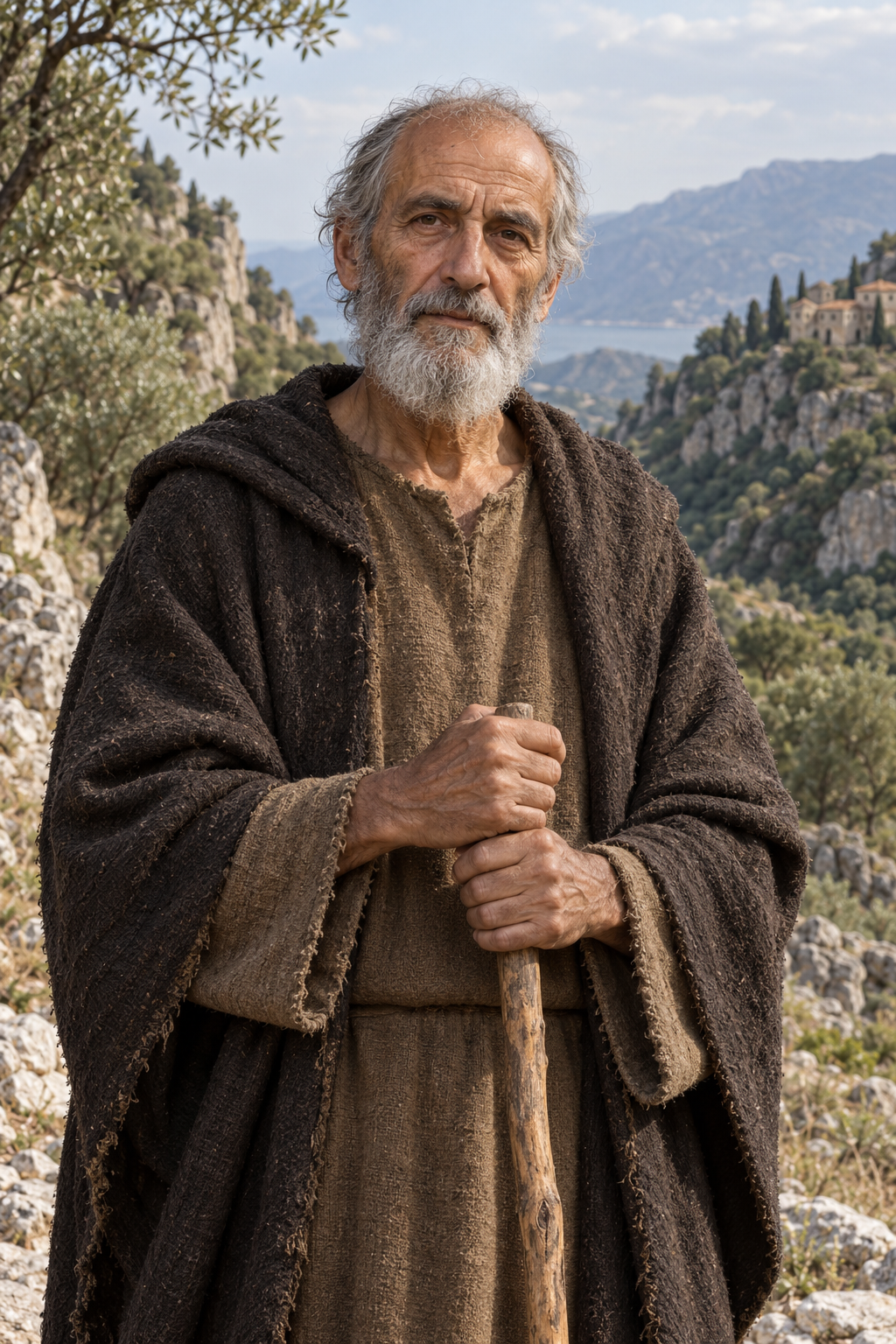
About Nicodemus of Kellarana
Nicodemus was a Greek-speaking monk in Calabria whose name became attached to the monastery of Kellarana near Mammola. Almost everything known about his life comes from a narrative by a monk named Neilos, written several decades after his death. The account places him in the tenth century, possibly extending into the early eleventh. It does not provide a secure year of death.
A donation to his monastery offers a possible limit for his lifetime, since it already calls him holy. Scholars disagree over whether the charter belongs to 1011–1012 or 1023. Attempts to connect an episode in his Life with a particular raid are also uncertain.
His birthplace is named Sikros in the medieval account, but its modern location remains disputed. Historian Vincenzo Naymo traces the familiar identification with Cirò to the seventeenth-century writer Apollinare Agresta. Naymo rejects that identification and proposes another possibility: a place called Psychrò, now Zifrò, near Roccella. A medieval property document records that name, but its resemblance to Sikros does not establish that Nicodemus was born there. Naymo presents the connection as a hypothesis.
The identity of his early teacher also requires care. Later accounts often make Nicodemus a disciple of Fantino the Younger. Naymo instead follows Enrica Follieri’s reading of the text: the teacher was another monk named Fantino, serving in a monastery dedicated to Fantino the Elder.
According to his Life, Nicodemus withdrew into the mountains during attacks on the region and settled at Kellarana. There he established an oratory dedicated to Michael the Archangel. Disciples joined him, and visitors came seeking help. The narrative portrays an austere teacher who gave offerings to the poor.
The sanctuary’s account preserves a story about the community’s wish to move closer to other people. Nicodemus accompanied the monks to Bucito, where a crowded feast was taking place. They found the setting unsuitable for their chosen life and returned with him to their retreat. The episode presents solitude as a shared commitment tested by experience.
The monastery’s later history is recorded separately from its founder’s uncertain chronology. The church census records its donation by Roger the Norman to the Benedictine abbey of the Holy Trinity at Mileto in 1081. It also describes the movement of monks and relics to the dependency of San Biagio at Mammola in 1501.
The modern sanctuary preserves his memory through more than its dedication. Its walls carry paintings of his life by the local artist Nik Spatari, made during the rebuilding of the 1960s. The church census also records a return to eremitic life there in 1995 and formal diocesan recognition of that vocation in 2000.
Mammola honors Nicodemus as its patron, a designation the official heritage record dates to 1638. His patronal celebration takes place on 12 March. The same record describes a September commemoration of the transfer of his relics, as well as pilgrimages along the old Seja path. His memory remains connected to both the mountain sanctuary and the town that preserves his relics.
Wondering how to weigh the stories and sources? Learn how to read a saint biography.