Biography
Nicodemus the Hagiorite
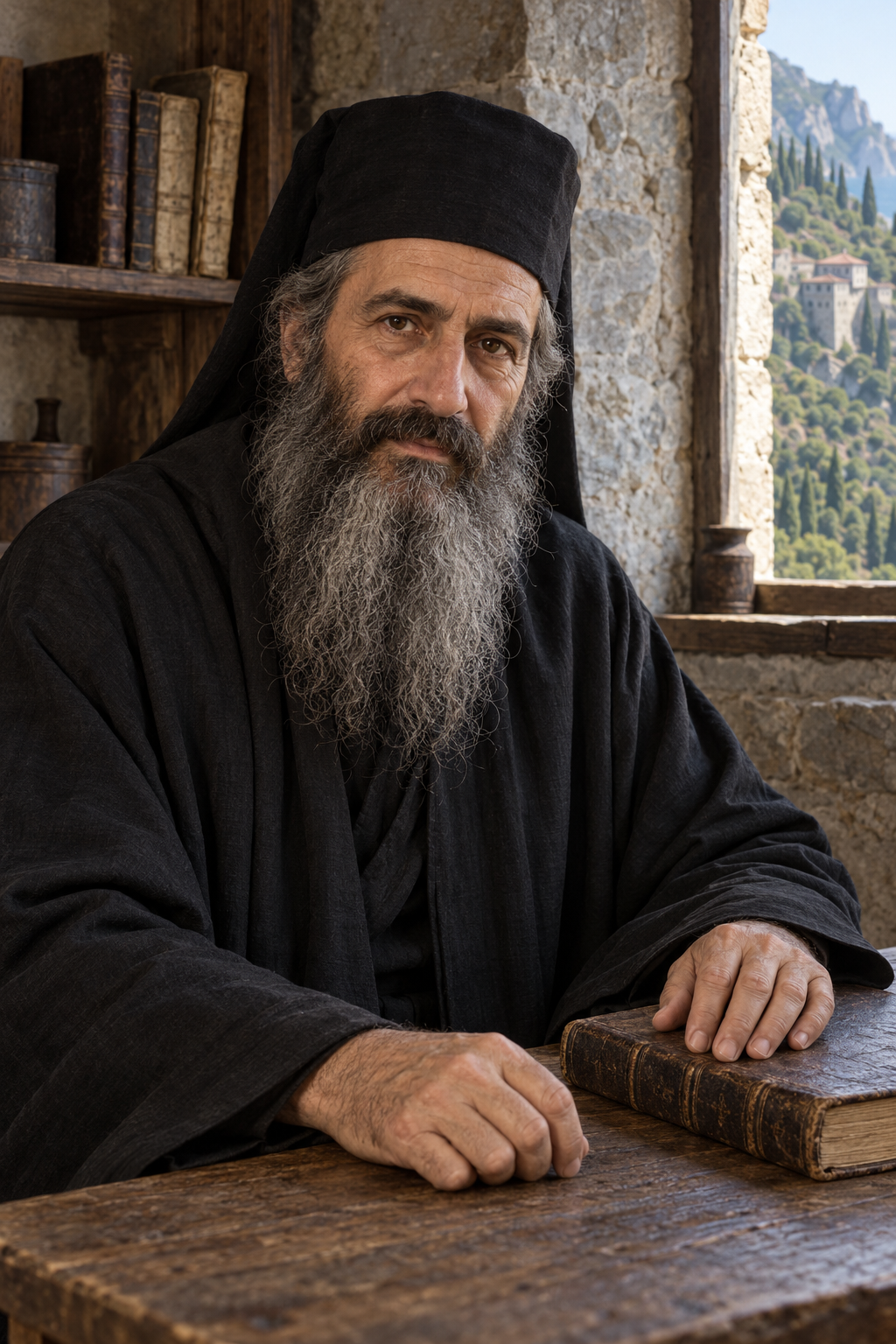
About Nicodemus the Hagiorite
Nicodemus the Hagiorite was a monk from Naxos whose books helped renew Orthodox spiritual life. Baptized Nicholas, he studied at Smyrna before returning to his home island in 1770. He entered the monastic community of Mount Athos in 1775 and took the name Nicodemus. His meeting with Macarius of Corinth led to work on the Philokalia, a collection of earlier Christian writings about prayer. Published in Venice in 1782, it helped bring the practices of inner attentiveness and the Jesus Prayer to later generations.
He belonged to the Kollyvades movement, which began with a dispute about holding memorial services for the dead on Sundays. Its concerns grew to include stricter monastic observance and the renewal of spiritual life beyond monasteries. Historian Norman Russell places Nicodemus within this effort to make inherited teaching accessible to ordinary believers. The movement used books and practical instruction to reach people who would never enter a monastery.
Nicodemus explained the purpose of this publishing work in his own prologue to the Philokalia. He feared that important texts were disappearing because manuscripts were scarce, damaged or never printed. He thanked John Mavrogordatos for supporting publication, which would spare existing readers the labor of copying and make the collection available to others. He also answered an objection that teaching inward prayer openly might be dangerous. Citing Scripture and earlier teachers, he argued that continual prayer concerned all Christians, and ended by inviting both laypeople and monks to the book. His stated aim joined the preservation of texts to their practical use.
At Dionysiou monastery, Nicodemus initially served as secretary. The Orthodox Church in America’s account describes his later move to the skete of Pantokrator, where he studied Scripture and earlier Christian authors under the guidance of Arsenios. Macarius continued to bring him editorial projects, including writings of Symeon the New Theologian. This work required more than copying: Nicodemus introduced texts and helped prepare them for readers who depended on printed editions rather than access to Athonite manuscript collections.
His interests extended to the Church’s worship. He gathered sixty-two canons to the Virgin Mary in the New Theotokarion, published in Venice in 1796, and wrote explanations of liturgical hymns. Some of these works appeared only after his death. His literary output therefore continued to reach new readers even when he could no longer oversee its publication.
Frequent Communion was another important concern. His revised edition of Macarius’s work on that subject met opposition: according to the New Catholic Encyclopedia, Procopius of Smyrna condemned it in 1785, while the Synod of Constantinople accepted its position in 1819. Nicodemus’s influence was thus accompanied by controversy within his own tradition. The same reference work describes his broad contributions to biblical interpretation, liturgy, saints’ lives and canon law, rather than reducing his achievement to a single famous anthology.
His Manual of Confession addressed both those hearing confessions and those preparing to confess. The theologian George Metallinos describes its three-part arrangement: instructions for spiritual fathers, canonical material associated with John the Faster, and advice for penitents. Nicodemus worked as a compiler and interpreter, drawing on existing manuals and adding explanations. Metallinos rejects the claim that this kind of book was entirely new to the Orthodox Church. The work belonged to an established practice of giving concrete guidance about repentance.
Its severe language has divided later readers. Metallinos acknowledges the force of criticisms that its terms can sound punitive, but argues that the rules should be understood as spiritual treatment within the life of the Church. In his reading, Nicodemus sought restoration to communion, not an isolated transaction between an individual and a demanding judge. This is a theological interpretation of the book, and other Orthodox thinkers, notably Christos Yannaras, have criticized its legalistic language. The disagreement remains part of the reception of Nicodemus’s writings.
His relationship with Catholic writing was also complex. Russell shows that Nicodemus adapted works by Lorenzo Scupoli and Jesuit authors through Greek translations, while opposing Roman Catholic teaching and rejecting Catholic baptism. He used material from outside his Church without presenting those authors as religious authorities for his readers. Russell also describes his preparation of some returning converts from Islam for public confession of Christianity, despite the risk of execution and the reservations of other church authorities. These commitments belong beside his literary achievements in an account of his life.
In his final illness, Nicodemus stayed with the iconographers Stephen and Neophytos, asking them to help publish his writings. He died on July 14, 1809. The Church of Constantinople recognized him as a saint in 1955.
His home island remembers him as its patron. The Naxos tourism account describes a July 14 celebration in Chora, with a procession of his icon and visitors from neighboring islands and the Greek mainland. Glinado also keeps the day with a local festival. These celebrations give his memory a public place alongside the continuing study of his books.
Wondering how to weigh the stories and sources? Learn how to read a saint biography.