Biography
Nilus of Sinai
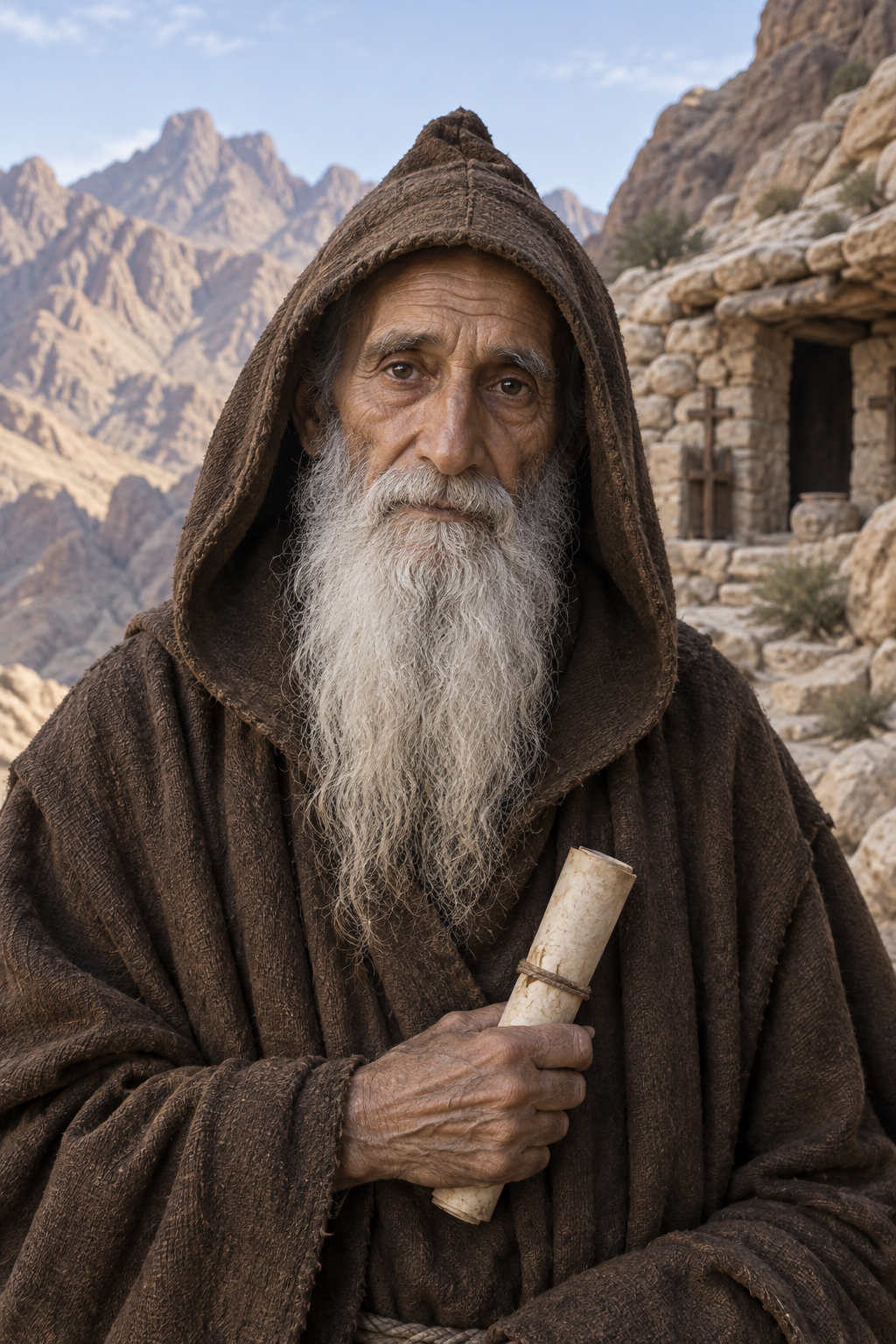
About Nilus of Sinai
Nilus of Sinai is remembered as a monk whose son was taken captive. In the narrative associated with him, he searches for Theodulus and finds him at Elusa.
The story does not portray an untroubled father. At Pharan, other monks hear his grief; he later helps bury the dead and continues searching.
Later tradition makes him a Constantinopolitan official who left married life for monasticism. Its additional details cannot be independently confirmed.
The captivity account may combine history and invention. Its author cannot securely be identified with Nilus of Ancyra.
That distinction matters because the Ancyra monk's ascetical writings are not automatically evidence for the Sinai saint's actions. Some teachings long circulated under Nilus's name were actually written by Evagrius.
The sources do not establish where or when the Sinai figure died.
The Orthodox Church in America commemorates Neilos the Ascetic of Sinai on November 12.
The name Nilus of Sinai presents an unusual editorial problem because several bodies of writing and tradition have been joined under it. The catalog entry is retained for the monk remembered in the Sinai captivity narrative, not treated automatically as a second name for the ascetic author Nilus of Ancyra. The distinction protects both figures from receiving an invented composite biography. It also means that familiar statements about a court career, friendship with John Chrysostom or authorship of ascetical treatises require separate evaluation.
The work traditionally called the Narrations is told in the voice of a father traveling with his son Theodulus among the monastic settlements of Sinai. After an attack, the son is taken and the father searches for him through grief, danger and uncertainty. The story includes the burial of dead monks and eventually brings father and son together at Elusa. These are episodes within a crafted narrative; they cannot be transferred directly into a modern historical timeline as eyewitness facts.
Modern literary study emphasizes how carefully the Narrations shapes emotion and suspense. Its first-person voice, delayed recognitions and movement between lament and relief belong to its narrative design. The earliest surviving manuscripts are many centuries later than the setting they describe and identify the author only as a monk or hermit named Nilus. A later identification with Nilus of Ancyra became influential, but manuscript attribution alone does not settle authorship or historicity.
Ward's study reviews competing proposals for the work's date and author. It argues that the educational concerns and picture of Sinai may fit the fourth century and proposes a connection with Emperor Julian's restrictions on Christian teachers. That proposal is an interpretation, not a securely dated episode in the narrator's life. For this reason the packet leaves both featured events undated and assigns them legendary confidence rather than manufacturing a chronology from a literary hypothesis.
Church tradition supplies a more continuous life: a prominent official leaves Constantinople, separates from his wife with mutual consent, and goes with Theodulus to Sinai. The raid, captivity, search and reunion then become stages in a saint's tested perseverance. This received account explains the titles Nilus the Ascetic and Nilus of Sinai in devotional calendars. Because its historical foundation remains disputed, the account is presented as tradition rather than as documented civic or family history.
Nilus of Ancyra is a better-attested ascetic writer active around the turn of the fifth century, probably in the region of Ancyra. A substantial corpus of letters, biblical interpretation and monastic instruction circulated under his name, though modern attribution remains complex. JERIHNA notes that the Narrations was long read as autobiographical but is now better understood as a novel and that its Nilian authorship continues to be questioned. Those findings prevent the Ancyra writer's works from being used as direct evidence for the Sinai father's journey.
Older reference works often merge the two identities and therefore remain useful mainly as evidence for the history of the tradition. They describe an official at Constantinople, a retreat to Sinai, correspondence with many readers and a body of teaching on prayer. Critical scholarship has reassigned some famous writings once printed under Nilus, including works associated with Evagrius. Consequently, neither a spiritual maxim nor an ascetical teaching is quoted here as the personal speech of the Sinai saint without a secure attribution.
Geography must be handled with the same restraint. Sinai, Pharan and Elusa are meaningful settings in the narrative, but a literary setting is not proof that one recoverable individual traveled each segment. The packet therefore records only the search and reunion as nonfeatured, undated legendary events and does not assign coordinates or draw a route. This allows future maps to show the received story only if their labels also communicate its evidentiary status.
The central virtue attached to the entry is perseverance, demonstrated in the narrative by the father's continued search for Theodulus and his care for others amid grief. It is deliberately marked legendary because the action belongs to the received story. The family relationship is qualified in the same way. No unsupported patronage, exact lifespan or historical death place is supplied, and no pronunciation is invented.
Orthodox observance continues to commemorate Neilos the Ascetic on November 12. That calendar date records liturgical remembrance, not a verified date of death for the disputed Sinai figure. A liturgical kontakion exists in the source record, but its excerpt remains rights-held and is not presented as Nilus's own composition. The durable significance of this entry lies partly in the story's portrayal of grief and persistence, and partly in the caution its tangled authorship teaches about reading hagiography as straightforward biography.
Wondering how to weigh the stories and sources? Learn how to read a saint biography.
Explore similar vocations
Prayers for Nilus of Sinai
Nilus of Sinai: petition
free me from ev’ry danger